• About UGM
  • Academic Portal
  • IT Center
  • Library
  • Research
  • Webmail
  • Informasi Publik
  • English
    • Indonesia
Universitas Gadjah Mada Faculty of Cultural Sciences
Universitas Gadjah Mada
  • Home
  • Profile
    • History
    • Vision and Mission
    • Organizational structure
    • Administration
    • Staff
    • Faculty Members
  • Academic
    • Academic Calendar
    • Undergraduate Programs
      • Bachelor of Cultural Antrophology
      • Bachelor in Archaeolagy
      • Bachelor in History
      • Bachelor in Tourism
      • Bochetor in Korean Language and Culture
      • Bachelor in Indonesian Language and Culture
      • Bachelor in English
      • Bachelor in Arabic
      • Bachelor in Japanese Language and Culture
      • Bachelor in Javanese Language, Literature and Culture
      • Bachelor in French language and literature
    • Graduate Programs
      • Master in Antrophology
      • Master in ArchaeoIogy
      • Master in History
      • Master in Linguistics
      • Master in Literature
      • Master In American Studies
      • Master in Middle Eastern Cultural Studies
    • Post-Graduate Programs / S3
      • Doctor in Antropology
      • Doctor in American Studies
      • Doctor in Humanities
    • Student Service
  • KPPM
    • Research Information
    • Scientific / Academic Publications
    • Community Service
    • International Cooperation
    • Domestic Cooperation
  • Student Organizations
    • Student Executive Council
    • Semi-Autonomous Organizations
      • KAPALASASTRA
      • Christian Student Alliance
      • LINCAK
      • Saskine
      • Catholic Student Family
      • Dian Budaya
      • Sastra Kanuragan (sasgan)
      • Family of Muslim Cultural Sciences Students (KMIB)
      • Bejo Mulyo
    • Autonomous Organizations
      • Family of Anthropology Students (KEMANT)
      • English Department Student Association
      • Tourism Students Association (HIMAPA)
      • Family of Indonesian Literature Students (KMSI)
      • West Asian Literature Student Association (IMABA)
      • Association of Korean-Language Students (HIMAHARA)
      • Family of Regional Indonesian Literatures Students (KAMASUTRA)
      • The Family Body of History Students (BKMS)
      • The French Literature Students Association (HMSP)
      • Family of Anthropology Students
      • Japanese Student Association (HIMAJE)
  • Admission
    • Student Evaluation
  • Home
  • SDGs 17: Partnerships for the Goals
  • SDGs 17: Partnerships for the Goals
  • page. 8
Arsip:

SDGs 17: Partnerships for the Goals

Starting Final Exams with “Sibuya” Free Breakfast

News Release Monday, 8 December 2025

Yogyakarta, December 8, 2025 – The Faculty of Cultural Sciences at Universitas Gadjah Mada has once again launched the Sibuya program, which provides free breakfast for students currently taking the Odd Semester Final Exams for the 2025–2026 academic year. The program is held on December 8, 11, 15, and 18, 2025 at the Kantin Sastra using a coupon system, and on December 9 and 16, 2025 in front of the Soegondo Building, where meal boxes are distributed. A total of 200 servings are provided each day.

The Sibuya program is supported by the Parents Association of Students (POTMA) and Dharma Wanita FIB UGM. Students can redeem their food coupons at the food court area of Kantin Sastra according to the scheduled dates.

The Dean of FIB UGM, Prof. Setiadi, stated that the implementation of Sibuya reflects the faculty’s concern for students who are entering the exam period.
“Sibuya is our effort to support students who are about to take their exams. We hope this program brings them comfort and helps them feel more prepared for their finals. We also hope that more parties will participate in the future,” he said.

He added that the program is expected to help students, especially those who have not had the chance to eat breakfast before their exams.
“With Sibuya, we hope students can be assisted, particularly those who need breakfast, those who leave home without eating, or those who have not eaten at their boarding house, so they can take their exams with peace of mind. We are truly grateful to Dharma Wanita and the Parents Association for their full support of this program,” he explained.

The presence of Sibuya not only provides nutritional benefits and physical readiness but also fosters solidarity and a sense of community within the campus environment. The initiative stands as a tangible example of collaboration between institutions, families, and students in creating a caring and inclusive academic atmosphere.

Through this simple yet meaningful effort, Sibuya reminds us that attention to basic needs can be a powerful force in shaping a healthier and more empowered younger generation, equipped to face future challenges. This spirit of togetherness is expected to continue growing and inspiring sustainable development efforts in the field of education.

[Public Relations of FIB UGM,  Candra Solihin]

Korean Language and Culture Program and INAKOS Host Korean Studies Series Lectures #1: Exploring Korean Language Teaching Practices at NUS

News Release Friday, 5 December 2025

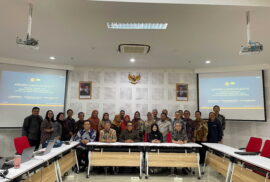
Yogyakarta, 14 November 2025 — INAKOS, in collaboration with the Korean Language and Culture Undergraduate Program at Universitas Gadjah Mada and supported by funding from the Korea Foundation, held the first lecture in the Korean Studies Series Lectures. The session took place online on 14 November 2025 under the title “Korean Language Education in Singapore.” The invited speaker was Dr. Ji Seowon from the Centre for Language Studies, National University of Singapore.

For approximately one hour, Dr. Ji delivered a lecture in Korean, presenting an overview of Korean language education at NUS, where the subject is offered as a minor and an elective. Although Korean is not offered as a primary undergraduate major, the program at NUS enables students to reach an advanced level of proficiency. The teaching approach incorporates various methods, including flipped learning, reflection notes, project presentations, and the integration of AI in language learning.

The lecture was attended by more than 33 participants, including undergraduate students from the program, master’s students in Korean Language Education from institutions such as Chulalongkorn University and Kyung Hee University, as well as Korean language instructors from universities and training institutions (LPK). The event was moderated by Dr. Hwang Who Young, M.A.

This lecture is expected to serve as a platform for educators and learners to enhance the quality of Korean language education in Indonesia, while also strengthening international academic networks that contribute to the advancement of quality education.

Written by : Alfiana Amrin R
Edited by : Eunike Serafia N.S

UGM Arabic Study Program Participates in ICESCO Arabic Language Teaching Training

News Release Wednesday, 3 December 2025

Yogyakarta, 13 November 2025 — The Arabic Study Program at Universitas Gadjah Mada (UGM), with Universitas Islam Negeri Sunan Kalijaga, Universitas Ahmad Dahlan, and Pondok Pesantren Muhammadiyyah, took part in the Arabic Language Teaching Training organized by the Islamic World Educational, Scientific and Cultural Organization (ICESCO). The training brought together not only participants from Indonesia but also representatives from various countries such as Malaysia, Thailand, Uzbekistan, Morocco, Russia, and others.

The ICESCO training focused on four fundamental theories in Arabic language teaching and learning. The first was the Grammar–Translation Theory, which is suitable for advanced learners and emphasizes reading, writing, and vocabulary mastery, particularly for academic, religious, and literary purposes. The second was the Behaviorism Theory (as-Sulukiyah), which views language as a form of behavior shaped through repetition and imitation, highlighting the significant role of environment in language acquisition. The third theory, Cognitivism (al-Ma‘rifiyyah), underscores that language learning involves active mental processes such as attention, information processing, and comprehension, placing learners as active participants rather than passive recipients. The final theory, Communicative Theory (at-Tawasuliyyah), emphasizes real-life language use within social contexts, prioritizing fluency and communicative ability over strict grammatical accuracy. This theory also acknowledges dialectal variations as an integral part of everyday language use.

In its concluding remarks, ICESCO highlighted that no single theory is entirely sufficient. Each has strengths and limitations, meaning effective Arabic language instruction requires an integrated approach that adapts to context. The training also emphasized the growing role of technology and artificial intelligence (AI) in designing lessons, generating exercises, and visualizing theoretical applications in more engaging and effective ways.

The Arabic Study Program at UGM’s participation in the ICESCO training reinforces the university’s commitment to strengthening the capacity of Arabic language educators and learners on campus. This initiative aligns with the Sustainable Development Goals (SDGs), particularly SDG 4 (Quality Education), SDG 16 (Peace, Justice, and Strong Institutions), and SDG 17 (Partnerships for the Goals). Through this involvement, the Arabic Study Program at UGM continues to advance as a progressive and globally connected center for Arabic language and cultural studies.

Author: Muhammad Ardiansyah

UGM Arabic Study Program Holds Academic Writing Workshop to Prepare Students for Undergraduate Thesis Stage

News Release Wednesday, 3 December 2025

Yogyakarta, 27 November 2025 – The Arabic Study Program at Universitas Gadjah Mada held an Academic Writing Workshop for students of the 2023 cohort who are entering the thesis preparation stage. The workshop featured Adwidya Yoga, M.A., publishing manager at the Bureau of Journals and Publications, Faculty of Cultural Sciences UGM, as the guest speaker.

The workshop aimed to equip students with a comprehensive understanding of effective academic writing techniques, covering both undergraduate thesis composition and the preparation of publishable journal articles. In his presentation, Adwidya Yoga emphasized that academic writing requires precision, a strong logical flow, and a well-structured research strategy. He also clarified the differences between an undergraduate thesis, a master’s thesis, and a doctoral dissertation, enabling students to recognize the analytical standards expected at the undergraduate level.

Adwidya further elaborated on the essential components of journal article writing, including topic selection, research storytelling, source exploration, the use of clear and effective academic language, and strategies for identifying credible journals. He highlighted the importance of building a coherent research narrative through a structured format consisting of introduction, methods, findings and discussion, conclusion, and abstract.

In addition, the speaker shared practical tips on avoiding predatory journals, identifying indicators of journal credibility, and understanding the peer-review process before article submission. Students were also introduced to various writing and reference management tools such as Zotero, Mendeley, DeepL, Grammarly, and VOSviewer to support more efficient and accurate academic work. He underscored that the use of technology and AI tools must be accompanied by ethical responsibility, including the inclusion of a Statement of Originality and AI Tools Fair Use in the publication process.

Through this workshop, the Arabic Study Program at UGM reaffirmed its commitment to enhancing students’ academic competencies in a practical, forward-looking manner. This initiative is expected to strengthen research literacy among the 2023 cohort as they enter the thesis-writing stage with greater confidence, and to encourage the production of scholarly work that is high-quality, credible, and relevant to the development of Arabic studies and the humanities.


Author: Muhammad Ardiansyah

Exploring the Types and Meanings of Sesajen Culture in the Javanese Language, Literature, and Culture Study Program Workshop

News Release Wednesday, 3 December 2025

The Javanese Language, Literature, and Culture Study Program held a workshop titled “Exploring the Types and Meanings of Culture from Sesajen” on Thursday, November 27, 2025, at the Margono 4th floor lobby. This event was attended by Dr. R. Bima Slamet Raharja, S.S., M.A., as the lecturer in charge of the course, as well as students from the Javanese Language, Literature, and Culture Study Program and various other study programs. The guest speaker was Faizal Noor Singgih, S.T.P., a cultural practitioner and ceremonial master of ceremonies.

In his presentation, Faizal Noor Singgih explained various aspects of offerings, ranging from types and functions to cultural meanings. He emphasized that offerings in Javanese tradition are essentially a form of prayer or hope to God Almighty through a series of symbols contained within them. In addition to being a spiritual tool, offerings also serve as a medium of social communication, a form of respect from the Javanese people towards their environment, and an expression of the local community’s culture.

The participants were enthusiastic, saying that this activity provided them with new insights into offerings as part of Javanese culture. The workshop was closed with a prayer and a meal together.

Through this workshop, it is hoped that students will gain a deeper understanding of Javanese culture. The presence of speakers from the cultural sector is considered to enrich perspectives, both in terms of theory and practice. Thus, cooperation from various parties is essential to continue studying, preserving, and reviving Javanese culture.

Author : Haryo Untoro
Editor : Haryo Untoro

1…678910…63

Video UGM

[shtmlslider name='shslider_options']
Universitas Gadjah Mada

Faculty of Cultural Sciences
Universitas Gadjah Mada
Jl. Nusantara 1, Bulaksumur Yogyakarta 55281, Indonesia
   fib@ugm.ac.id
   +62 (274) 513096
   +62 (274) 550451

Work Units

  • Office of Journal & Publishing
  • INCULS
  • Information Technology and Database
  • Language Learning Center
  • Library Unit
  • Public Relations
  • Research

Facilities

  • Computer Laboratory
  • Gamelan
  • Guest House
  • Language Library
  • Library
  • Phonetics Library
  • Self Access Unit
  • Student Internet Centre

Importan Links

  • Journal of Humaniora
  • Subscriber Journal
  • Alumni Portal
  • Career
  • Departmens News
  • UGM Streaming

Contacts

  • Academic
  • Administration
  • Dean’s Office
  • Departments / Study Programs
  • Public Relations

© 2024 Faculty of Cultural Sciences Universitas Gadjah Mada

KEBIJAKAN PRIVASI/PRIVACY POLICY

[EN] We use cookies to help our viewer get the best experience on our website. -- [ID] Kami menggunakan cookie untuk membantu pengunjung kami mendapatkan pengalaman terbaik di situs web kami.I Agree / Saya Setuju