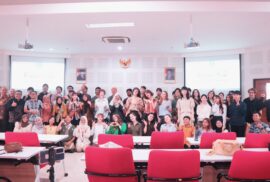
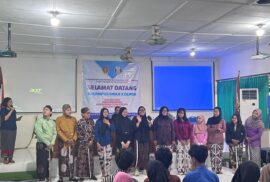
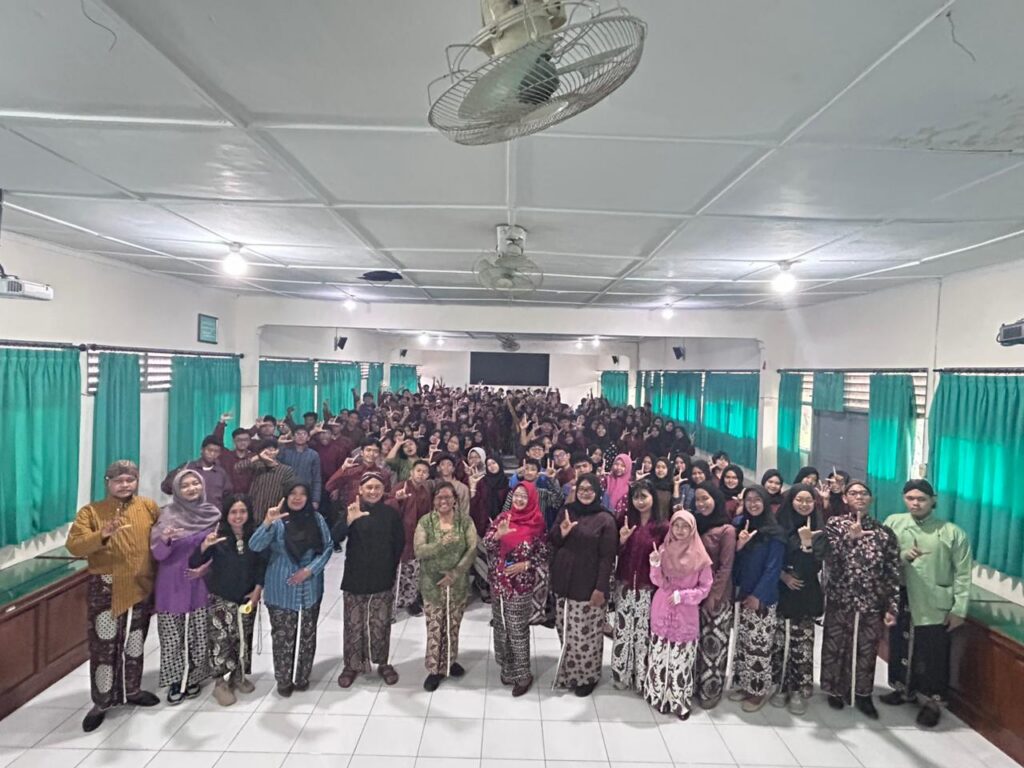
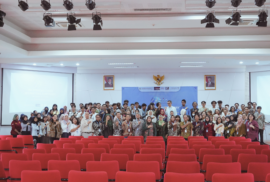
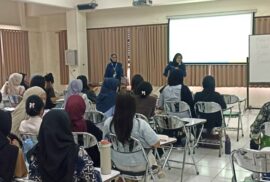
Hamzah Fansuri’s legacy extends far beyond the poems preserved in the Malay literary tradition. Behind works such as Syair Perahu and Syair Ikan Tunggal lie enduring debates about humanity and God, as well as questions of power and cultural boundaries that continue to invite scholarly inquiry. These issues were revisited at the National Seminar “Hamzah Fansuri and the Poetic Tradition of the Nusantara,” organized by the Master’s Program in Literature at Universitas Gadjah Mada (UGM) in collaboration with the Government of Subulussalam City at the Faculty of Cultural Sciences, UGM, on Wednesday, September 16, 2026.
Held from 12:00 to 17:00 WIB, the seminar brought together three scholars as speakers: Prof. Dr. Faruk, S.U.; Prof. Dr. Aprinus Salam, M.Hum.; and Prof. Dr. Sangidu, M.Hum. The discussion was moderated by Rini Febriani.
The seminar provided an academic forum for examining Hamzah Fansuri, his works and Sufi thought, as well as their significance for the development of Malay literature and the intellectual history of the Nusantara. The collaboration also formed part of an effort to reintroduce Hamzah Fansuri as an important intellectual figure closely associated with Subulussalam.
In his remarks, the Mayor of Subulussalam described Hamzah Fansuri as a source of pride for the people of Subulussalam. He also highlighted the recognition Hamzah Fansuri had received and the enduring significance of his intellectual legacy.
He emphasized Hamzah Fansuri’s important place in the cultural history of the Nusantara. For this reason, he hoped that the collaboration between the Government of Subulussalam City and UGM’s Master’s Program in Literature would serve as a starting point for developing a range of cultural initiatives, including plans to hold a Hamzah Fansuri Festival in Subulussalam.
“This is the beginning of the Hamzah Fansuri Festival that we hope to hold in Subulussalam,” the Mayor said in his remarks.
Meanwhile, the Vice Dean of the Faculty of Cultural Sciences, UGM, in his opening remarks, stressed the importance of viewing the Malay language and literary tradition not merely as means of communication, but also as part of the intellectual heritage of the Nusantara.
He highlighted Hamzah Fansuri’s contribution to the development of the syair genre. His work, he noted, demonstrates how literature can serve as a space for articulating profound reflections on human existence, divinity, and the human journey.
One work discussed was Syair Perahu, which portrays the human journey through the metaphor of a boat. Literature, he suggested, offers more than linguistic beauty; it also provides intellectual depth and a means of reflecting on the complexities of life.
In the contemporary context, literature can also offer a moment to pause and reconsider the direction in which society is moving. The question of where Indonesia’s “boat” is heading is one such reflection that can be drawn from literature today.
Examining Hamzah Fansuri’s Works and Sufi Thought
The first speaker, Prof. Dr. Sangidu, presented a paper entitled “The Works of Hamzah Fansuri and His Sufi Thought.” He discussed several of Hamzah Fansuri’s prose and poetic works, as well as the development of the Sufi ideas underlying them.
Sangidu explained that Hamzah Fansuri’s thought was influenced by the Neo-Platonic tradition and the ideas of Ibn Arabi. Hamzah Fansuri left behind works in Malay, including a number of syair and rubā’i. Four rubā’i later provided with commentaries (syarah) by Syamsuddin as-Samatrani are Subchānal-Lāh Terlalu Kāmil, Allah Maujud Terlalu Bāqī, Sidang Fakir Empunya Kata, and Ikan Tunggal Bernama Fādhil.
One of the main works discussed was Syair Ikan, which is known by two names: Syair Ikan Tongkol and Syair Ikan Tunggal. Sangidu preferred the term Ikan Tunggal, following Doorenbos’s reading, because he considered the poem closely connected to the concept of wahdatul wujud.
In this interpretation, the fish represents the human being, or sālik, while the sea represents God. The relationship between the fish and the sea illustrates the relationship between humanity and God within the framework of wahdatul wujud. Human beings are likened to waves that emerge from water and ultimately return to water as their source. In this sense, the wave and the water are part of a single unity.
Sangidu also discussed the concepts of tajalli and Nur Muhammad. The universe is understood as a manifestation of God’s Essence and Being, while human beings, as microcosms, undertake a spiritual journey toward knowledge of and closeness to God. This process is associated with fanā’ fil-Lāh, tarkud-dunyā, and the attainment of ma’rifatullah.
The discussion then turned to Sidang Fakir Empunya Kata. In this work, self-knowledge becomes an important part of the journey toward knowing God. Sangidu explained that spiritual experience in Hamzah Fansuri’s work places the heart at the center of the process of coming to know God. The purification of the heart and the practice of ilmu hakikat are integral to this journey.
Sangidu also situated Hamzah Fansuri’s thought within the historical context of Aceh, referring to figures such as Syamsuddin as-Samatrani, Nuruddin ar-Raniri, Sultan Iskandar Muda, and Sultan Iskandar Tsani. Shifting interpretations of Sufism, he noted, were closely connected to changes in Aceh’s political and power structures.
Sufism, Marxism, and the Human Condition
The second speaker, Prof. Dr. Aprinus Salam, addressed the theme “Problems of Indonesia, Sufism’s Martabat Tujuh, and (Post-)Marxism.”
Aprinus began by examining the tendency to excuse wrongdoing and harmful acts as simply “human.” Expressions such as “people are only human” or “that is only human nature,” he argued, can become problematic when they are used to justify or normalize actions that cause harm.
He then connected this issue to the histories of colonialism, modernization, capitalism, and the development of social theory in Indonesia. From the seventeenth century onward, colonialism helped shape class and social-status structures as part of the governance of Nusantara society. By the early twentieth century, social theories, including Marxism, had begun to circulate and were being used to understand Indonesia’s social, economic, and political conditions.
According to Aprinus, secularization and modernization also contributed to placing Sufism in a more limited position within academic discourse. Marxism, meanwhile, became a source of concern for the ruling authorities and was banned during the New Order period because it was seen as potentially encouraging radical resistance to power. After 1998, capitalism and modernism continued to expand, while Marxism underwent a transformation toward post-Marxism.
It was at this point that Aprinus explored a possible meeting point between post-Marxism and Sufism. Post-Marxism is concerned, among other things, with the emergence of radical subjects, while the Martabat Tujuh tradition contains the concept of insan kamil, or the perfected human being. Although they belong to different intellectual frameworks, both can be approached through the question of human liberation from ideological, political, economic, and social constraints.
Aprinus also connected this discussion to the position of Sufi literature in the history of Indonesian literature. Sufi literature, he argued, has continued to develop, even though it has not always occupied a prominent position in discussions of Indonesian literature. Some works from the Balai Pustaka period already displayed Sufi dimensions, while in the post-independence period—particularly as state control became increasingly pronounced in the 1970s—Sufism became one of the spaces through which literature could sustain particular forms of expression.
In subsequent developments, poets such as Abdul Hadi, Sutardji Calzoum Bachri, Zawawi Imron, and Cak Nun have been associated with Sufi tendencies in their works. For Aprinus, examining Sufi literature is part of a broader effort to reconsider the relationship between literature, humanity, and social life.
The discussion was further expanded through the idea of human beings as interconnected with nature and their environment. Aprinus suggested that traditional Indonesian communities, which understand humans as intimately connected with plants, animals, and material objects, might be viewed as embodying a form of “Nusantara posthumanism.”
Hamzah Fansuri and Sultan Iskandar Muda
The third speaker, Prof. Dr. Faruk, presented a paper entitled “Hamzah Fansuri and Sultan Iskandar Muda: A Homology.”
Faruk began by asking why Hamzah Fansuri’s works received different treatment during the reign of Sultan Iskandar Muda and in the period that followed. His presentation compared the political circumstances under Sultan Iskandar Muda with those under Sultan Iskandar Tsani.
The reign of Sultan Iskandar Muda was presented as a period of Aceh’s prominence, characterized by a strong orientation toward global trade and political expansion. Under Sultan Iskandar Tsani, by contrast, the ruling authorities were more deeply preoccupied with internal affairs and struggles for power.
From this comparison, Faruk identified a homology between the orientation of Sultan Iskandar Muda and the tendencies within Hamzah Fansuri’s thought. Iskandar Muda sought to move beyond local boundaries through trade and political expansion, while Hamzah Fansuri’s Sufi thought likewise moved beyond geographical and cultural boundaries.
According to Faruk, Hamzah Fansuri’s Sufi thought situates human life within a more universal dimension. Sufism, in this reading, has an impulse toward crossing the border—moving beyond boundaries that divide people according to territory and culture. Hamzah Fansuri’s thought can therefore be considered in relation to cosmopolitanism and an openness to diversity.
Faruk also examined the relationship between Hamzah Fansuri’s Sufi ideas and the syair form through which they were expressed. The breadth of his Sufi thought, he suggested, sometimes seemed to exceed the capacity of the syair form to contain it fully. The tension between literary form and the expansiveness of thought thus offers an important subject for further study.
The national seminar demonstrated that discussions of Hamzah Fansuri extend beyond the history of Malay literature. They also intersect with Sufism, the political history of Aceh, social theory, cultural studies, and the development of intellectual thought in the Nusantara.
Through the collaboration between UGM’s Master’s Program in Literature and the Government of Subulussalam City, the seminar is expected to open broader avenues for scholarly research and cultural initiatives surrounding Hamzah Fansuri, while bringing academic inquiry into dialogue with efforts to reintroduce the intellectual and literary heritage of the Malay world to the wider public.
Author: Khotibul Umam