
There is a question that initially sounds simple but is difficult to answer: who has the right to tell women’s stories?
That question led Sofiana Martha Rini and her two colleagues, Priyo Joko Purnomo and Mulya Atmana Dwiyana WNA, much deeper. What began as an assignment for a prose course eventually developed into a paper presented at The 2nd International Conference Bali Gender Studies Forum (BGSF) 2026.
The paper, titled Walking in Her Shoes: Gender and Ethics of Representing Women in Post-Reform Indonesian Novels (2000–2025), went on to receive the Best Paper award at the conference, organized by Yayasan Bali Sruti on August 28–29, 2026, online.
For Sofiana, the paper did not suddenly emerge from a research desk piled high with books and theories. It began with a sense of unease.
One of the things that prompted it was Sofiana’s reading and reconsideration of the works of Panji Sukma. From there came questions about representation: how women are written, who writes them, and whether women’s experiences can truly be represented in their entirety by someone else.
The questions did not disappear after a single reading.
“The point is that we have to recognize that representation is difficult to make completely free from bias,” Sofiana said.
She even carried this concern into other discussions, including during a summer school, where she discussed representation and the boundaries one encounters when attempting to tell an experience that does not belong to oneself with Ramayda Akmal, a lecturer and literary writer, as well as Prof. Arnez.
From there, a topic that initially stemmed from a single work expanded into a broader question: how are women represented in Indonesian literature after the Reformasi era?
Together with her two colleagues, Sofiana did not stop at one or two novels. They read 21 Indonesian novels published between 2002 and 2025, written by both male and female authors from different literary backgrounds and ideological orientations.
One of the theoretical frameworks informing their analysis was Stuart Hall’s concept of representation. Within this framework, representation is not merely about making something visible or presenting something so that it can be seen. Rather, it is a process through which meaning is produced.
The question therefore shifted: who constructs meaning about women? From whose perspective are women’s experiences told? And who has the authority to represent women?
To examine these questions, they employed several theoretical tools, including Laura Mulvey’s concept of the male gaze, as well as the concepts of focalization and non-narratorial commentary in Mieke Bal’s narratology.
Their reading of dozens of female characters across the 21 novels revealed an interesting pattern.
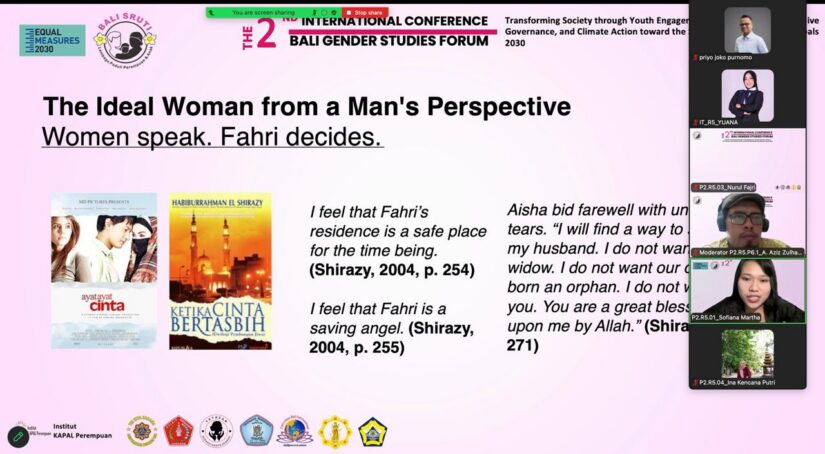
Women increasingly appear at the center of stories. But being at the center of a story does not automatically mean being at the center of power. Women may speak. But who determines what that voice means?
In a number of novels, Sofiana and her team found that women were still largely positioned around male characters.
There are women who speak, feel, love, and even make decisions. Yet their voices remain within narrative structures determined by male characters.
They found one example in Ayat-Ayat Cinta by Habiburrahman El Shirazy. Aisha has her own voice and emotional experiences. However, the way readers come to understand those experiences remains closely connected to Fahri’s position as the center of the story.
Another pattern emerges when women become the main characters.
Yet once again, being a protagonist does not necessarily mean possessing authority.
In their reading of several novels, women may become the focus of the narrative, while decisions about how their bodies, experiences, trauma, and lives are interpreted can still be controlled by a larger narrative structure.
At this point, Sofiana identified an important distinction between agency and authority.
Women may possess agency—the ability to choose, act, refuse, and even resist. But that does not necessarily mean they possess the authority to determine how their own stories are understood.
Then comes another question: what happens when women write about women?
This question brought their research to its next stage. Does representation automatically become more ethical when women are the ones writing it? Their answer turned out to be more complicated than that.
Sofiana and her team also examined works written by female authors. In these works, they found that women could indeed appear with more diverse voices, experiences, and concerns.
But for them, the author’s gender is not the only measure. The issue is not simply who holds the pen. More important is how the text produces meaning about women and the extent to which it recognizes the limits of its authority when speaking about someone else’s experience.
That is why the conclusion of their paper feels more like a question deliberately left without closure:
Can we ever fully walk in her shoes?
Perhaps not. And precisely because of that, Sofiana and her team argue, literature needs to recognize that no one can ever completely walk in another person’s shoes.
The ethical task is not to pretend that one has arrived at or fully understood that experience. It is to recognize the limits.
Interestingly, the paper that eventually brought Sofiana the award began with something very close to everyday student life: a course assignment.
The paper originated as an assignment for a prose course. After completing it and reading it again, Sofiana and her two colleagues realized that there was an idea within it that could still be developed.
They then revised the paper and submitted it to the BGSF call for papers.
Yayasan Bali Sruti has long worked to develop publications in the fields of academic literacy, social and cultural studies, women and children, language, and public policy. The organization also has publication lines for conference proceedings and book chapters. Sofiana and her team’s paper was eventually presented online on August 28.
Their presentation time was also limited—only about six minutes.
Six minutes to bring 21 novels, several theories, concerns about representation, and questions of authority before an international forum.
In the end, it was that paper that brought Sofiana and her team the Best Paper award. The recognition came not simply because of the number of novels they had read or the theories they had employed. There was a longer journey behind it: a course assignment that did not remain merely an assignment, a concern that continued to occupy their thoughts, and a question that they carried all the way into the conference room.
Who has the right to tell women’s stories?
Sofiana herself does not offer a simple answer. Perhaps there is none.
Because the further she reads, the clearer it becomes that the question of representation is not merely about who gets to speak. Whenever someone speaks about another person, there will always be a part of that experience that can never completely belong to them.
Author: Khotibul Umam
