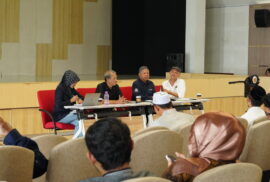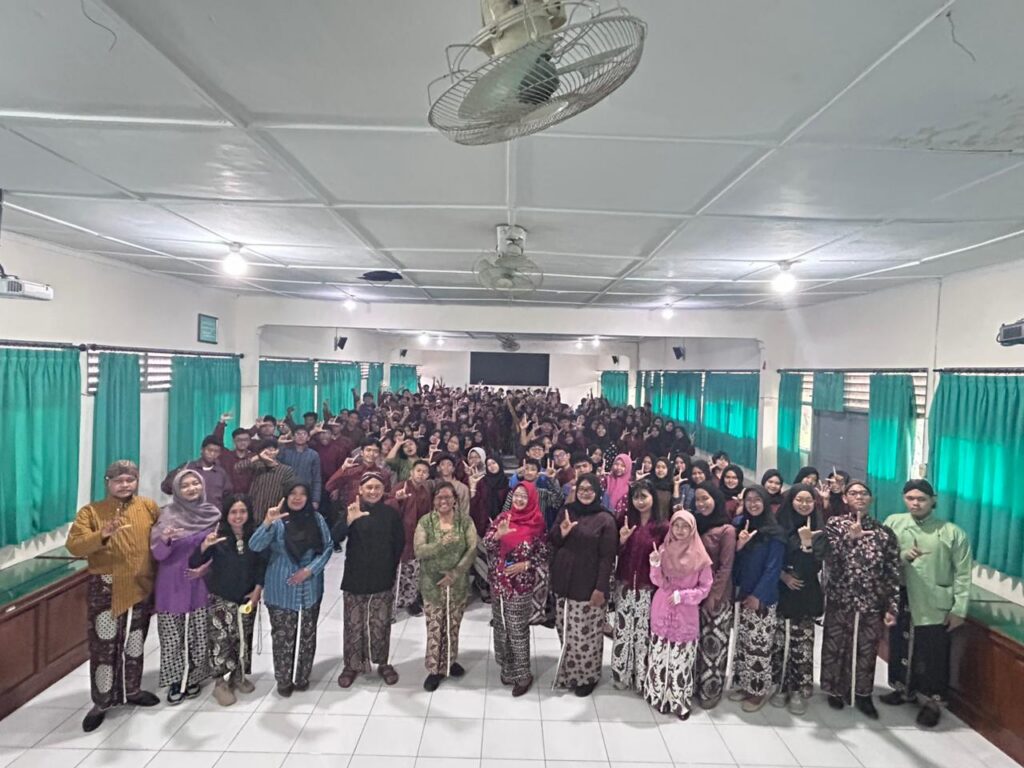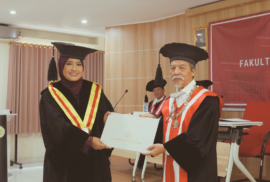
The Faculty of Cultural Sciences UGM held an Open Doctoral Defense for linguistics candidate Intan Pradita on Wednesday (September 23, 2026). The event took place at the Multimedia Room, Margono Building, FIB UGM, from 09.00 to 11.00 WIB, attended by academics and invited guests.
During the defense, Intan Pradita presented her doctoral dissertation entitled “Acceptability of Lexical Collocations in English Research Articles by Indonesian and Anglo-American Academics: A Corpus-Based Comparative Study.”
The research highlights the growing importance of English as a Lingua Franca (ELF) in international academic publishing. The use of lexical collocations—combinations of words that naturally co-occur—serves as a crucial aspect of academic writing. This study specifically focuses on the acceptability of collocations written by non-Anglophone academics, acknowledging that while certain word combinations may meet grammatical criteria, they are not necessarily perceived as natural or conventional within global academic discourse.
The study employed a comparative corpus-based approach, analyzing more than 250,000 word tokens from research articles in the field of English Language Teaching (ELT). Data were collected from two primary sources:
PRAYA Corpus: Comprising 32 research articles written by Indonesian academics.
PRANA Corpus: Comprising 31 research articles written by Anglo-American academics.
The analytical focus was directed toward four dominant collocation patterns in academic writing: Adverb + Verb, Adverb + Adjective, Verb + Noun, and Adjective + Noun.
Through her findings, Intan elaborated on the patterns, functions, and meanings of lexical collocations utilized by both groups of academics. The research affirms that collocation variations used by Indonesian academics maintain functional acceptability within international academic discourse. The outcomes of this study are expected to contribute significantly to the advancement of linguistic studies, scientific article writing, and the understanding of diversity in academic English.
The open defense proceeded smoothly under the supervision of Dr. Adi Sutrisno, M.A. as promoter and Dr. Tofan Dwi Hardjanto, M.A. as co-promoter, reflecting FIB UGM’s ongoing commitment to supporting high-quality academic achievements and research at the doctoral level.
[Author: Humas FIB, Zaidan Abdurrahman]