• About UGM
  • Academic Portal
  • IT Center
  • Library
  • Research
  • Webmail
  • Informasi Publik
  • English
    • Indonesia
Universitas Gadjah Mada Faculty of Cultural Sciences
Universitas Gadjah Mada
  • Home
  • Profile
    • History
    • Vision and Mission
    • Organizational structure
    • Administration
    • Staff
    • Faculty Members
  • Academic
    • Academic Calendar
    • Undergraduate Programs
      • Bachelor of Cultural Antrophology
      • Bachelor in Archaeolagy
      • Bachelor in History
      • Bachelor in Tourism
      • Bochetor in Korean Language and Culture
      • Bachelor in Indonesian Language and Culture
      • Bachelor in English
      • Bachelor in Arabic
      • Bachelor in Japanese Language and Culture
      • Bachelor in Javanese Language, Literature and Culture
      • Bachelor in French language and literature
    • Graduate Programs
      • Master in Antrophology
      • Master in ArchaeoIogy
      • Master in History
      • Master in Linguistics
      • Master in Literature
      • Master In American Studies
      • Master in Middle Eastern Cultural Studies
    • Post-Graduate Programs / S3
      • Doctor in Antropology
      • Doctor in American Studies
      • Doctor in Humanities
    • Student Service
  • KPPM
    • Research Information
    • Scientific / Academic Publications
    • Community Service
    • International Cooperation
    • Domestic Cooperation
  • Student Organizations
    • Student Executive Council
    • Semi-Autonomous Organizations
      • KAPALASASTRA
      • Christian Student Alliance
      • LINCAK
      • Saskine
      • Catholic Student Family
      • Dian Budaya
      • Sastra Kanuragan (sasgan)
      • Family of Muslim Cultural Sciences Students (KMIB)
      • Bejo Mulyo
    • Autonomous Organizations
      • Family of Anthropology Students (KEMANT)
      • English Department Student Association
      • Tourism Students Association (HIMAPA)
      • Family of Indonesian Literature Students (KMSI)
      • West Asian Literature Student Association (IMABA)
      • Association of Korean-Language Students (HIMAHARA)
      • Family of Regional Indonesian Literatures Students (KAMASUTRA)
      • The Family Body of History Students (BKMS)
      • The French Literature Students Association (HMSP)
      • Family of Anthropology Students
      • Japanese Student Association (HIMAJE)
  • Admission
    • Student Evaluation
  • Home
  • Master of Literature
  • Master of Literature
Arsip:

Master of Literature

Min Seong Kim’s Public Lecture Explores More-than-Human Antagonism and Pluriversal Politics in the Indonesian Archipelago

News Release Tuesday, 9 June 2026

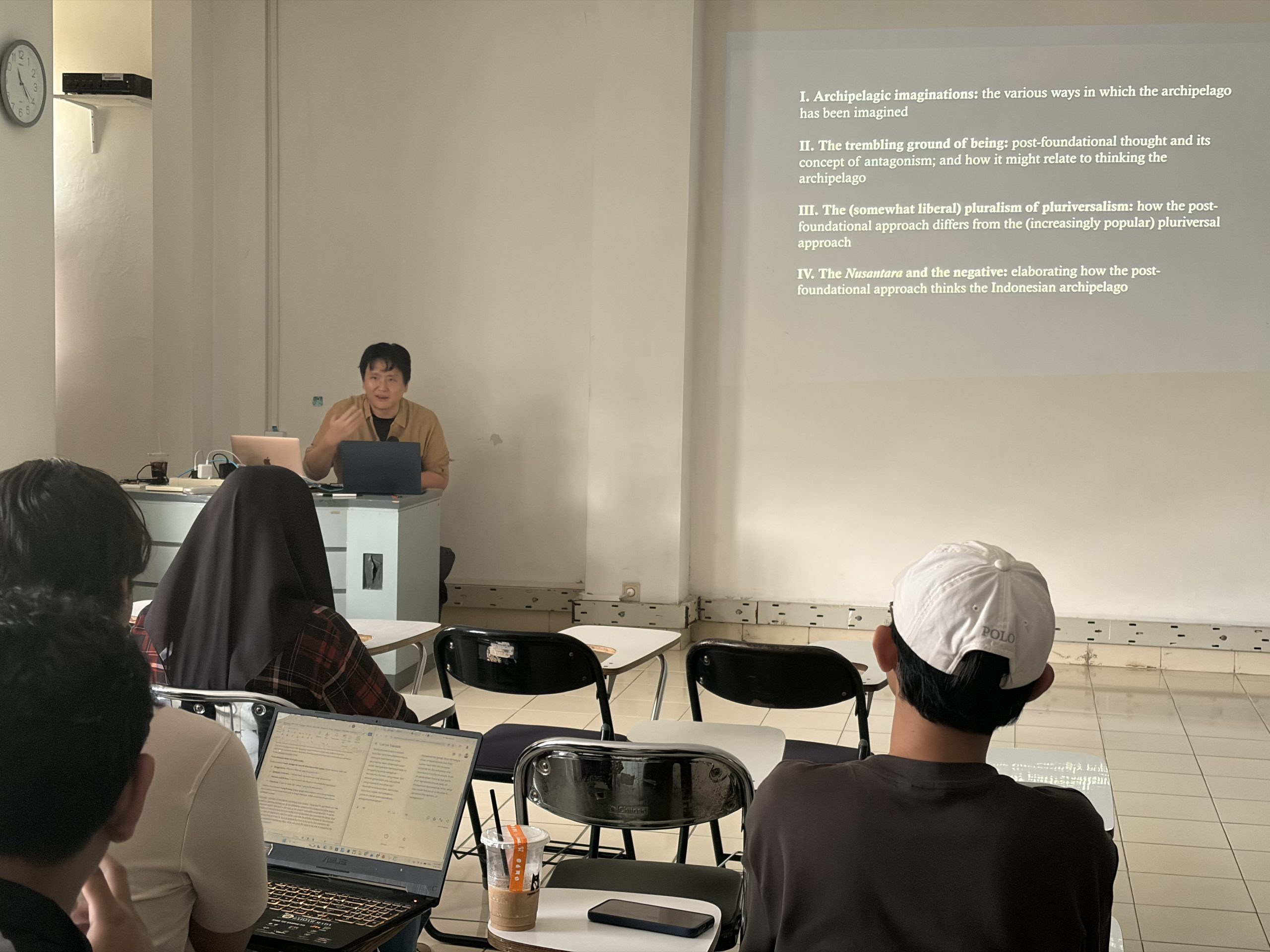
Yogyakarta, June, 4 2026 — A public lecture featuring Min Seong Kim was held on Thursday, June 4, from 11:00 a.m. to 1:00 p.m. in Room 205 of the Poerbatjaraka Building. On this occasion, Kim delivered a presentation entitled “Trembling Grounds of the Archipelago: Pluriversal Ontopolitics and More-than-Human Antagonism,” a study that reexamines the foundational assumptions of pluriversal politics through ecological and political experiences emerging across the Indonesian archipelago.

In his presentation, Kim addressed ongoing debates surrounding pluriversal politics that have recently gained prominence within environmental studies, decolonial thought, and posthumanist scholarship. As articulated by a number of contemporary thinkers, pluriversal politics seeks to challenge the modern worldview that separates humans from nature and treats the world as an object to be mastered and controlled. Instead, this perspective emphasizes that life is constituted through networks of interdependent relations among humans and a wide range of nonhuman entities, including animals, plants, landscapes, and the material forces of the earth.

According to Kim, pluriversal politics is generally grounded in the assumption that relationality constitutes the ontological basis of life. From this perspective, politics is understood as the effort to establish and sustain relationships that enable diverse forms of existence to coexist. However, Kim questioned whether relationality can truly serve as an adequate foundation for understanding political dynamics, particularly when confronted with conflict, tension, and division that cannot always be resolved through reconciliation and relational repair.

To develop this critique, Kim drew on the works of Adam Bobbette and Sophie Chao, whose research explores various forms of human–nonhuman relations in Indonesia. The cases they examine demonstrate that interconnectedness among beings does not necessarily produce harmony. Rather, such relations are often marked by frictions, competing interests, and forms of instability that reveal the political dimensions of the more-than-human world. The presence of nonhuman actors in politics, therefore, not only creates possibilities for collaboration and relationality but also gives rise to antagonisms that shape social and ecological fields.

Building on this reading, Kim connected the question of more-than-human politics to the tradition of post-foundational political thought, particularly the concept of antagonism developed by Ernesto Laclau. Within this framework, antagonism refers to the condition that no social order can ever be fully complete, final, or free from conflict. Every attempt to establish order inevitably encounters something that cannot be fully integrated into the existing system. Politics, therefore, is never simply a matter of creating relationships; it must also contend with the limits, tensions, and forms of negativity that accompany every mode of collective existence.

Through this analysis, Kim proposed that conflict and negativity should occupy a more central place in discussions of pluriversalism. Rather than treating relationality as a pre-given foundation, he argued that collective life—whether among humans or between humans and nonhumans—is always shaped through processes of negotiation, struggle, and antagonism that can never be entirely eliminated.

The public lecture offered a critical perspective on contemporary developments in political theory and ecological thought while opening a space for reflection on how societies understand their relationship with a world that extends beyond the human. At a time of growing concern over ecological crises and interspecies relations, Kim’s presentation provided a compelling framework for understanding conflict, tension, and uncertainty as inseparable dimensions of political life itself.

Author: Khotibul Umam

Matragama: Nurturing a Literary Community in the Land of a Thousand Temples

News Release Wednesday, 20 May 2026

Yogyakarta, May 16, 2026 – At Pondok A. Salam Kalimasada in Pakem, Sleman, Yogyakarta, a new chapter of Matragama became more than merely an organizational agenda. It transformed into a gathering space for people who believe that literature still needs to be nurtured collectively. Since 6:00 PM WIB, people arrived one by one, bringing voices, stories, laughter, and memories. They sat on woven mats in the cold night air, while the dim light in the corner of the lodge made every conversation feel more intimate. The event was attended by the extended Matragama family from various generations, doctoral students of Humanities Studies, and invited guests from Middle Eastern Cultural Studies, American Studies, Linguistics, History, Anthropology, and various circles within the Faculty of Cultural Sciences at UGM.

Since its establishment in 2022 under the leadership of Billy, Matragama has continued moving forward through a relay of generations. Leadership was then continued by Awan in the second generation, and now enters a new phase with Brian steering the third generation. That evening marked a sign that the relay had not stopped. Amid the cold air of Pakem and the warmth of conversations beginning to grow, Matragama seemed to be rediscovering its flame.

The head of Matragama, Giandra Febrian Haidar, opened the event in a calm yet confident tone. In his remarks, he expressed hope that literature would not remain confined to classrooms alone, but would also grow in gathering spaces, through long nights, and among people who still wish to listen to one another.

The Head of UGM’s Master’s Program in Literature, Aprinus Salam, was also present and delivered warm remarks. Before the students and invited guests, he emphasized the importance of organizing and building communities as part of intellectual and cultural processes. According to him, literature cannot live in isolation. It grows through encounters, conversations, and collective work. Aprinus also stated that Pondok A. Salam Kalimasada could serve as a venue for literary and artistic activities—an open house for anyone wishing to keep the pulse of culture alive.

After the opening session, warmly guided by Pute as the host, poem after poem began to be recited. Short stories were brought to life through voices. Under the theme Little Candles at the Foot of Merapi, moments of silence felt deeply meaningful, as though everyone was gathering something from within themselves. The readers appeared one after another: M. Iqbal Saputra, Romzul Falah, Awabeen Samsuding, Ella Manikam, Nuzul Ilmiawan, Islahudin Muhammad, Khatibul Umam, and several invited guests. They did not merely read poetry, but also shared anxieties and inner experiences with the audience.

At times, the sound of crickets slipped between the poetry readings. Some listeners bowed their heads in silence as the poems were recited. Then a light drizzle fell gently, as though helping preserve the calm and warmth of the night. As the rain grew heavier, some participants slowly moved to the terrace and inside the lodge while continuing to listen attentively. Words continued floating through the night air, mingling with the cold winds from the slopes of Mount Merapi and the aroma of coffee and boiled soybeans wafting from the lodge.

In between sessions, M. Iqbal Saputra, a committee member from the technical division, shared his reflections on the importance of literary appreciation nights such as this. According to him, events like the launch of Matragama are something that should exist amidst the turbulence of changing times. He said that poetry, storytelling, and even simple discussions are efforts to become whole human beings again—to see life from various perspectives and then determine one’s path, whether through writing, action, or perhaps simply through a smile.

One of the evening’s most captivating moments came through a dramatic reading by Luthfi, a doctoral student in Humanities at UGM. The dramatic performance transformed the text from mere writing into a moving body, a pulsating voice, and emotions vividly alive before the audience’s eyes. The invited guests were swept into the intimate yet energetic atmosphere.

In the middle of the appreciation night, Rini Febriani Hauri read her short story titled The Three Deaths of Dayang Temulun in a calm and rhythmic voice. The climax of the event came when Rini’s short story was discussed collectively. The discussion was moderated by Giandra, featuring Ricky Yudhistira Nasution, a doctoral student in Humanities at UGM, as the speaker. The short story, which won Second Place in the 2025 International HB Jassin Award, was explored through the lens of magical realism—a landscape where bodies, earth, trees, mist, and memories coexist without rigid boundaries between the real and the supernatural. The discussion unfolded warmly. It examined how literature operates within collective memory, myth, the body, and human history. Participants listened enthusiastically; some remained silent in contemplation, while others immersed themselves in endless interpretive possibilities.

The night grew later, yet no one truly wished to leave. After the entire series of events concluded, the atmosphere became more relaxed. Some people sang together, while others chatted freely, joked, and shared long laughter. Some sat in circles discussing books and literature, while others simply enjoyed the night while exchanging unfinished life stories beyond the formal forum. It was there that Matragama truly felt alive—not in banners, event schedules, or ceremonial formalities, but in encounters and conversations that continued glowing deep into the night.

Several invited guests from various departments and communities within UGM’s Faculty of Cultural Sciences also shared reflections and hopes for Matragama. Representatives from Middle Eastern Cultural Studies, American Studies, Linguistics, History, and Anthropology expressed hopes that inter-organizational bonds would continue warmly. They also wished for Matragama to have a long life and remain consistent as a shared space for nurturing literature, art, and culture.

At the foot of Merapi that night, literature appeared like little candles—not grand, but enough to keep the warmth of encounters and conversations alive. The drizzle still fell softly as people slowly began leaving Pondok Kalimasada one by one.

Author: Rini Febriani Hauri

Scientific Article Writing Workshop Encourages High-Quality Academic Publications

News Release Sunday, 15 March 2026

Efforts to strengthen the academic capacity of students and researchers in producing high-quality scientific publications continue to be promoted on campus. The Master’s Program in Literature at the Faculty of Cultural Sciences, Universitas Gadjah Mada organized a “Scientific Article Writing Workshop: Strategies for Publishing in Reputable Journals” on Monday, February 23, 2026, in Room 709 Soegondo, Faculty of Cultural Sciences UGM.

The event, which took place from 12:30 to 15:00 WIB, featured a scholar in cultural and gender studies, Wening Udasmoro, as the main speaker. The workshop aimed to enhance the ability of young academics to write scientific articles capable of competing in reputable international journals.

In her presentation, Wening emphasized that academic publishing is not merely about techniques or quick strategies to get articles accepted by journals. According to her, writing in reputable journals is an important process for testing the intellectual quality of an academic before a broader scholarly community.

She stressed that academic publication should be viewed as a process of learning and intellectual development rather than simply fulfilling administrative academic requirements. Through publication, scholars’ ideas can be read and critically examined by researchers from various universities and countries, thereby enriching academic discourse.

During the session, participants were introduced to the importance of problematization in research. Wening explained that strong research generally begins with social or cultural phenomena that attract attention and generate scholarly questions.

She illustrated how contemporary phenomena—such as the display of luxurious lifestyles on social media—can become entry points for research relevant to current social dynamics. Researchers are encouraged not merely to find objects that have not yet been analyzed but to develop new perspectives that make their research academically significant.

In addition to formulating research problems, participants were also equipped with an understanding of the importance of a strong literature review. The workshop highlighted that scientific research must be built upon a dialogue with theories and previous studies.

Several theoretical frameworks can be used to analyze social phenomena, including the concept of conspicuous consumption, the symbolic value of goods (sign value), and modern consumer culture. These theoretical frameworks help researchers interpret social phenomena in a more critical and systematic way.

Through this training, it is hoped that postgraduate students will be able to produce scientific articles that not only meet academic standards but also contribute to the advancement of knowledge and provide solutions to various social issues.

The workshop was enthusiastically welcomed by the Master’s students in Literature who attended. The discussion was highly interactive, particularly when participants explored strategies for identifying research topics with novelty and academic relevance.

Through initiatives such as this, the Faculty of Cultural Sciences UGM seeks to strengthen a critical, reflective, and productive academic culture in producing high-quality scientific publications at both national and international levels.

Author: Khotibul Umam

Master’s Program in Literature, FIB UGM Records Fastest Graduate at Postgraduate Graduation Period II AY 2025/2026

News Release Monday, 9 February 2026

The Master’s Program in Literature, Faculty of Cultural Sciences (FIB), Universitas Gadjah Mada (UGM), recorded a notable academic achievement at the Postgraduate Graduation Ceremony for Period II of the 2025/2026 Academic Year, held in Yogyakarta on Tuesday (January 21, 2026). One of its graduates, Iftinan Rose Putri Safana, earned the distinction of fastest graduate, completing her studies in 1 year, 8 months, and 8 days.

The postgraduate graduation ceremony of the Faculty of Cultural Sciences this period conferred degrees upon 46 graduates, consisting of 38 master’s graduates and 8 doctoral graduates. Of the total master’s graduates, 21 received the cum laude distinction, with an average Grade Point Average (GPA) of 3.77.

Iftinan’s achievement as the fastest graduate reflects academic consistency, careful study planning, and the effectiveness of the learning process and academic supervision within the Master’s Program in Literature. Completing a master’s degree in less than two years demonstrates that postgraduate education can be pursued optimally without compromising academic quality.

In her remarks at the Mangayubagya (farewell and appreciation) ceremony for graduates of the Faculty of Cultural Sciences, Vice Dean of FIB UGM, Dr. Nur Saktiningrum, S.S., M.Hum., emphasized the vital role of education in shaping individuals who are critical and socially responsible. She cited Paulo Freire’s thought that the task of education is to form people who will later become agents of change.

“Education does not change the world. Education changes people. People change the world. Education at the Faculty of Cultural Sciences, including in the Master’s Program in Literature, is directed toward shaping graduates who possess intellectual sensitivity and a commitment to humanitarian values,” she said.

Academic excellence at the master’s level was also demonstrated by the highest GPA achievement, attained by Hanina Naura Fadila, a graduate of the Anthropology Study Program, with a GPA of 3.93. In her address as the representative of master’s students, Hanina invited graduates to view their academic work as a form of intellectual responsibility.

The achievements of the Master’s Program in Literature graduates at this graduation ceremony align with UGM’s commitment to supporting quality education, through the provision of excellent, reflective postgraduate education oriented toward holistic human development.

Author: Khotibul Umam

Master’s Program in Literature at FIB UGM Holds Workshop on Breaking Into Reputable Journals: Strategies for Writing and Publishing Academic Articles

SDGs 10: Reduced InequalitiesSDGs 17: Partnerships for the GoalsSDGs 4: Quality EducationSDGs 5: Gender equality Thursday, 18 September 2025

Yogyakarta, 17/9/2025 – The Master’s Program in Literature, Faculty of Cultural Sciences, Universitas Gadjah Mada, organized an academic workshop themed “Breaking Into Reputable Journals: Strategies for Writing and Publishing Academic Articles.” The event, held on Wednesday (17/9) at Auditorium C, Poerbatjaraka Building, featured two keynote speakers: Prof. Dr. Wening Udasmoro, S.S., M.Hum., DEA., professor at the Faculty of Cultural Sciences UGM, and Adwidya Susila Yoga, S.Pd., M.A., an academic as well as a practitioner in scientific publishing. The session was moderated by Nada Nadillah.

In her presentation, Prof. Dr. Wening Udasmoro emphasized that writing for reputable journals requires decisiveness in selecting the issue and accuracy in building methodological frameworks. “The first thing to pay attention to is the material or issue. A strong issue is one that is specific, contextual, and intellectually challenging. Do not fall into the trap of cliché topics,” she explained.

She gave examples of fresh entry points in literary research, such as LGBTQ+ issues in Muslim-majority countries, abortion debates in Muslim contexts, and the rebellion of Indonesian women writers against male-dominated literary traditions.

Prof. Wening also highlighted the importance of a novelty-based literature review. “The literature review is the foundation. It is from there that we can demonstrate our contribution to academic debates. If we only repeat previous studies, our work will not be considered competent,” she stressed.

The second session, delivered by Adwidya Susila Yoga, S.Pd., M.A., underlined the importance of accuracy in identifying target journals and the necessity of determining clear topics. “Writing an article cannot be separated from mapping the topic and having a clear storyline. After that, we need to do optimal sourcing—do not let references pile up only in the introduction while being scarce in the discussion. The next step is the ‘journal hunt,’ which means finding journals that match the topic, are consistent, and have a good reputation,” he explained.

He also warned participants about the dangers of predatory journals. “If a journal has an excessively high publication frequency, an unusually fast review process, an invalid E-ISSN, or ambiguous publication fees, we need to be cautious. Those are usually signs of a predatory journal,” he cautioned.

Furthermore, Adwidya encouraged students to utilize digital tools. “Use digital platforms such as Grammarly, DeepL, Vosviewer, and even AI—but their use must be academically accountable. Do not just use them recklessly,” he noted.

The workshop continued dynamically with a Q&A session between participants and speakers. Naria (Master’s in Literature) raised a question regarding the selection of research material: “Should research objects be literary works that have already received awards? And should research questions always be derived from theory?” she asked.

Responding to this, Prof. Wening stated, “Research objects do not have to be award-winning works. What matters most is the issue we want to bring forward. Focus on novelty and the perspective we present, not the credibility of the text itself. As for research questions, they can arise from the problems we want to examine, not necessarily from theory alone.”

Meanwhile, Andi (Master’s in Public Administration) asked about balancing local research with global issues. “Indonesia’s research strength lies in its rich empirical evidence. How can we balance this with global issues to ensure relevance?” he inquired.

Prof. Wening emphasized, “The key is to focus on contextual issues while still opening up to global debates. Take issues that others may not be familiar with, then connect them to wider discourses. That way, our research will gain international appeal.”

This workshop successfully provided in-depth insights into strategies for writing academic articles and breaking into reputable journals. Participants not only gained theoretical knowledge but also practical guidance from the speakers. With this momentum, the Master’s Program in Literature at FIB UGM hopes its students can produce high-quality, contributive scholarly works capable of competing at both national and international levels.

Author: Marsya Kamila / Public Relations, Master’s Program in Literature

1234

Video UGM

[shtmlslider name='shslider_options']
Universitas Gadjah Mada

Faculty of Cultural Sciences
Universitas Gadjah Mada
Jl. Nusantara 1, Bulaksumur Yogyakarta 55281, Indonesia
   fib@ugm.ac.id
   +62 (274) 513096
   +62 (274) 550451

Work Units

  • Office of Journal & Publishing
  • INCULS
  • Information Technology and Database
  • Language Learning Center
  • Library Unit
  • Public Relations
  • Research

Facilities

  • Computer Laboratory
  • Gamelan
  • Guest House
  • Language Library
  • Library
  • Phonetics Library
  • Self Access Unit
  • Student Internet Centre

Importan Links

  • Journal of Humaniora
  • Subscriber Journal
  • Alumni Portal
  • Career
  • Departmens News
  • UGM Streaming

Contacts

  • Academic
  • Administration
  • Dean’s Office
  • Departments / Study Programs
  • Public Relations

© 2024 Faculty of Cultural Sciences Universitas Gadjah Mada

KEBIJAKAN PRIVASI/PRIVACY POLICY

[EN] We use cookies to help our viewer get the best experience on our website. -- [ID] Kami menggunakan cookie untuk membantu pengunjung kami mendapatkan pengalaman terbaik di situs web kami.I Agree / Saya Setuju