• About UGM
  • Academic Portal
  • IT Center
  • Library
  • Research
  • Webmail
  • Informasi Publik
  • English
    • Indonesia
Universitas Gadjah Mada Faculty of Cultural Sciences
Universitas Gadjah Mada
  • Home
  • Profile
    • History
    • Vision and Mission
    • Organizational structure
    • Administration
    • Staff
    • Faculty Members
  • Academic
    • Academic Calendar
    • Undergraduate Programs
      • Bachelor of Cultural Antrophology
      • Bachelor in Archaeolagy
      • Bachelor in History
      • Bachelor in Tourism
      • Bochetor in Korean Language and Culture
      • Bachelor in Indonesian Language and Culture
      • Bachelor in English
      • Bachelor in Arabic
      • Bachelor in Japanese Language and Culture
      • Bachelor in Javanese Language, Literature and Culture
      • Bachelor in French language and literature
    • Graduate Programs
      • Master in Antrophology
      • Master in ArchaeoIogy
      • Master in History
      • Master in Linguistics
      • Master in Literature
      • Master In American Studies
      • Master in Middle Eastern Cultural Studies
    • Post-Graduate Programs / S3
      • Doctor in Antropology
      • Doctor in American Studies
      • Doctor in Humanities
    • Student Service
  • KPPM
    • Research Information
    • Scientific / Academic Publications
    • Community Service
    • International Cooperation
    • Domestic Cooperation
  • Student Organizations
    • Student Executive Council
    • Semi-Autonomous Organizations
      • KAPALASASTRA
      • Christian Student Alliance
      • LINCAK
      • Saskine
      • Catholic Student Family
      • Dian Budaya
      • Sastra Kanuragan (sasgan)
      • Family of Muslim Cultural Sciences Students (KMIB)
      • Bejo Mulyo
    • Autonomous Organizations
      • Family of Anthropology Students (KEMANT)
      • English Department Student Association
      • Tourism Students Association (HIMAPA)
      • Family of Indonesian Literature Students (KMSI)
      • West Asian Literature Student Association (IMABA)
      • Association of Korean-Language Students (HIMAHARA)
      • Family of Regional Indonesian Literatures Students (KAMASUTRA)
      • The Family Body of History Students (BKMS)
      • The French Literature Students Association (HMSP)
      • Family of Anthropology Students
      • Japanese Student Association (HIMAJE)
  • Admission
    • Student Evaluation
  • Home
  • News Release
  • Master Program in Literature UGM Holds a Creative Writing Public Lecture on “Tracing Self-Identity Through Fiction”

Master Program in Literature UGM Holds a Creative Writing Public Lecture on “Tracing Self-Identity Through Fiction”

  • News Release
  • 25 November 2025, 09.05
  • Oleh: Humas FIB
  • 0

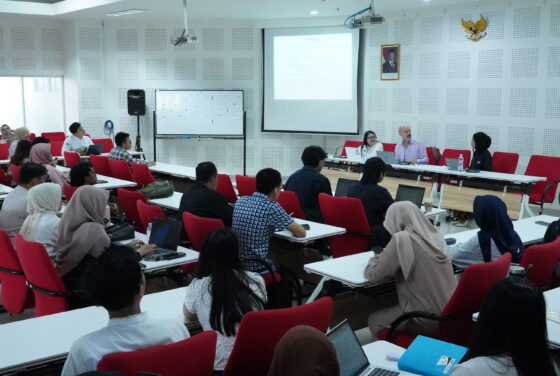
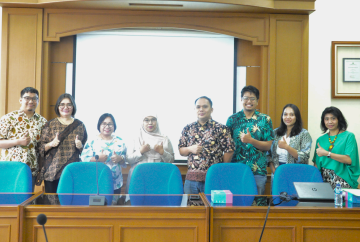
Yogyakarta, 18 November 2025 — As part of its ongoing effort to expand creative dialogue within the academic community, the Master’s Program in Literature, Faculty of Cultural Sciences, Universitas Gadjah Mada, held a public lecture titled “Tracing Self-Identity Through Fiction” on Tuesday, 18 November 2025, in Room 204 of the Soegondo Building, FIB UGM. The event featured California-based writer of Vietnamese–Indonesian descent, Mazdo, as the keynote speaker, with Naria Nur Iftitah serving as moderator. Her presence drew enthusiastic attention from students, alumni, and literary researchers eager to explore how fiction can serve as a medium for reflecting identity, personal experience, and socio-cultural dynamics.

In her presentation, Mazdo explained that writing, for her, is a deep dialogue between personal experience, imagination, and the internal questions that continually shape her creative process. She introduced three of her short stories as examples of how she navigates identity through fiction. The first piece she discussed, When the Moths Came (2023), stems from her personal experience. “This story began from my experience living in an apartment where moths were flying everywhere— in the kitchen, around the living room, everywhere. I felt disturbed, but I thought it would be interesting to turn it into a short story,” she explained. From this simple experience, Mazdo crafted a narrative about a married couple dealing with the constant presence of moths, which disrupt their daily life and create emotional distance between them.

Her second story, The Collector (2024), is rooted in her time studying at the Southeast Asia Program building at Cornell University, which was filled with cultural artifacts. She invited the audience to examine how such objects hold long historical traces, including power relations between the United States and Southeast Asian nations. Through the perspective of two curious and innocent children, she demonstrates how Orientalism and colonial traces can be reimagined in fictional space.

Meanwhile, her story Cut Blooms (2025) highlights the relationship between two sisters—shaped by affection, misunderstanding, and an unbreakable emotional bond. Mazdo shared that the inspiration for this work came from her closeness to her own sisters. “When I write, inspiration can come from anywhere, even from my own life experiences. For example, Cut Blooms comes from my personal experience, but I do not write it literally as it happened. Since I write fiction, only small details that truly happened in my life are adapted into the story,” she explained. This statement helped the audience understand that fiction does not require literal adherence to real events, but instead transforms lived experience into a broader emotional structure.

The public lecture also aligned with values of social and cultural sustainability. Through her stories, Mazdo demonstrated that literature can serve as a tool for cultivating empathy, honoring diverse identities, and encouraging reflection on one’s place within larger historical contexts.

The question-and-answer session unfolded warmly and thoughtfully. The first question came from Marisa Santi (Kagama UGM), who asked about the narrative approach Mazdo most frequently uses, whether she prefers the author as an omniscient narrator or allows the characters full autonomy. Responding to this, Mazdo said, “I tend to use the first approach, where the writer serves as the narrator.” She added that this position allows her to guide the fictional world while still giving her characters space to move freely.

The next question was posed by Marsya Kamila, a student of UGM’s Master’s Program in Literature, who asked whether Mazdo plans to write fiction that explicitly addresses migration or identity exploration in the United States, given that her parents migrated there. Mazdo responded enthusiastically: “Yes, because both of my parents come from Vietnam and Indonesia, I think it would be interesting to write fiction that gives voice to our origins and experiences.” Her answer indicates that family history and migration remain enduring sources of inspiration in her creative journey.

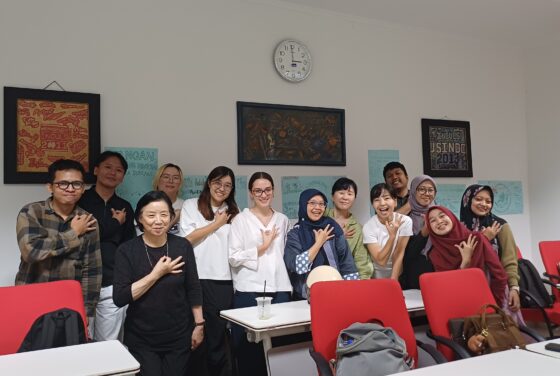
The event concluded with great appreciation from participants, who felt they gained new insights into how fiction operates as a tool for self-exploration, historical reading, and reinterpreting lived experience. The Master’s Program in Literature hopes that similar public lectures will continue to provide creative spaces that strengthen literary literacy while fostering cultural awareness and sustainability in society.

[Master’s Program in Literature, Marsya Kamila]

Tags: Fakultas Ilmu Budaya UGM SDG 4: Quality Education SDGs SDGs 10: Berkurangnya kesenjangan SDGs 10: Reduced Inequalities SDGs 11: Kota dan Pemukiman yang berkelanjutan SDGs 11: Sustainable Cities and Communities SDGs 16: Peace Justice and Strong Institutions SDGs 16: Perdamaian Keadilan dan Kelembagaan Yang Tangguh SDGs 17: Kemitraan Untuk Mencapai Tujuan SDGs 17: Partnerships for the Goals SDGs 4 Pendidikan Berkualitas SDGs 5: Gender Equality SDGs 5: Kesetaraan Gender

Video UGM

[shtmlslider name='shslider_options']
Universitas Gadjah Mada

Faculty of Cultural Sciences
Universitas Gadjah Mada
Jl. Nusantara 1, Bulaksumur Yogyakarta 55281, Indonesia
   fib@ugm.ac.id
   +62 (274) 513096
   +62 (274) 550451

Work Units

  • Office of Journal & Publishing
  • INCULS
  • Information Technology and Database
  • Language Learning Center
  • Library Unit
  • Public Relations
  • Research

Facilities

  • Computer Laboratory
  • Gamelan
  • Guest House
  • Language Library
  • Library
  • Phonetics Library
  • Self Access Unit
  • Student Internet Centre

Importan Links

  • Journal of Humaniora
  • Subscriber Journal
  • Alumni Portal
  • Career
  • Departmens News
  • UGM Streaming

Contacts

  • Academic
  • Administration
  • Dean’s Office
  • Departments / Study Programs
  • Public Relations

© 2024 Faculty of Cultural Sciences Universitas Gadjah Mada

KEBIJAKAN PRIVASI/PRIVACY POLICY

[EN] We use cookies to help our viewer get the best experience on our website. -- [ID] Kami menggunakan cookie untuk membantu pengunjung kami mendapatkan pengalaman terbaik di situs web kami.I Agree / Saya Setuju