• About UGM
  • Academic Portal
  • IT Center
  • Library
  • Research
  • Webmail
  • Informasi Publik
  • English
    • Indonesia
Universitas Gadjah Mada Faculty of Cultural Sciences
Universitas Gadjah Mada
  • Home
  • Profile
    • History
    • Vision and Mission
    • Organizational structure
    • Administration
    • Staff
    • Faculty Members
  • Academic
    • Academic Calendar
    • Undergraduate Programs
      • Bachelor of Cultural Antrophology
      • Bachelor in Archaeolagy
      • Bachelor in History
      • Bachelor in Tourism
      • Bochetor in Korean Language and Culture
      • Bachelor in Indonesian Language and Culture
      • Bachelor in English
      • Bachelor in Arabic
      • Bachelor in Japanese Language and Culture
      • Bachelor in Javanese Language, Literature and Culture
      • Bachelor in French language and literature
    • Graduate Programs
      • Master in Antrophology
      • Master in ArchaeoIogy
      • Master in History
      • Master in Linguistics
      • Master in Literature
      • Master In American Studies
      • Master in Middle Eastern Cultural Studies
    • Post-Graduate Programs / S3
      • Doctor in Antropology
      • Doctor in American Studies
      • Doctor in Humanities
    • Student Service
  • KPPM
    • Research Information
    • Scientific / Academic Publications
    • Community Service
    • International Cooperation
    • Domestic Cooperation
  • Student Organizations
    • Student Executive Council
    • Semi-Autonomous Organizations
      • KAPALASASTRA
      • Christian Student Alliance
      • LINCAK
      • Saskine
      • Catholic Student Family
      • Dian Budaya
      • Sastra Kanuragan (sasgan)
      • Family of Muslim Cultural Sciences Students (KMIB)
      • Bejo Mulyo
    • Autonomous Organizations
      • Family of Anthropology Students (KEMANT)
      • English Department Student Association
      • Tourism Students Association (HIMAPA)
      • Family of Indonesian Literature Students (KMSI)
      • West Asian Literature Student Association (IMABA)
      • Association of Korean-Language Students (HIMAHARA)
      • Family of Regional Indonesian Literatures Students (KAMASUTRA)
      • The Family Body of History Students (BKMS)
      • The French Literature Students Association (HMSP)
      • Family of Anthropology Students
      • Japanese Student Association (HIMAJE)
  • Admission
    • Student Evaluation
  • Home
  • SDGs 10: Berkurangnya kesenjangan
Arsip:

SDGs 10: Berkurangnya kesenjangan

Japanese Studies Lecture (KSK): Reading Japanese Culture Beyond the Visible through Visual Media

News Release Tuesday, 11 August 2026

The Student Association of Japanese Language and Culture (HIMAJE), Faculty of Cultural Sciences, Universitas Gadjah Mada (UGM), organized the Japanese Studies Lecture (Kuliah Seru Kejepangan/KSK) on Saturday, May 2, 2026, from 9:30 to 11:30 a.m. at the 4th Floor of Soegondo Building, Faculty of Cultural Sciences, UGM. The event was open to the public and attended by students from the Japanese Language and Culture Study Program as well as participants from other faculties within UGM.

HIMAJE invited Lili Febriyani, S.S., M.Si., a lecturer from the Japanese Language and Culture Study Program, Faculty of Cultural Sciences, UGM, as the keynote speaker. She delivered a lecture entitled “The Visible and the Invisible: Reading Japanese Culture through Visual Media.”

The session began with a series of photographs taken in Japan, encouraging participants to share their initial observations and interpretations. The discussion then moved beyond what was immediately visible, inviting participants to explore the cultural meanings embedded within the images. In addition to photographs, the speaker introduced various forms of visual media—including scenes from Japanese television dramas, television commercials, magazine covers, and other visual materials—to demonstrate how Japanese culture can be understood through critical visual analysis. The lecture covered several topics, including Japanese homogeneity and conformity, changes in Japanese food culture, and shifting representations of masculinity as portrayed in different forms of media.

As one of the flagship programs of HIMAJE’s Education and Strategic Studies Division (DIKASTRAT), the Japanese Studies Lecture aims to broaden public understanding of Japanese Studies through engaging and accessible learning activities. The event was offered free of charge to encourage wider participation from students and the general public.

Author: Heni Putri Lestari

Editor: Lili Febriyani, S.S., M.Si.

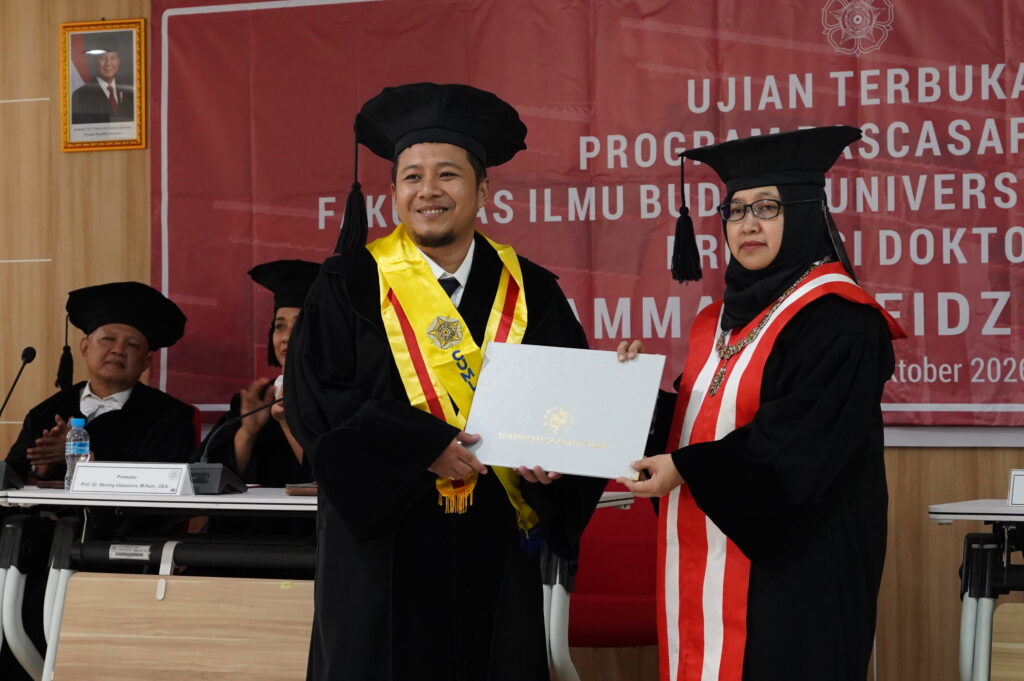
UGM Humanities Ph.D. Student Wins First Place in the 2026 DKJ Literary Criticism Contest: Challenging Anthropocentrism through Post-Human Narratives

News Release Friday, 31 July 2026

JAKARTA – Academics from Gadjah Mada University (UGM) have once again achieved a prestigious milestone on the national stage. Fitrilya Anjarsari, a doctoral student in the Humanities at UGM, was officially named First Prize Winner of the Jakarta Arts Council (DKJ) 2026 Literary Criticism Competition. The announcement was made during the “2026 DKJ Literary Criticism Contest Awards Night,” which took place in a solemn ceremony at the Small Theater Building, Taman Ismail Marzuki, on July 23, 2026.

Fitrilya succeeded in outshining 141 other entries that had passed the administrative screening with her essay titled “The Collapse of Humanity as the Center: Post-Human Tendencies in Contemporary Indonesian Literary Aesthetics.” This victory is not only a source of personal pride but also reflects the depth of intellectual tradition and the sharpness of critical analysis fostered within UGM’s doctoral program.

This year’s contest is held under the overarching theme “The Long Journey of Indonesian Literature.” Fadjriah Nurdiarsih, Chair of the DKJ Literature Committee, explained that this event represents a consistent effort to foster a healthy ecosystem of thought and scholarly tradition. Since its inception in 2007, this competition has served as a vital platform for the emergence of new literary critics capable of offering fresh perspectives on the development of literature.

In his remarks, DKJ Executive Chair Bambang Prihadi emphasized that literary criticism acts as a bridge, enabling works of art to be discussed and appreciated more deeply by the general public. In line with this, Harry Sanjaya, Head of the Management Unit of the Jakarta Arts Center Taman Ismail Marzuki (UPPKJ TIM), stated that a vibrant tradition of criticism is the foundation for the nation’s cultural progress.

The manuscript written by Fitrilya Anjarsari caught the jury’s attention for its bold exploration of post-humanism in Indonesian literature after the year 2000. In the jury’s statement, read by Areispine Dymussaga Miraviori and Asep Subhan, Fitrilya’s work was deemed capable of transcending conventional readings that typically focus on the human subject.

Fitrilya employs cutting-edge references to analyze four literary works as her subject matter, namely:
1. O (2016) by Eka Kurniawan;
2. Semua Ikan di Langit (2017) by Ziggy Zezsyazeoviennazabrizkie;
3. Aroma Karsa (2018) by Dee Lestari;
4. Gentayangan: Pilih Sendiri Petualangan Sepatu Merahmu (2017) by Intan Paramaditha.

In her analysis, Fitrilya demonstrates how non-human elements in these novels are no longer merely background or supplementary elements, but have transformed into story drivers with agency (both material and non-material). The author skillfully weaves together theoretical foundations and formal analysis using simple language that maintains a rigorous scientific structure through the division of subsections, which enhances overall readability.

The judging process was conducted via “blind reading,” in which the judges evaluated the manuscript without knowing the author’s identity or regional origin. This ensures objectivity in determining the winner based on craftsmanship, readability, and the novelty of the arguments.

Although named the winner, the judging panel still provided critical feedback as part of a healthy academic tradition. The judges highlighted the opening section of Fitrilya’s manuscript, where she presented various humanistic trends in the interpretation of contemporary literary works as the basis for her argument. According to the judges, this section lacked concrete examples, leaving room for doubt as to whether these trends actually exist within the current critical landscape or are merely the author’s imagination.

However, these shortcomings were offset by Fitrilya’s keen ability to weave narrative elements into a highly compelling contextual interpretation. The judges concluded that Fitrilya’s manuscript is a highly versatile work that demonstrates the skill of a master reader in charting a new direction for Indonesian literary aesthetics.

Fitrilya Anjarsari’s first-place victory, followed by Cindy Wijaya (2nd place) and Ridwanul Hakim Authonul Muther (3rd place), demonstrates the dominance of the younger generation on the national literary criticism scene. Bambang Prihadi noted that the majority of this year’s contest participants were from the millennial and Gen Z generations, proving that the critical thinking skills of Indonesia’s youth remain strong.

As a doctoral student in the Humanities at UGM, Fitrilya’s achievement serves as tangible proof of the university’s academic community’s contribution to charting a new course for literary studies beyond the ivory tower of academia. This essay will be published on tengara.id, a literary criticism website operated by the DKJ Literature Committee, so that it can be widely accessed by the public and other researchers.

The awards ceremony concluded with the hope that the winners would continue to inspire critical thinking. With this victory, Fitrilya Anjarsari not only took home a tangible award but also solidified her position as one of the future critics poised to guide “The Long Road of Indonesian Literature” with a sharp and relevant academic perspective.

Penulis: Islahuddin Ibrahim

Sumber dokumentasi:

https://www.youtube.com/live/sJnTES3fXr8?si=ySQ6Kf1tXQDfXq-W 


The 2nd CAUGM Officially Opens; UGM and Chung-Ang University Students Celebrate Cultural Collaboration

News Release Friday, 24 July 2026

The Korean Language and Culture Study Program at FIB UGM, in collaboration with Chung-Ang University (CAU), held the opening ceremony for the “2nd CAUGM” on Tuesday, July 21, 2026. The opening ceremony took place in the Poerbatjaraka Building Auditorium. This cultural exchange program will run from July 20 through August 1.

The event was attended by 24 students from Chung-Ang University and 70 students from the Korean Language and Culture Program at FIB, UGM. Over the course of two weeks, participants will take part in various activities, such as cultural exchange classes, language exchange sessions, and collaborative activities designed to strengthen cross-cultural understanding between Indonesian and South Korean students.

At today’s opening ceremony, students from both countries presented lively cultural performances. Students from Chung-Ang University performed K-Pop dances and songs, a taekwondo demonstration, and traditional Korean musical instrument performances. Equally captivating, UGM students also presented traditional Indonesian cultural performances, including the Edan-edanan dance, the Sintren dance, singing, and pencak silat.

In addition, one of the main events in this series of collaborative activities is the Korean Festival, which will be open to the public on July 25. The general public and the campus community are invited to attend and experience Korean culture firsthand.

Through this series of activities, students not only gain academic experience but also have the opportunity to interact directly with participants from other countries. This type of cultural exchange is expected to broaden their global perspective, improve their cross-cultural communication skills, and strengthen ties among students from both institutions.

Author: Juleha (朱殷萱Chu Yin Hsuan)

Literature and Mythmaking in the Narratives of Chinese Indonesian Life

News Release Monday, 25 May 2026

The Master’s Program in Literature once again held a public discussion titled “Exercises in Chineseness: Literature, Mythmaking & Identity in Contemporary Tionghoa Communities” at Room 105 Soegondo, Faculty of Cultural Sciences, Universitas Gadjah Mada, on Wednesday (20/5/2026). The event featured researcher Alexandra Masri Do from Cornell University, moderated by Naria Nur Iftitah from the Master’s Program in Literature, FIB UGM. The discussion explored contemporary Chinese Indonesian identity through literature, collective memory, and everyday cultural practices.

In her presentation, Alexandra highlighted the position of Chinese Indonesians as part of the world’s largest Chinese diaspora population. She explained that Chinese communities in the Indonesian archipelago existed long before the emergence of the modern nation-state, with records of settlements dating back to the seventh century. According to her, “Chinese” identity in Indonesia has never been singular, but rather continuously negotiated through language, culture, historical experience, and intergenerational social relations.

Alexandra also examined how the legacy of Dutch colonialism created social stratifications whose effects continue to persist today. She referred to 1965 and 1998 as two traumatic historical moments deeply embedded in the collective memory of Chinese Indonesian communities. The political circumstances of those periods, she argued, shaped the ways Chinese Indonesians viewed themselves, the state, and the very idea of citizenship.

Through several contemporary literary works, Alexandra demonstrated how the experience of being Chinese in Indonesia is articulated through personal narratives. She quoted The Longing by Alberta Natasia Adji, which portrays the younger generation’s disconnection from their ancestral cultural roots: “I’m a copy of my mother, but I speak the language of the locals. The closest thing I’ve got to my Chinese heritage now is eating noodles with chopsticks and checking my luck according to the Chinese horoscope.”

Referring to the passage, Alexandra noted that Chinese identity often survives only through simple cultural symbols such as chopsticks or zodiac beliefs, while ancestral languages gradually disappear from everyday life.

Beyond literature, Alexandra presented field documentation that she described as both collective and deeply personal, gathered from areas such as Glodok, Pantjoran PIK, Jambi, and Yogyakarta. Photographs of Chinese temples, Chinese schools, markets, and even citizenship archives from 1953 illustrated how Chinese identity continues to be reproduced through social spaces and cultural practices. She referred to this process as “mythmaking,” or the construction of collective narratives surrounding who Chinese Indonesians are and how they are understood.

Alexandra’s research also explored the aspirations of contemporary Chinese Indonesians, particularly the post-1998 generation. She questioned whether the idea of “homeland” is understood as Indonesia, China, or an in-between space of identity. These questions emerge alongside social change, globalization, and the increasing mobility of younger generations.

During the discussion, Alexandra emphasized the importance of fiction and literature as mediums for understanding minority experiences that are often absent from official historical narratives. In her view, literary works are capable of capturing the emotions, anxieties, and hopes of Chinese Indonesian communities more intimately than formal historical documents.

The event proceeded interactively with enthusiastic participation from students and academics. The discussion expanded to issues of discrimination, nationalism, and the representation of Chinese Indonesians in Indonesian popular culture. Through this public lecture, participants were encouraged to see Chinese identity not as a static category, but as an experience continually shaped by history, politics, culture, and everyday life.


[Magister Sastra, Khotibul Umam]

Transformation of Arabic Language Learning in the AI Era Highlighted in International Seminar

News Release Wednesday, 20 May 2026

 Efforts to strengthen the integration of technology in Arabic language education were once again highlighted through an international seminar titled “Arabic Linguistic Analysis and Instructional Design.” Held virtually on Thursday, April 30, 2026, the seminar brought together educators, academics, and Arabic language practitioners from various countries. The event served as a discussion forum to explore the development of Arabic language teaching methods in the era of Artificial Intelligence (AI). Through this forum, participants were encouraged to understand the importance of utilizing technology in education while still maintaining scientific and pedagogical foundations in language learning.

Throughout the seminar, participants were introduced to a five-hour learning roadmap consisting of three main stages: theoretical reinforcement, hands-on practice, and professional development for educators. Through this approach, participants gained a broader understanding of how AI can be implemented effectively and sustainably in Arabic language learning. One of the main highlights of the seminar was the introduction of “Mubeen,” an AI model specifically designed for Arabic linguistic needs. Compared to general AI models, Mubeen is considered more capable of handling the complexities of the Arabic language, including accurate tashkil (diacritical marks), morphological structure analysis, and understanding cultural contexts embedded in Arabic usage.

In addition to the presentation sessions, the seminar also featured interactive activities where participants were directly involved in prompt engineering practices. During this session, participants created descriptive Arabic texts, which were later analyzed using the Pedagogical Judge (القاضي البيداغوجي) approach to evaluate their educational quality. The discussions became increasingly engaging, particularly when addressing the role of AI in education. Some participants viewed AI as a tool that could help educators reduce repetitive administrative and planning tasks. Others, however, expressed concerns that excessive reliance on AI could make the learning process overly mechanical. These differing perspectives enriched the discussion and broadened participants’ understanding of technology’s role as a supporting tool in education.

Although conducted virtually, participants remained highly enthusiastic throughout the seminar. This was reflected in the active question-and-answer sessions, discussions, and exchanges of experiences regarding the use of technology in Arabic language learning. As the seminar concluded, the event not only became a platform for sharing knowledge and insights, but also encouraged participants to commit to implementing the training outcomes in their respective institutions. Through this initiative, participants are expected to develop Arabic language teaching methods that are more innovative, adaptive, and relevant to technological advancements in the digital era.

Author : Indana Zulfa Maulida

123…5

Video UGM

[shtmlslider name='shslider_options']
Universitas Gadjah Mada

Faculty of Cultural Sciences
Universitas Gadjah Mada
Jl. Nusantara 1, Bulaksumur Yogyakarta 55281, Indonesia
   fib@ugm.ac.id
   +62 (274) 513096
   +62 (274) 550451

Work Units

  • Office of Journal & Publishing
  • INCULS
  • Information Technology and Database
  • Language Learning Center
  • Library Unit
  • Public Relations
  • Research

Facilities

  • Computer Laboratory
  • Gamelan
  • Guest House
  • Language Library
  • Library
  • Phonetics Library
  • Self Access Unit
  • Student Internet Centre

Importan Links

  • Journal of Humaniora
  • Subscriber Journal
  • Alumni Portal
  • Career
  • Departmens News
  • UGM Streaming

Contacts

  • Academic
  • Administration
  • Dean’s Office
  • Departments / Study Programs
  • Public Relations

© 2024 Faculty of Cultural Sciences Universitas Gadjah Mada

KEBIJAKAN PRIVASI/PRIVACY POLICY

[EN] We use cookies to help our viewer get the best experience on our website. -- [ID] Kami menggunakan cookie untuk membantu pengunjung kami mendapatkan pengalaman terbaik di situs web kami.I Agree / Saya Setuju