• About UGM
  • Academic Portal
  • IT Center
  • Library
  • Research
  • Webmail
  • Informasi Publik
  • English
    • Indonesia
Universitas Gadjah Mada Faculty of Cultural Sciences
Universitas Gadjah Mada
  • Home
  • Profile
    • History
    • Vision and Mission
    • Organizational structure
    • Administration
    • Staff
    • Faculty Members
  • Academic
    • Academic Calendar
    • Undergraduate Programs
      • Bachelor of Cultural Antrophology
      • Bachelor in Archaeolagy
      • Bachelor in History
      • Bachelor in Tourism
      • Bochetor in Korean Language and Culture
      • Bachelor in Indonesian Language and Culture
      • Bachelor in English
      • Bachelor in Arabic
      • Bachelor in Japanese Language and Culture
      • Bachelor in Javanese Language, Literature and Culture
      • Bachelor in French language and literature
    • Graduate Programs
      • Master in Antrophology
      • Master in ArchaeoIogy
      • Master in History
      • Master in Linguistics
      • Master in Literature
      • Master In American Studies
      • Master in Middle Eastern Cultural Studies
    • Post-Graduate Programs / S3
      • Doctor in Antropology
      • Doctor in American Studies
      • Doctor in Humanities
    • Student Service
  • KPPM
    • Research Information
    • Scientific / Academic Publications
    • Community Service
    • International Cooperation
    • Domestic Cooperation
  • Student Organizations
    • Student Executive Council
    • Semi-Autonomous Organizations
      • KAPALASASTRA
      • Christian Student Alliance
      • LINCAK
      • Saskine
      • Catholic Student Family
      • Dian Budaya
      • Sastra Kanuragan (sasgan)
      • Family of Muslim Cultural Sciences Students (KMIB)
      • Bejo Mulyo
    • Autonomous Organizations
      • Family of Anthropology Students (KEMANT)
      • English Department Student Association
      • Tourism Students Association (HIMAPA)
      • Family of Indonesian Literature Students (KMSI)
      • West Asian Literature Student Association (IMABA)
      • Association of Korean-Language Students (HIMAHARA)
      • Family of Regional Indonesian Literatures Students (KAMASUTRA)
      • The Family Body of History Students (BKMS)
      • The French Literature Students Association (HMSP)
      • Family of Anthropology Students
      • Japanese Student Association (HIMAJE)
  • Admission
    • Student Evaluation
  • Home
  • SDGs 16: Perdamaian Keadilan dan Kelembagaan Yang Tangguh
  • SDGs 16: Perdamaian Keadilan dan Kelembagaan Yang Tangguh
  • page. 8
Arsip:

SDGs 16: Perdamaian Keadilan dan Kelembagaan Yang Tangguh

Oration & Public Lecture on Cultural Diplomacy and Peace: ‘Towards Eight Decades of Building World Civilisation’

79th Anniversary of Faculty of Cultural Sciences UGMHEADLINESNews ReleaseSDGs 16: Peace justice and strong institutionsSDGs 4: Quality Education Friday, 28 February 2025

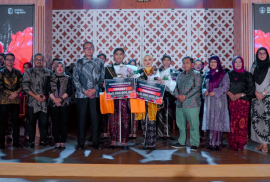
Yogyakarta, 24/2/2025 – In the series of anniversary of Faculty of Cultural Sciences (FIB) Universitas Gadjah Mada (UGM), a scientific oration and public lecture titled ‘Welcoming Eight Decades of Work to Build World Civilisation’ was held on 24 February 2025. The event took place at Soegondo Auditorium, gathering academics, students, and culture lovers to discuss the important role of education in building peace and resolving conflicts.

The event began with a speech from the Vice Rector for Education and Teaching, Prof. Dr Wening Udasmoro, S.S., M.Hum., DEA. In her speech, she emphasised the importance of education as a tool for conflict resolution and cultural diplomacy as she did in her researches. After the speech, the Dean of the Faculty, Prof. Dr Setiadi, M.Si., took the stage to explain the Faculty’s role in the humanities. He pointed out that the humanities play an important role in shaping a more peaceful society by promoting critical thinking and empathy among students.

The highlight of the event was a scientific oration delivered by Dr (H.C) Drs. H. Muhammad Jusuf Kalla, a leading figure in Indonesian politics and diplomacy. In his speech, he discussed the historical context of cultural diplomacy and its impact on peacebuilding efforts. He argued that understanding cultural differences is crucial in resolving conflicts and that education plays an important role in this process.

The session was followed by an engaging discussion involving participants from various backgrounds, including students, faculty members, and cultural practitioners. The audience asked questions about the practical application of cultural diplomacy in contemporary conflicts and the role of educational institutions in promoting peace. The discussion emphasised the need for collaborative efforts in facing global challenges through education.

As the event drew to a close, participants expressed their appreciation for the insights shared by the speakers. Many stressed the importance of continuing this kind of dialogue to foster a culture of peace and understanding. The event not only celebrated the Faculty’s achievements over the past eight decades but also affirmed its commitment to contribute to global civilisation through education and cultural diplomacy.

In the context of the SDGs, the event served as a reminder of the interconnections between education, peace and conflict resolution. It highlighted the role of educational institutions in shaping future leaders who are prepared to face the complexities of a diverse world. The discussions held during this event will surely inspire further initiatives aimed at promoting peace through education.

Overall, the scientific oration and public lecture at FIB UGM was a resounding success, gathering a community dedicated to the ideals of cultural diplomacy and peace. As the world faces increasing challenges, the role of education in fostering understanding and resolving conflict has never been more important.

[Public Relations Faculty of Cultural Sciences UGM, Bulan Churniati]

Shedding Light on Timor Timur: How to Teach the History of Timor Timur in Indonesia

HEADLINESNews ReleaseSDGSSDGs 16: Peace justice and strong institutionsSDGs 4: Quality Education Thursday, 10 October 2024

On Tuesday, The UGM History Department held a public lecture titled “How to Teach the History of Timor Timur in Indonesia” (9/10). Prof. Dr. Asvi Marwan Adam, a historian and researcher at the National Research and Innovation Agency (BRIN), was the keynote speaker for this lecture. The primary goal of this public lecture was to raise awareness about the history of Timor Timur, which is often presented with a limited or biased perspective.

In his opening address, Dr. Abdul Wahid, Head of UGM’s History Department, noted that this topic is particularly intriguing since it deals with a former Indonesian province and is rarely discussed in depth by academics.

“Timor Timur is our neighbor. We are so close to each other, yet unfortunately, very few Indonesians have thoroughly studied its history,” said Abdul Wahid.

In his lecture, Prof. Dr. Asvi Marwan Adam explained that his deep interest in the history of Timor Timur stemmed from the fact that it has largely disappeared from the history curriculum in Indonesia.  

“With Prabowo’s election as president and the appointment of several ministers who previously served in Timor Timur, could this pose a challenge in teaching Timor Leste’s history? Will the history being written or taught be aligned with those currently in power, meaning that military violence in the past could be covered up?” he questioned.

He emphasized that writing the history of Timor Timur is incredibly complex, especially due to the numerous human rights violations that occurred there. This complexity is reflected in the many films, books, novels, and memoirs focusing on human rights abuses in Timor Timur. Prof. Asvi’s presentation sparked an engaging and lively discussion, with the audience enthusiastically asking questions over two separate discussion sessions.

The panel concluded that a deep understanding of Timor Timur’s history is crucial to be presented objectively and openly within Indonesian education. Understanding the historical events in Timor Timur will help Indonesians view the past with a broader perspective and comprehend its impact on regional relations and humanitarian issues. By studying this history, young generations can become more critical of political interference in historical narratives and better appreciate the importance of justice and reconciliation processes.

[PR of FIB UGM: Aldiza, Translated: Aldiza, Photo: Adnan, Putu]

Linguistics Students from Faculty of Cultural Sciences UGM Must Speak Regional Language during Presentation

HEADLINESNews ReleaseSDGs 10: Reduced InequalitiesSDGs 16: Peace justice and strong institutionsSDGs 17: Partnerships for the GoalsSDGs 4: Quality Education Saturday, 15 June 2024

Linguistics study program is one of the master level study programs at the Faculty of Cultural Sciences, Universitas Gadjah Mada. The vision of the study program is to become a linguistics study program with superior quality, national insight, active and responsive to language problems and linguistic development, and able to become a reference study program in the Asia Pacific region in 2025. To achieve this vision, one of the missions carried out by the study program is to educate linguistics graduates with a master’s degree who are able to apply the linguistic knowledge they have obtained to solve various social problems and are able to dialogue and partner with foreign scholars in an effort to establish mutually beneficial intercultural cooperation. This is evidenced by the requirement for students to use their respective regional languages when presenting in Psycholinguistics courses.

Psycholinguistics is a field that studies how humans create and use language. Psycholinguistic theory views language as a means of conveying information, focusing on the view that language is the result of human habits. In essence, psycholinguistics seeks to explain how language structures are formed, used and understood in the process of communication. From this focus, a psycholinguistics lecturer at the Faculty of Cultural Sciences, Universitas Gadjah Mada, Drs. Tatang Hariri, M.A., Ph.D., took the initiative to utilize the condition where his students come from various regions to introduce their respective native languages. This aims to be a direct example of how different languages occur and so that local languages are preserved and not lost.

1…678

Video UGM

[shtmlslider name='shslider_options']
Universitas Gadjah Mada

Faculty of Cultural Sciences
Universitas Gadjah Mada
Jl. Nusantara 1, Bulaksumur Yogyakarta 55281, Indonesia
   fib@ugm.ac.id
   +62 (274) 513096
   +62 (274) 550451

Work Units

  • Office of Journal & Publishing
  • INCULS
  • Information Technology and Database
  • Language Learning Center
  • Library Unit
  • Public Relations
  • Research

Facilities

  • Computer Laboratory
  • Gamelan
  • Guest House
  • Language Library
  • Library
  • Phonetics Library
  • Self Access Unit
  • Student Internet Centre

Importan Links

  • Journal of Humaniora
  • Subscriber Journal
  • Alumni Portal
  • Career
  • Departmens News
  • UGM Streaming

Contacts

  • Academic
  • Administration
  • Dean’s Office
  • Departments / Study Programs
  • Public Relations

© 2024 Faculty of Cultural Sciences Universitas Gadjah Mada

KEBIJAKAN PRIVASI/PRIVACY POLICY

[EN] We use cookies to help our viewer get the best experience on our website. -- [ID] Kami menggunakan cookie untuk membantu pengunjung kami mendapatkan pengalaman terbaik di situs web kami.I Agree / Saya Setuju