• About UGM
  • Academic Portal
  • IT Center
  • Library
  • Research
  • Webmail
  • Informasi Publik
  • English
    • Indonesia
Universitas Gadjah Mada Faculty of Cultural Sciences
Universitas Gadjah Mada
  • Home
  • Profile
    • History
    • Vision and Mission
    • Organizational structure
    • Administration
    • Staff
    • Faculty Members
  • Academic
    • Academic Calendar
    • Undergraduate Programs
      • Bachelor of Cultural Antrophology
      • Bachelor in Archaeolagy
      • Bachelor in History
      • Bachelor in Tourism
      • Bochetor in Korean Language and Culture
      • Bachelor in Indonesian Language and Culture
      • Bachelor in English
      • Bachelor in Arabic
      • Bachelor in Japanese Language and Culture
      • Bachelor in Javanese Language, Literature and Culture
      • Bachelor in French language and literature
    • Graduate Programs
      • Master in Antrophology
      • Master in ArchaeoIogy
      • Master in History
      • Master in Linguistics
      • Master in Literature
      • Master In American Studies
      • Master in Middle Eastern Cultural Studies
    • Post-Graduate Programs / S3
      • Doctor in Antropology
      • Doctor in American Studies
      • Doctor in Humanities
    • Student Service
  • KPPM
    • Research Information
    • Scientific / Academic Publications
    • Community Service
    • International Cooperation
    • Domestic Cooperation
  • Student Organizations
    • Student Executive Council
    • Semi-Autonomous Organizations
      • KAPALASASTRA
      • Christian Student Alliance
      • LINCAK
      • Saskine
      • Catholic Student Family
      • Dian Budaya
      • Sastra Kanuragan (sasgan)
      • Family of Muslim Cultural Sciences Students (KMIB)
      • Bejo Mulyo
    • Autonomous Organizations
      • Family of Anthropology Students (KEMANT)
      • English Department Student Association
      • Tourism Students Association (HIMAPA)
      • Family of Indonesian Literature Students (KMSI)
      • West Asian Literature Student Association (IMABA)
      • Association of Korean-Language Students (HIMAHARA)
      • Family of Regional Indonesian Literatures Students (KAMASUTRA)
      • The Family Body of History Students (BKMS)
      • The French Literature Students Association (HMSP)
      • Family of Anthropology Students
      • Japanese Student Association (HIMAJE)
  • Admission
    • Student Evaluation
  • Home
  • SDGs 11: Sustainable Cities and Communities
  • SDGs 11: Sustainable Cities and Communities
  • page. 8
Arsip:

SDGs 11: Sustainable Cities and Communities

Safranbolu, UNESCO World Heritage City from Turkiye, Presented at FIB UGM

News ReleaseSDGs 11: Sustainable cities and communitiesSDGs 12: Responsible consumption and productionSDGs 15: Life on landSDGs 17: Partnerships for the GoalsSDGs 8: Decent work and economic growth Wednesday, 1 October 2025

Yogyakarta, September 2, 2025 – The Undergraduate Tourism Program, Faculty of Cultural Sciences, Universitas Gadjah Mada, held an international guest lecture under the ERASMUS+ Staff Mobility program with the theme “Sustainability and Sustainable Practices in Tourism Enterprises.” The lecture featured Assoc. Prof. Halime Göktas Kulualp from Karabük University, Turkiye, shared valuable insights through the case study of Safranbolu, a UNESCO World Heritage City recognized since 1994.

In her presentation, Prof. Kulualp described Safranbolu as a small but historically rich town in Karabük Province, located in the Black Sea region of Turkiye. For centuries, it served as an important stop on the ancient Silk Road, a trade route connecting Asia and Europe. The town has witnessed the presence of great civilizations, including the Hittites, Romans, and Byzantines, and reached its golden age under the Ottoman Empire. During this period, caravanserais such as the famous Cinci Han were established to host merchants and travelers passing through the region.

What makes Safranbolu truly unique is its remarkable Ottoman architecture. The town is renowned for its traditional houses, many of which are more than 300 years old, characterized by whitewashed walls, wooden frames, large windows, and private courtyards. These houses are living examples of how Turkish people once lived. Beyond its architecture, Safranbolu is also surrounded by natural beauty, with stunning sites like Tokatl Canyon and Bulak Caves attracting both domestic and international visitors.

The name Safranbolu comes from “saffron,” a rare and precious spice that grows in the area, combined with the name of the nearby region, Bolu. This name reflects the city’s cultural identity and historical wealth. UNESCO’s recognition highlights Safranbolu’s authenticity, integrity, and its importance as a living heritage for humanity. According to Prof. Kulualp, Safranbolu’s success in preserving its cultural legacy while embracing tourism offers an inspiring example of how heritage conservation and sustainable development can go hand in hand.

Through this guest lecture, UGM Tourism students were encouraged to see tourism not only as an economic activity but also as a responsibility to safeguard cultural heritage. The story of Safranbolu reminds us that sustainability in tourism is essential to protect history while ensuring benefits for local communities and future generations.

[Public Relations of FIB UGM, Candra Solihin]

FIB UGM–Iwate University Collaboration: Summer School Opens with Cultural Heritage Protection Talk

SDGs 11: Sustainable cities and communitiesSDGs 17: Partnerships for the GoalsSDGs 4: Quality Education Tuesday, 23 September 2025

Yogyakarta, 19/9/2025– The Department of Archaeology, Faculty of Cultural Sciences (FIB) Universitas Gadjah Mada officially opened its Summer School program in collaboration with Iwate University, Japan, at the Multimedia Room, Margono Building, FIB UGM. The opening session featured Dwi Pratnyawan, S.S., M.A., who delivered a lecture titled Protecting Archaeological Site (Cultural Heritage).

The event brought together Archaeology students from UGM and international students from Iwate University. This academic forum highlighted the significance of safeguarding cultural heritage as both an identity marker and a collective memory of society.

In his presentation, Dwi explained that cultural heritage preservation, based on Indonesia’s Cultural Heritage Law, rests on three pillars: Protection, Development, and Utilization. He provided concrete examples, including rescue excavations at the Morangan Temple site near Prambanan, regular maintenance at Prambanan’s Siwa Temple, and zoning efforts to establish protective boundaries.

Development, he emphasized, involves research, revitalization, and adaptation, while utilization aims to maximize public benefit without compromising sustainability. However, he also addressed critical challenges such as weak enforcement—citing the use of Borobudur for a Red Bull commercial and damage to Majapahit sites due to illegal brick excavations—and uncoordinated developments, such as the destruction of parts of Trowulan to build a new museum.

The session concluded with an engaging Q&A discussion, where both Indonesian and Japanese students raised questions on how best to preserve cultural heritage amid rapid modernization and urban development.

This initiative strongly aligns with the global Sustainable Development Goals (SDGs), particularly SDG 11 (Sustainable Cities and Communities), which stresses the importance of protecting the world’s cultural heritage, and SDG 17 (Partnerships for the Goals), as reflected in the international collaboration between UGM and Iwate University.

Cultural Harmony and Appreciation of Works at the 14th Gugur Gunung Festival

SDGs 11: Sustainable cities and communitiesSDGs 17: Partnerships for the GoalsSDGs 4: Quality Education Monday, 22 September 2025

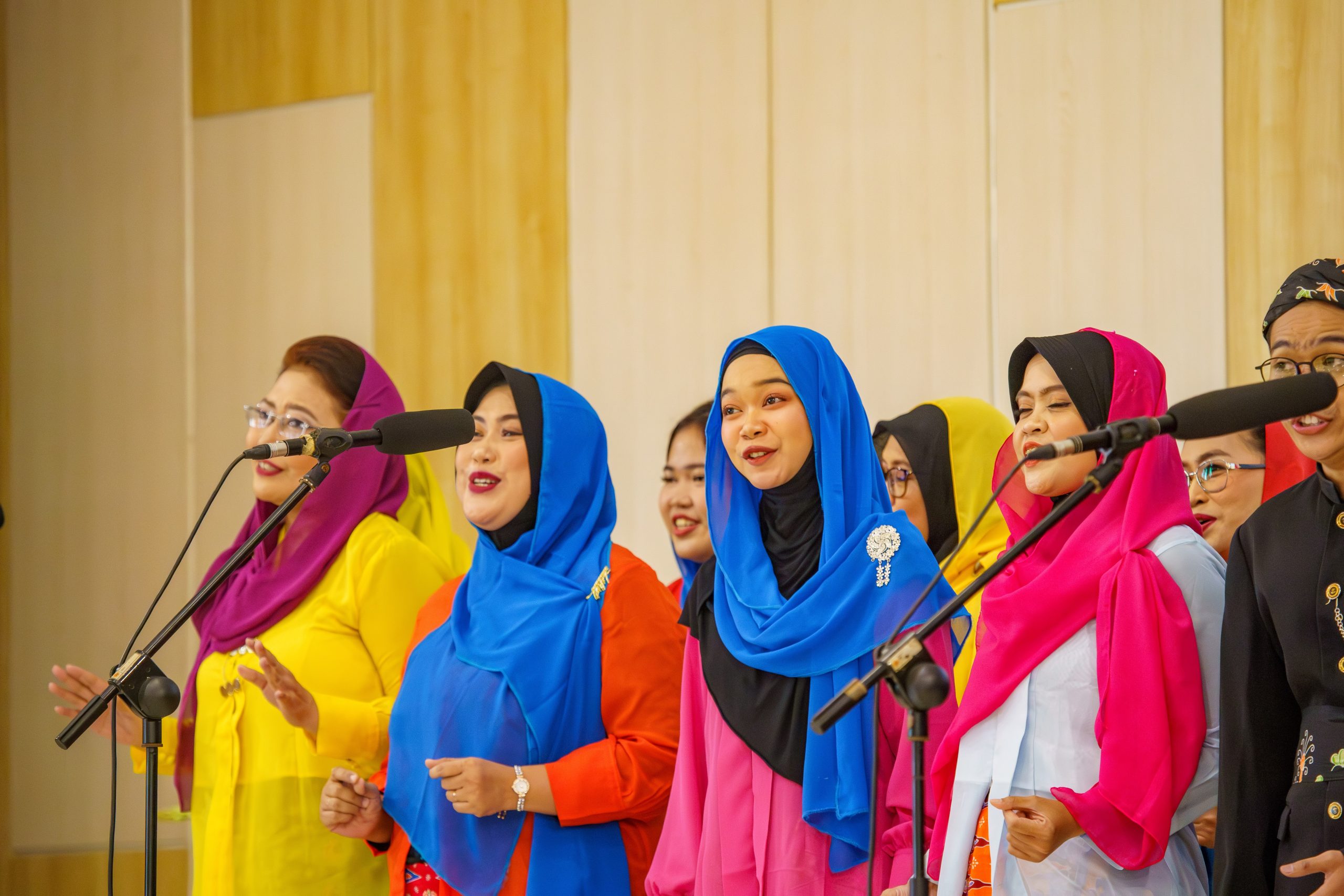
Yoigyakarta, 19/9/2025 – A warm and meaningful atmosphere filled the Poerbatjaraka Auditorium, Faculty of Cultural Sciences (FIB) UGM, on Friday evening (Sept 19). Hundreds of attendees gathered for “Gugur Gunung 14: Anniversary of the Javanese Language, Literature, and Culture Study Program, as well as the Retirement Celebration of Dr. Sri Ratna Saktimulya, M.Hum.” The event was not merely a birthday celebration, but also a tribute, a gathering of kinship, and a cultural encounter across generations and nations.

Carrying the theme “Tataning Ucap Sirnaning Dhêsti” which means “Arranging Words to Avoid Misfortune,” the program opened solemnly with the Indonesian national anthem, Gadjah Mada Hymn, and Sastra March. A series of keynote remarks followed, delivered by Head of Study Program Dr. Daru Winarti, M.Hum., Osaka University’s representative Dr. Yumi Sugahara, Dean of FIB UGM Prof. Dr. Setiadi, and Vice Rector for Education and Teaching, Prof. Dr. Wening Udasmoro. The presence of cultural leaders from Kadipaten Pakualaman, government representatives of Yogyakarta, and international students from Osaka University enriched the evening with diverse cultural resonance.

A touching and symbolic moment took place in the Ambal Warsa procession, when the Head of Study Program, together with the Head of the Student Association Kamastawa, received a ceremonial tumpeng—a symbol of continuity for the Javanese Language, Literature, and Culture Study Program. The loud applause that followed embodied the spirit of togetherness, the very soul of Gugur Gunung.

The stage came alive with cultural performances, starting with the graceful Sekar Pudyastuti welcoming dance, symbolizing safety and blessing. A performance by Osaka University students added an international touch, before the audience was captivated by Tari Andhira from Sanggar Sigrak Delimo, which retold the heroic story of Nyi Ageng Sérang—a courageous Javanese heroine who fought against Dutch colonial forces.

The highlight of the night was the retirement tribute to Dr. Sri Ratna Saktimulya, M.Hum., fondly known as “Doktor Sakti.” Renowned as an academic, researcher, and cultural advocate, she has contributed greatly through her research, publications, and community service, and has been awarded the prestigious Satyalancana Karyasatya. As her parting gift, she presented “Adisari: The Light of Love Behind Conquest”, a performance art adaptation of an ancient manuscript, creatively transformed into a stage production.

The 14th Gugur Gunung was more than just a commemoration of the Study Program’s journey—it was also a reflection on the importance of preserving and celebrating culture. From students and lecturers to international collaborations, all came together on one stage, proving that Javanese language and culture continue to live, endure, and inspire.

FIB UGM Hosts School Visit from SMA Cikal Amri, East Jakarta

HEADLINESNews ReleaseSDGs 11: Sustainable cities and communitiesSDGs 17: Partnerships for the GoalsSDGs 4: Quality Education Friday, 19 September 2025

Yogyakarta, 17 September 2025 – The Faculty of Cultural Sciences, Universitas Gadjah Mada (FIB UGM), hosted a school visit from SMA Cikal Amri, East Jakarta. The event was warmly received by the Public Relations team of FIB UGM and provided students with the opportunity to experience academic life and the campus environment at UGM.

The program began with a presentation on the history of FIB UGM, its vision and mission, as well as various academic and non-academic activities. The interactive session allowed students to ask questions and gain deeper insights into learning opportunities and student life at FIB UGM.

After the presentation, the group joined a faculty tour. On the fourth floor, they were introduced to the Indonesian Language and Culture Learning Service (INCULS), a unit that facilitates Indonesian language and cultural learning for international students. The tour continued to Gedung Margono, home to various study programs of FIB UGM. In the same building, students were also invited to visit the Mandala Majapahit Archaeology Museum and the Archaeology Laboratory, both of which play an important role in supporting research and the preservation of cultural heritage.

Through this visit, the students of SMA Cikal Amri not only gained new insights into academic life but also experienced firsthand the importance of preserving language, literature, and culture in both national and international contexts.

This activity reflects FIB UGM’s commitment to supporting the Sustainable Development Goals (SDGs), particularly SDG 4: Quality Education through the introduction of inclusive access to higher education, and SDG 11: Sustainable Cities and Communities through the preservation of cultural heritage in its museum and archaeology laboratory.

[Public Relations of FIB UGM, Alma Syahwalani]

HMJ Kamastawa Serves the Community through Social Service and Teaching

SDGs 10: Mengurangi KetimpanganSDGs 10: Reduced InequalitiesSDGs 11: Sustainable cities and communitiesSDGs 17: Partnerships for the GoalsSDGs 3: Good health and well-beingSDGs 4: Quality Education Tuesday, 9 September 2025

On Sunday (August 24, 2025), HMJ Kamastawa conducted social service and teaching activities at the Darun Najah Orphanage and Shelter for the Poor in Maguwoharjo Village, Depok, Sleman. This initiative, organized by the Social Community Division and the Academic Division, reflects the students’ social responsibility and dedication to the community as part of implementing the Tri Dharma of Higher Education. The target audience for the activity was orphaned and underprivileged children, with a focus on educational support for female high school students.

Prior to the social service activity, the Social Community Division opened donations of money and goods, including reading books, stationery, and cleaning supplies. These donations were then distributed to meet the needs of the Darun Najah Orphanage.

The series of events began with a teaching activity guided by the Academic Division with the theme of Javanese script and how to write it. In this session, students presented interactive group games. Participants were asked to answer questions competitively, and each correct and quick answer would earn points. After the game ended, the group with the most points was entitled to a prize.

The event continued with a social service activity by the Social Community Division, which donated snacks and necessities for the orphanage, such as brooms, boxes, and so on. The funds for these necessities were obtained from an open donation that had been opened previously. 

The event concluded with a symbolic presentation of commemorative plaques and the handover of donations from the chairman of HMJ Kamastawa to representatives of the Darun Najah Orphanage management. Students and orphanage children also took part in a group photo session to commemorate the occasion and share stories.

Kamastawa’s community service activities are not merely about carrying out work programs, but also provide a shared learning space that offers valuable experiences for both students and children at the orphanage. In addition, these activities support the achievement of the Sustainable Development Goals (SDGs) in the areas of health, education, equality, and sustainable communities and partnerships.

Author : Maysa Putri Fatihah & Dwiyan Teguh Darmawan
Editor : Haryo Untoro

1…678910…39

Video UGM

[shtmlslider name='shslider_options']
Universitas Gadjah Mada

Faculty of Cultural Sciences
Universitas Gadjah Mada
Jl. Nusantara 1, Bulaksumur Yogyakarta 55281, Indonesia
   fib@ugm.ac.id
   +62 (274) 513096
   +62 (274) 550451

Work Units

  • Office of Journal & Publishing
  • INCULS
  • Information Technology and Database
  • Language Learning Center
  • Library Unit
  • Public Relations
  • Research

Facilities

  • Computer Laboratory
  • Gamelan
  • Guest House
  • Language Library
  • Library
  • Phonetics Library
  • Self Access Unit
  • Student Internet Centre

Importan Links

  • Journal of Humaniora
  • Subscriber Journal
  • Alumni Portal
  • Career
  • Departmens News
  • UGM Streaming

Contacts

  • Academic
  • Administration
  • Dean’s Office
  • Departments / Study Programs
  • Public Relations

© 2024 Faculty of Cultural Sciences Universitas Gadjah Mada

KEBIJAKAN PRIVASI/PRIVACY POLICY

[EN] We use cookies to help our viewer get the best experience on our website. -- [ID] Kami menggunakan cookie untuk membantu pengunjung kami mendapatkan pengalaman terbaik di situs web kami.I Agree / Saya Setuju