• About UGM
  • Academic Portal
  • IT Center
  • Library
  • Research
  • Webmail
  • Informasi Publik
  • English
    • Indonesia
Universitas Gadjah Mada Faculty of Cultural Sciences
Universitas Gadjah Mada
  • Home
  • Profile
    • History
    • Vision and Mission
    • Organizational structure
    • Administration
    • Staff
    • Faculty Members
  • Academic
    • Academic Calendar
    • Undergraduate Programs
      • Bachelor of Cultural Antrophology
      • Bachelor in Archaeolagy
      • Bachelor in History
      • Bachelor in Tourism
      • Bochetor in Korean Language and Culture
      • Bachelor in Indonesian Language and Culture
      • Bachelor in English
      • Bachelor in Arabic
      • Bachelor in Japanese Language and Culture
      • Bachelor in Javanese Language, Literature and Culture
      • Bachelor in French language and literature
    • Graduate Programs
      • Master in Antrophology
      • Master in ArchaeoIogy
      • Master in History
      • Master in Linguistics
      • Master in Literature
      • Master In American Studies
      • Master in Middle Eastern Cultural Studies
    • Post-Graduate Programs / S3
      • Doctor in Antropology
      • Doctor in American Studies
      • Doctor in Humanities
    • Student Service
  • KPPM
    • Research Information
    • Scientific / Academic Publications
    • Community Service
    • International Cooperation
    • Domestic Cooperation
  • Student Organizations
    • Student Executive Council
    • Semi-Autonomous Organizations
      • KAPALASASTRA
      • Christian Student Alliance
      • LINCAK
      • Saskine
      • Catholic Student Family
      • Dian Budaya
      • Sastra Kanuragan (sasgan)
      • Family of Muslim Cultural Sciences Students (KMIB)
      • Bejo Mulyo
    • Autonomous Organizations
      • Family of Anthropology Students (KEMANT)
      • English Department Student Association
      • Tourism Students Association (HIMAPA)
      • Family of Indonesian Literature Students (KMSI)
      • West Asian Literature Student Association (IMABA)
      • Association of Korean-Language Students (HIMAHARA)
      • Family of Regional Indonesian Literatures Students (KAMASUTRA)
      • The Family Body of History Students (BKMS)
      • The French Literature Students Association (HMSP)
      • Family of Anthropology Students
      • Japanese Student Association (HIMAJE)
  • Admission
    • Student Evaluation
  • Home
  • SDGs 11: Sustainable Cities and Communities
  • (Page 9)
Arsip:

SDGs 11: Sustainable Cities and Communities

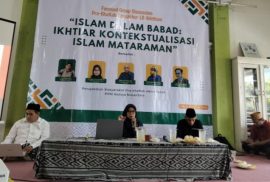
Dr. Arsanti Wulandari, M.Hum., Becomes Speaker in FGD “Islam in Javanese Babad: Efforts to Revitalize Mataraman Islam”

News Release Monday, 2 March 2026

Dr. Arsanti Wulandari, M.Hum., lecturer in the Javanese Language, Literature, and Culture Study Program in the field of Philology, was one of the speakers at the Focus Group Discussion (FGD) entitled “Islam in Javanese Babad: Efforts to Revitalize Mataraman Islam”. The event was organized by PPM Aswaja Nusantara in the PPM Aswaja Nusantara Mlangi Hall on Friday (February 6, 2026) from 1:30 p.m. to 4:30 p.m.

In her presentation, Dr. Arsanti Wulandari, M.Hum. explained the connection between literary works, particularly Babad Ngayogyakarta, and the development and existence of Islam in the Yogyakarta Palace. She explained that Babad Ngayogyakarta was written during the reign of Sri Sultan Hamengkubuwana (HB) V and was transcribed again during the reign of HB VII. The manuscript was written in Javanese script and contains expressions of Islamic teachings that developed within the Yogyakarta Palace.

The chronicle covers the period of HB IV-V, starting from the childhood of HB IV until the coronation of HB V. During this period, Prince Diponegoro is also described as the guardian of HB IV until the outbreak of the Diponegoro war. Prince Diponegoro is also described as a figure who upheld Islamic teachings and revived them in the life of the Yogyakarta Sultanate.

One example cited was Prince Diponegoro’s role in providing Islamic education to Hamengkubuwana IV. This education included the obligation to study the Qur’an, understand fiqh, and instill values of struggle. Dr. Arsanti Wulandari, M.Hum. also explained that Diponegoro’s concept of struggle was reflected in the war against colonialism, which was based on the spirit of upholding Islamic teachings, including the call of sabilullah as a motivator for the troops.

Through a study of the literary work Babad Ngayogyakarta, various important information can be found, ranging from historical facts, literary forms, to information about the existence of Islam in Java. He described the existence of Islam at that time in three (3) words, namely manjing ‘enter’, ajur ‘melt’, and ajer ‘walk together’.

Information related to literature and history of the past can be found in various manuscripts. In this case, philology plays an important role in uncovering the information contained in ancient manuscripts so that it can be understood and utilized by today’s society. In addition, philological studies are also part of efforts to preserve and protect regional languages, literature, and cultures in Indonesia.

This FGD activity is in line with the Sustainable Development Goals (SDGs), particularly point 4 on quality education, point 11 on sustainable cities and communities, and point 17 on partnerships to achieve development goals.

Author : Haryo Untoro
Editor : Haryo Untoro

Khabib Anwar “Rektor Desa” Encourages Local Economic Empowerment Through Digital Content

News Release Friday, 27 February 2026

Khabib Anwar, widely known by his digital persona “Rektor Desa” (Village Rector), continues to promote village empowerment through a creative, digital-based approach. He is recognized as a village empowerment practitioner, creative mentor, and local economic mobilizer who focuses on content development and YouTube optimization.

Through the identity of “Rektor Desa,” Khabib carries a vision of bringing educational standards and professionalism to the village level. He believes that villages should not be left behind in the digital transformation, particularly in utilizing social media as a platform for education, promoting local potential, and strengthening community-based economies.

In various sharing sessions, Khabib emphasizes that becoming a beginner YouTuber is not about owning expensive cameras or sophisticated equipment. “It’s not about how expensive your camera is, but how strong your willingness is to start telling stories,” he said. He stressed that the most crucial step is having the courage to begin with whatever tools are available, because consistency in creating content is far more valuable than luxurious equipment.

According to him, digital platforms such as YouTube can serve as strategic spaces for rural communities to showcase local potential, promote MSME products, and share inspiring grassroots stories. With the right content strategy and sustained commitment, villages can build economic independence while expanding their market networks.

Khabib Anwar’s initiatives and ideas are aligned with the Sustainable Development Goals (SDGs), particularly in promoting inclusive and sustainable economic growth (SDG 8) by strengthening the creative capacity of rural communities. The use of digital technology to expand access to information and economic opportunities also supports reducing inequalities (SDG 10) and building sustainable communities (SDG 11). Furthermore, this effort reflects the importance of partnerships and collaboration within the digital ecosystem (SDG 17).

Through consistency and the courage to take the first step, “Rektor Desa” demonstrates that digital transformation can begin in villages, by villages, and for the advancement of villages themselves.

Okky Madasari Highlights the Representation of Marginalized Voices in Public Discourse

News Release Friday, 27 February 2026

Yogyakarta, February 26, 2026 – Indonesian novelist and sociologist Okky Madasari, Ph.D., delivered a critical reflection titled “The Representation of Marginalized Voices: Who Speaks for Them?” at a public discussion forum in Yogyakarta. In her presentation, she encouraged participants to question who truly speaks on behalf of marginalized communities.

Okky elaborated on various forms of marginalization occurring across different spheres of life, including economic, political, cultural, identity-based, and even global political marginalization. According to her, marginalized groups often face not only limited access to resources but also the loss of space to represent themselves within public discourse.

“Representation that does not stem from empathy and solidarity will continue to exclude and sideline marginalized communities,” she emphasized. She warned that without critical awareness, voices claiming to represent marginalized groups may, in fact, reinforce unequal power relations and perpetuate social exclusion.

In the context of Ramadan, Okky also underscored the importance of social piety. “Ramadan is about social piety. A mosque is not only a place of worship, but also a space for dialogue and critical education,” she stated. She encouraged society to transform religious spaces into arenas for fostering empathy, solidarity, and advocacy for vulnerable groups.

The discussion is closely aligned with the Sustainable Development Goals (SDGs), particularly the commitment to reducing inequalities (SDG 10) by strengthening the participation and representation of vulnerable groups in decision-making processes. Furthermore, the promotion of critical dialogue, social justice, and inclusive public spaces supports the goal of peace, justice, and strong institutions (SDG 16). Efforts to build collective awareness and social solidarity also contribute to the creation of inclusive and sustainable communities, in line with SDG 11.

Through this reflection, Okky Madasari reaffirmed that advocating for marginalized voices is not merely about providing them with speaking space, but about ensuring empathy, solidarity, and structural transformation so that they can become full subjects in social and political life.

[Public Reation of FIB UGM, Alma Syahwalani]
From Literature to the Global Stage: A UGM Master’s Student at the Korea Youth Summit 2026

News Release Thursday, 19 February 2026

It may seem uncommon for a humanities student to be involved in an international forum centered on business and innovation. Yet that is precisely what makes the story of Kharisma Qurrota Ayun compelling. A Master’s student in Literature at Universitas Gadjah Mada (UGM), Kharisma took part in the Korea Youth Summit 2026, organized by Youth Break the Boundaries from February 2–5, 2026, in South Korea.

Rather than attending as a project delegate, Kharisma contributed from behind the scenes as a member of the organizing committee. Far from being a secondary role, her position highlights an important point: global forums are not sustained by ideas alone, but also by the cultural fluency, communication skills, and coordination that make international collaboration possible. Her involvement invites a broader reflection on how the humanities, often perceived as distant from business and technology, play a vital role in knowledge diplomacy and cross-cultural engagement.

The summit’s central agenda, the International Symposium, brought together 34 young innovators from New Zealand, Vietnam, Indonesia, Morocco, Bangladesh, Mexico, and Uzbekistan. Participants presented business-driven solutions to pressing global challenges, including green economic transitions and community-based empowerment initiatives. The symposium functioned not merely as a competition of ideas, but as a shared learning space where diverse perspectives met and evolved.

In this context, Kharisma’s academic training in literary studies proved unexpectedly relevant. Literature sharpens the ability to interpret narratives, understand cultural nuances, and engage with different worldviews, skills that are indispensable in multinational settings. In global conversations, persuasive storytelling and cultural sensitivity are often as important as technical feasibility. Her background equipped her to navigate complex intercultural dynamics while supporting the event’s overall coordination.

As part of the organizing team, she helped ensure the smooth execution of the symposium, facilitated communication among international participants, and maintained the flow of the program. The role demanded meticulous planning, adaptability, and intercultural competence: qualities that reflect the emerging practice of youth-led global diplomacy.

Kharisma’s experience underscores a broader message: humanities graduates are not confined to classrooms or textual analysis. They are equally positioned to contribute to global innovation ecosystems. Her journey illustrates that literature is not only about studying texts, but about cultivating the capacity to “read” societies, bridge differences, and shape meaningful dialogue.

From Yogyakarta to South Korea, her participation signals the growing presence of Indonesian youth in international arenas. It also reminds us that transformative global initiatives rely not only on groundbreaking ideas and capital investment, but on empathy, narrative intelligence, and collaboration across cultures.

[Master of Arts in Literature, Khotibul Umam]

Inauguration Night for New Master’s Students in Literature at UGM Affirms the Five Pillars and Academic Integrity

News Release Thursday, 19 February 2026

The Master’s Program in Literature at the Faculty of Cultural Sciences, Universitas Gadjah Mada (UGM), held an Inauguration Night for New Students of the Even Semester of the 2025/2026 Academic Year at Pondok As-Salam Kalimasada, Sleman Regency, Yogyakarta, on Saturday–Sunday, 14–15 February 2026. Carrying the theme “Our Literature, One Family,” the event marked the initial momentum in shaping the academic identity of master’s students.

The main session commenced on Saturday at 7:30 p.m. (WIB) and featured the Head of the Master’s Program in Literature, Prof. Dr. Aprinus Salam, M.Hum. In his remarks, he emphasized that at the master’s level, students are expected to demonstrate a higher degree of academic maturity.

“Master’s students are not only required to master course materials. They must also understand the history and philosophy of UGM as the foundation for developing academic attitudes and ethics,” he stated.

Aprinus also highlighted the importance of building a collaborative academic culture. He stressed that an open tradition of discussion, accompanied by mutual support across cohorts, is a prerequisite for fostering a healthy, productive, and sustainable scholarly community.

The event also featured a sharing session with senior students—Khotibul Umam, Marsya Kamila, and Kharisma Qurrota A’yun—who shared their experiences regarding time management, academic dynamics, and strategies for preparing research proposals as initial preparation for graduate studies.

The keynote lecture was delivered by Professor of Philosophy at UGM, Prof. Drs. M. Mukhtasar Syamsuddin, M.Hum., Ph.D., who elaborated on UGM’s Five Pillars as the philosophical foundation of the university. He explained that UGM is grounded in five principal identities: a National University, a University of Struggle, a Pancasila University, a People-Oriented University, and a Center of Culture. These pillars serve as the institutional direction as well as ethical guidelines for the entire academic community.

“UGM is not merely an educational institution, but a space for shaping the nation’s character. Therefore, its core values must be embodied in students’ daily conduct,” he remarked.

During the discussion session, Mukhtasar Syamsuddin also underscored the importance of interdisciplinary openness, particularly for literature students. According to him, the complexity of social and cultural issues demands cross-disciplinary dialogue; therefore, students should not construct rigid boundaries between literature, philosophy, and other fields of study. This perspective is highly relevant to the reflective and humanistic character of literary studies.

The main session concluded at 9:30 p.m. and was followed by performances by the 2025/2026 Even Semester cohort, including poetry readings and musical performances that strengthened solidarity among members. After the evening program, participants rested and continued the agenda the following day.

On the second day, Sunday (15/2), activities began with congregational dawn prayer, followed by a morning walk and group games designed to reinforce togetherness. The event concluded with a session for sharing hopes and a group photo before participants returned to their respective homes.

Through this inauguration night, the Master’s Program in Literature at the Faculty of Cultural Sciences, UGM, reaffirmed its commitment to postgraduate education that is oriented not only toward academic achievement but also toward the cultivation of integrity, interdisciplinary awareness, and moral responsibility in upholding the university’s core values. The event marked the beginning of the intellectual journey of 33 new students in developing critical, reflective literary studies that contribute meaningfully to society.

[Master of Arts in Literature, Rini Febriani Hauri]

1…7891011…47

Video UGM

[shtmlslider name='shslider_options']
Universitas Gadjah Mada

Faculty of Cultural Sciences
Universitas Gadjah Mada
Jl. Nusantara 1, Bulaksumur Yogyakarta 55281, Indonesia
   fib@ugm.ac.id
   +62 (274) 513096
   +62 (274) 550451

Work Units

  • Office of Journal & Publishing
  • INCULS
  • Information Technology and Database
  • Language Learning Center
  • Library Unit
  • Public Relations
  • Research

Facilities

  • Computer Laboratory
  • Gamelan
  • Guest House
  • Language Library
  • Library
  • Phonetics Library
  • Self Access Unit
  • Student Internet Centre

Importan Links

  • Journal of Humaniora
  • Subscriber Journal
  • Alumni Portal
  • Career
  • Departmens News
  • UGM Streaming

Contacts

  • Academic
  • Administration
  • Dean’s Office
  • Departments / Study Programs
  • Public Relations

© 2024 Faculty of Cultural Sciences Universitas Gadjah Mada

KEBIJAKAN PRIVASI/PRIVACY POLICY

[EN] We use cookies to help our viewer get the best experience on our website. -- [ID] Kami menggunakan cookie untuk membantu pengunjung kami mendapatkan pengalaman terbaik di situs web kami.I Agree / Saya Setuju