• About UGM
  • Academic Portal
  • IT Center
  • Library
  • Research
  • Webmail
  • Informasi Publik
  • English
    • Indonesia
Universitas Gadjah Mada Faculty of Cultural Sciences
Universitas Gadjah Mada
  • Home
  • Profile
    • History
    • Vision and Mission
    • Organizational structure
    • Administration
    • Staff
    • Faculty Members
  • Academic
    • Academic Calendar
    • Undergraduate Programs
      • Bachelor of Cultural Antrophology
      • Bachelor in Archaeolagy
      • Bachelor in History
      • Bachelor in Tourism
      • Bochetor in Korean Language and Culture
      • Bachelor in Indonesian Language and Culture
      • Bachelor in English
      • Bachelor in Arabic
      • Bachelor in Japanese Language and Culture
      • Bachelor in Javanese Language, Literature and Culture
      • Bachelor in French language and literature
    • Graduate Programs
      • Master in Antrophology
      • Master in ArchaeoIogy
      • Master in History
      • Master in Linguistics
      • Master in Literature
      • Master In American Studies
      • Master in Middle Eastern Cultural Studies
    • Post-Graduate Programs / S3
      • Doctor in Antropology
      • Doctor in American Studies
      • Doctor in Humanities
    • Student Service
  • KPPM
    • Research Information
    • Scientific / Academic Publications
    • Community Service
    • International Cooperation
    • Domestic Cooperation
  • Student Organizations
    • Student Executive Council
    • Semi-Autonomous Organizations
      • KAPALASASTRA
      • Christian Student Alliance
      • LINCAK
      • Saskine
      • Catholic Student Family
      • Dian Budaya
      • Sastra Kanuragan (sasgan)
      • Family of Muslim Cultural Sciences Students (KMIB)
      • Bejo Mulyo
    • Autonomous Organizations
      • Family of Anthropology Students (KEMANT)
      • English Department Student Association
      • Tourism Students Association (HIMAPA)
      • Family of Indonesian Literature Students (KMSI)
      • West Asian Literature Student Association (IMABA)
      • Association of Korean-Language Students (HIMAHARA)
      • Family of Regional Indonesian Literatures Students (KAMASUTRA)
      • The Family Body of History Students (BKMS)
      • The French Literature Students Association (HMSP)
      • Family of Anthropology Students
      • Japanese Student Association (HIMAJE)
  • Admission
    • Student Evaluation
  • Home
  • SDGs 11: Sustainable Cities and Communities
  • SDGs 11: Sustainable Cities and Communities
  • page. 3
Arsip:

SDGs 11: Sustainable Cities and Communities

Korean Days 2025: Two Decades of Indonesia–Korea Cultural Harmony at UGM

HEADLINESNews ReleaseStudent's Activity Tuesday, 18 November 2025

Yogyakarta, 15 November 2025 — Universitas Gadjah Mada once again became a vibrant center of Korean cultural celebration through the Festival Oullim Korea Yogyakarta: 20th Korean Day, held at the UGM Gelanggang Inovasi dan Kreativitas (GIK). This two-decade celebration was made possible through collaboration between the Korean Language and Culture Study Program of the Faculty of Cultural Sciences (FIB UGM) and the Korean Cultural Center Indonesia (KCCI). The festival was officially opened by UGM Rector, Prof. dr. Ova Emilia, M.Med.Ed., Sp.OG(K)., Ph.D., alongside KCCI Director Kim Yong Woon and distinguished guests from government institutions, academia, and cultural communities. Their presence underscored the significance of the festival as a thriving cultural interaction platform within the university environment.

The festival opened with the spirit of Oullim, meaning harmony, showcased through collaborative performances blending Indonesian and Korean traditional arts. A captivating fusion of Indonesian mask dance and Javanese gamelan with Korean fan dance and bukchum (traditional drum dance) delighted audiences. This performance was the result of an intensive week-long collaboration between students of SMKN 1 Kasihan and a visiting Korean art instructor. Students of the Korean Language and Culture Program at FIB UGM supported the process as cultural interpreters and assistants, ensuring smooth communication and rehearsals that culminated in a widely praised performance.

Beyond the stage performances, the festival featured a wide array of programs highlighting the richness of Korean culture. Shows by Salmunori UGM, music and dance showcases, dongari exhibitions, noraebang, and random play dance sessions all contributed to the lively atmosphere. One of the most striking highlights was the Hanbok Fashion Show featuring works by Leesle, a renowned South Korean designer known for dressing prominent Korean celebrities. On this occasion, Leesle presented a special hanbok collection crafted using Indonesian batik fabric, creating designs that symbolized harmonious cultural fusion. The interplay of colors, patterns, and silhouettes embodied the true meaning of Oullim as a representation of unity expressed through artistic beauty.

The festival’s dynamic atmosphere was further enriched by Korean culinary booths serving complimentary dishes to visitors, from tteokbokki to a variety of popular street foods. Additionally, the Korea Tourism Organization (KTO) participated by providing information on South Korean tourism, interactive activities, and destination promotions. Various Korean cultural institutions and communities also contributed, enhancing the festival with educational programs, entertainment, and inclusive cultural engagement. Their involvement reinforced Yogyakarta’s position as one of Indonesia’s key centers for Korean cultural exchange.

In her remarks, the UGM Rector emphasized that the twenty-year continuity of Korean Day reflects the strong cultural relations between Yogyakarta and South Korea, as well as the university’s role in promoting international collaboration. The festival serves as a cultural meeting ground that enriches students’ perspectives and expands UGM’s global network through mutually beneficial partnerships. With its overarching theme of Oullim, the festival fosters an environment that embraces diversity and encourages deep appreciation of cross-cultural heritage.

Through the 2025 Festival Oullim Korea Yogyakarta, UGM hopes to further strengthen collaboration in cultural exchange, education, and academic partnerships between Indonesia and South Korea. The event aligns with key principles of the Sustainable Development Goals (SDGs), particularly SDG 4 on Quality Education through intercultural learning opportunities; SDG 11 on Sustainable Cities and Communities through cultural preservation; and SDG 17 on Partnerships for the Goals through cooperative engagement among universities, government bodies, and international cultural organizations. In this way, the festival stands not only as a celebration of art but also as a meaningful contribution to building harmonious and sustainable global relations.

[Public Relations of FIB UGM, Candra Solihin]

FIB Encourages a Sustainable Campus Culture Through Waste Management Training

HEADLINESNews Release Tuesday, 18 November 2025

Yogyakarta, 14 November 2025 — The Faculty of Cultural Sciences at Universitas Gadjah Mada (FIB UGM) reaffirmed its commitment to developing an environmentally responsible campus by organizing a Workshop on Waste Management and Recycling at the Multimedia Room, RM Margono Building. The program forms part of the UGM Sustainability Campus Action FIB 2025 initiative and serves as a concrete effort to support the Sustainable Development Goals (SDGs), particularly SDG 11 (Sustainable Cities and Communities), SDG 12 (Responsible Consumption and Production), and SDG 13 (Climate Action).

In her opening remarks, the Vice Dean for Research, Community Service, Cooperation, and Alumni of FIB UGM, Dr. Mimi Savitri, M.A., Ph.D., emphasized the essential role of the academic community in maintaining environmental sustainability. She noted that an eco-conscious culture can only be achieved through shared awareness and collective participation across all campus components. The workshop thus served as both a discussion forum and a practical training platform to build new perspectives and habits in waste management, especially for administrative staff, cleaning personnel, the landscaping team, and representatives of LEM FIB UGM, all of whom participated enthusiastically.

The main session featured Prof. Ir. Wiratni, S.T., M.T., Ph.D., IPM., an environmental engineering expert who presented the fundamental concepts of waste management based on the 3R principles—Reduce, Reuse, Recycle. During her presentation, Prof. Wiratni elaborated on the importance of separating organic and inorganic waste, simple recycling techniques applicable in office settings, and case studies of waste management implementation in other campuses. She also highlighted the challenges UGM continues to face in reducing waste production and outlined practical strategies that each work unit can adopt to contribute to long-term solutions.

The event continued with an interactive discussion session between the audience and the speaker. Student participants conveyed their evaluations and aspirations regarding improved facilities to foster a cleaner faculty environment and strengthen discipline in waste sorting. Meanwhile, representatives from the cleaning team shared various ongoing efforts in handling inorganic waste such as leaves and food remnants. “Food waste has thankfully been managed by turning it into animal feed. As for fallen leaves, some are discarded, shredded, and processed into compost,” explained one of the FIB cleaning staff members. The dialogue remained lively as participants exchanged insights on waste management practices currently implemented across UGM, particularly within FIB.

The workshop produced several positive outcomes, including improved staff understanding of waste categories and management methods, as well as stronger collective awareness of the urgency of waste reduction on campus. Several work units also expressed their commitment to implementing continuous waste sorting practices. As a follow-up, FIB UGM plans to provide additional waste-sorting facilities around the faculty and conduct regular monitoring led by the FIB Sustainability Team. These steps align with the faculty’s long-term efforts to support UGM’s green campus goals in accordance with the SDGs.

Through this initiative, FIB UGM hopes that all staff and students can become agents of change in creating a cleaner, healthier, and more resource-efficient academic environment. The workshop reinforces FIB UGM’s dedication to advancing a culture of sustainability and strengthening its contribution to global sustainable development goals, positioning the campus as a real-world model of environmentally friendly practices for the broader community.

[Public Relations of FIB UGM, Candra Solihin]

BSO Sastra Oebah Wins Gold Medal in the Modern Dance Competition at Porsenigama 2025

News Release Thursday, 13 November 2025

Yogyakarta, November, 13, 2025 — The Badan Seni Otonom (BSO) Sastra Oebah from the Faculty of Cultural Sciences (FIB), Universitas Gadjah Mada, once again achieved an outstanding accomplishment by winning a gold medal in the Modern Dance Competition at the Gadjah Mada Sports and Arts Week (Porsenigama) 2025.

The Modern Dance contingent of FIB UGM, led by Oryza Sativa Rosyadi, delivered an exceptional performance after going through a series of selection stages. Previously, the FIB UGM team successfully advanced from the preliminary round and secured a spot in the Top 5 of the Modern Dance competition. In the final round, held on 9 November 2025, the team achieved first place, surpassing contingents from various other faculties across UGM.

This achievement not only serves as recognition of the creativity and dedication of FIB students in the field of dance but also reflects the spirit of collaboration and perseverance in developing artistic potential within the campus environment.

The accomplishment aligns with the Sustainable Development Goals (SDGs), particularly Goal 4: Quality Education and Goal 11: Sustainable Cities and Communities. Through events like Porsenigama, students are provided with opportunities to develop their talents and creativity while strengthening an inclusive, empowered, and sustainable artistic community within the university.

[Public Relations of FIB UGM, Alma Syahwalani]

Workshop on Wayang Golek Menak: Preserving the Existence of Art, Literature, and History through Media Transfer

HEADLINESNews Release Friday, 7 November 2025

Yogyakarta, November 29, 2025 — The Department of Javanese Language, Literature, and Culture, Faculty of Cultural Sciences, Gadjah Mada University (FIB UGM), held an event titled “Dari Kertas Naik ke Pentas: Workshop Alih Wahana Epos Jawa-Islam dari Teks Sastra ke Lakon Pertunjukan” [From Paper to Stage: Workshop on Adapting Javanese-Islamic Epics from Literary Texts to Performance Play] in the Gamelan Room, Margono Building, 4th floor of FIB UGM. This public event attracted participants from various backgrounds, including students, academics, arts and culture enthusiasts, and the general public.

This workshop served as a cross-disciplinary discussion forum that combined perspectives from literature, history, and performing arts, particularly in the context of Menak puppet theater, a cultural heritage that represents a fusion of Islamic values, Javanese traditions, and puppet theater arts. Three speakers were present at this event, namely Dr. Drs. Sudibyo, M.Hum. (Head of the Department of Language and Literature, FIB UGM), Kusnanta Riwus Ginanjar, S.Sn. (actor, scriptwriter, director, and Menak puppet show puppeteer), and Rinal Khaidar Ali, ST., M.Eng. (Menak puppet show activist). The event was moderated by Dr. Rudy Wiratama, S.I.P., M.A., lecturer at the Javanese Language, Literature, and Culture Study Program.

The first presentation was delivered by Kusnanta Riwus Ginanjar, S.Sn. He discussed the existence of Menak puppet theater from an artistic perspective and its function as a learning medium. In addition, Kusnanta emphasized the importance of adapting classical literary works so that they do not remain merely as written texts. This is done so that these works can continue to be preserved and known to the wider community.

The second speaker, Rinal Khaidar Ali, ST., M.Eng., highlighted the current condition of Menak puppet theater in Indonesia, particularly in the Java region. He said that its existence is currently in decline. “There are no longer any Menak puppet craftsmen in Yogyakarta, located in the Sentolo area. Even in Kebumen, their numbers are dwindling,” he explained.

The third session was presented by Dr. Sudibyo, M.Hum., who discussed the historical dimensions of the Menak story. He explained that the Menak epic originated in Persia based on the heroic story of Amir Hamzah bin Abdul Muthalib, the uncle of the Prophet Muhammad. The story then spread to the Arab and Malay worlds before finally being adapted into Javanese culture. Later, during the Mataram Kartasura Sultanate, this story was rewritten in Javanese by carik Narawita and then updated by the poet Yasadipura. According to him, this adaptation process was not merely a translation, but also a creative form of cultural contextualization with the addition of interludes.

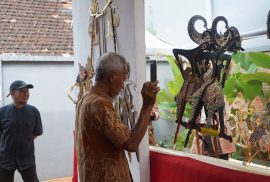
To conclude, this event featured a Menak golek puppet show entitled “Menak Iskandar” by Dr. Rudy Wiratama, S.I.P., M.A. The story is sourced from Serat Iskandar Jawi or Caritanira Iskandar, which was composed at the Kartasura Palace in 1729 AD by order of Kangjeng Ratu Mas Balitar, the queen consort of Pakubuwana I.

The story tells of the journey of Prabu Iskandar Zulkarnain, King of Ngerum, in his efforts to conquer the eastern and western worlds in order to spread the teachings of the Prophet Ibrahim. However, his struggle was hindered by King Ubur of Jabarsah and the army of giant worshippers Ya’juj and Ma’juj. Based on the advice of Prophet Kilir, Iskandar built a great wall that enclosed Ja-Makjuja until the end of time. Nevertheless, Iskandar was still worried that Ja-Makjuja would escape one day. He asked Prophet Kilir for the elixir of life. Prophet Kilir then departed for the land of Lulmat in the country of Jaminambar, where a lake called Ma’ul Hayat was located. Next, Prophet Kilir drank the water, performed ablution, and prayed at the edge of the lake. After finishing his prayers, by God’s will, Prophet Kilir gained immortality without having the chance to give the water to Iskandar. Iskandar, who was waiting for Prophet Kilir at the cave entrance, then realized that no power is eternal except that of Allah. He returned to the kingdom of Ngerum with his entire army.

This workshop is a tangible manifestation of academic and cultural efforts to revive Menak puppet theater as a literary and performing arts heritage in Indonesia. Through this activity, it is hoped that cross-disciplinary awareness can be built regarding the importance of preserving traditions while developing new forms that are relevant to the present day. Furthermore, the synergy between academics, artists, and the community is expected to continue to be encouraged so that Menak puppet theater art and literature remain a source of inspiration, cultural identity, and a living educational tool within the community.

Author : Haryo Untoro
Editor : Haryo Untoro

KMIB FIB UGM Holds “Rabita”: Environmental Hygiene Education with Orphanage Children

HEADLINESNews ReleaseStudent's Activity Tuesday, 4 November 2025

Yogyakarta, October 26, 2025 – The Muslim Family of Cultural Sciences (Keluarga Muslim Ilmu Budaya – KMIB) from the Faculty of Cultural Sciences (FIB), Universitas Gadjah Mada (UGM), successfully held a social service event titled “Rabita: Raih Berkah, Bagikan Cinta” (Gain Blessings, Share Love) at the Lembaga Kesejahteraan Sosial Anak (LKSA – Child Social Welfare Institution) Omah Ngaji Jogja. This year, the Rabita activity adopted the theme of “Environmental Hygiene” as a form of student concern for the importance of cleanliness and environmental sustainability, while also realizing the spirit of community service.

The event was attended by KMIB members, administrators and fostered children of LKSA Omah Ngaji, as well as students participating in the KMIB Soft Skills class. Their presence added to the spirit of togetherness and strengthened the value of mutual cooperation (gotong royong) throughout the series of activities. The event proceeded with great enthusiasm and cheerfulness, reflecting the collaborative spirit between the students, administrators, and the fostered children of LKSA Omah Ngaji in carrying out social activities.

The series of activities included education on waste sorting, tree planting, and an interactive activity of painting trash bins. Through these activities, KMIB FIB UGM aimed to cultivate awareness of the importance of cleanliness and environmental sustainability from an early age, while creating a fun and memorable learning experience for the children.

Dian Patmisari, the Chief Executive of Rabita, explained that the program not only focused on environmental cleanliness but also instilled humanitarian values, gratitude, and social concern. She stated that Rabita: Gain Blessings, Share Love is a manifestation of gratitude and care from the KMIB extended family towards others, as well as a means to strengthen kinship (silaturahmi) and foster the spirit of Islamic brotherhood (ukhuwah Islamiyah) among students.

More than just a social activity, Rabita served as a platform for FIB UGM students to channel positive energy and strengthen the spirit of community service (one of the Three Pillars of Higher Education – tri dharma perguruan tinggi). Through the theme of “environmental hygiene,” this initiative instilled the awareness that maintaining cleanliness is part of worship and a shared responsibility as the nation’s next generation.

The administrators of LKSA Omah Ngaji Jogja welcomed the implementation of Rabita and appreciated the attention and concern of KMIB FIB UGM for their fostered children. Events like this can provide emotional and educational benefits for the children, as besides fostering environmental awareness, they also instill the value of togetherness and cheerfulness through direct interaction with the students.

The Rabita: Gain Blessings, Share Love activity also supports the achievement of the Sustainable Development Goals (SDGs), specifically SDG 3 (Good Health and Well-being) through efforts to create a clean environment, SDG 4 (Quality Education) by providing environmental education to the fostered children, SDG 11 (Sustainable Cities and Communities) through concrete action to maintain cleanliness and green the environment, SDG 13 (Climate Action) through tree planting and natural preservation education, and SDG 17 (Partnerships for The Goals) through collaboration between FIB UGM students and LKSA Omah Ngaji Jogja.

(KMIB FIB UGM, Hilmi Anugerah Alghani)

12345…36

Video UGM

[shtmlslider name='shslider_options']
Universitas Gadjah Mada

Faculty of Cultural Sciences
Universitas Gadjah Mada
Jl. Nusantara 1, Bulaksumur Yogyakarta 55281, Indonesia
   fib@ugm.ac.id
   +62 (274) 513096
   +62 (274) 550451

Work Units

  • Office of Journal & Publishing
  • INCULS
  • Information Technology and Database
  • Language Learning Center
  • Library Unit
  • Public Relations
  • Research

Facilities

  • Computer Laboratory
  • Gamelan
  • Guest House
  • Language Library
  • Library
  • Phonetics Library
  • Self Access Unit
  • Student Internet Centre

Importan Links

  • Journal of Humaniora
  • Subscriber Journal
  • Alumni Portal
  • Career
  • Departmens News
  • UGM Streaming

Contacts

  • Academic
  • Administration
  • Dean’s Office
  • Departments / Study Programs
  • Public Relations

© 2024 Faculty of Cultural Sciences Universitas Gadjah Mada

KEBIJAKAN PRIVASI/PRIVACY POLICY

[EN] We use cookies to help our viewer get the best experience on our website. -- [ID] Kami menggunakan cookie untuk membantu pengunjung kami mendapatkan pengalaman terbaik di situs web kami.I Agree / Saya Setuju