• About UGM
  • Academic Portal
  • IT Center
  • Library
  • Research
  • Webmail
  • Informasi Publik
  • English
    • Indonesia
Universitas Gadjah Mada Faculty of Cultural Sciences
Universitas Gadjah Mada
  • Home
  • Profile
    • History
    • Vision and Mission
    • Organizational structure
    • Administration
    • Staff
    • Faculty Members
  • Academic
    • Academic Calendar
    • Undergraduate Programs
      • Bachelor of Cultural Antrophology
      • Bachelor in Archaeolagy
      • Bachelor in History
      • Bachelor in Tourism
      • Bochetor in Korean Language and Culture
      • Bachelor in Indonesian Language and Culture
      • Bachelor in English
      • Bachelor in Arabic
      • Bachelor in Japanese Language and Culture
      • Bachelor in Javanese Language, Literature and Culture
      • Bachelor in French language and literature
    • Graduate Programs
      • Master in Antrophology
      • Master in ArchaeoIogy
      • Master in History
      • Master in Linguistics
      • Master in Literature
      • Master In American Studies
      • Master in Middle Eastern Cultural Studies
    • Post-Graduate Programs / S3
      • Doctor in Antropology
      • Doctor in American Studies
      • Doctor in Humanities
    • Student Service
  • KPPM
    • Research Information
    • Scientific / Academic Publications
    • Community Service
    • International Cooperation
    • Domestic Cooperation
  • Student Organizations
    • Student Executive Council
    • Semi-Autonomous Organizations
      • KAPALASASTRA
      • Christian Student Alliance
      • LINCAK
      • Saskine
      • Catholic Student Family
      • Dian Budaya
      • Sastra Kanuragan (sasgan)
      • Family of Muslim Cultural Sciences Students (KMIB)
      • Bejo Mulyo
    • Autonomous Organizations
      • Family of Anthropology Students (KEMANT)
      • English Department Student Association
      • Tourism Students Association (HIMAPA)
      • Family of Indonesian Literature Students (KMSI)
      • West Asian Literature Student Association (IMABA)
      • Association of Korean-Language Students (HIMAHARA)
      • Family of Regional Indonesian Literatures Students (KAMASUTRA)
      • The Family Body of History Students (BKMS)
      • The French Literature Students Association (HMSP)
      • Family of Anthropology Students
      • Japanese Student Association (HIMAJE)
  • Admission
    • Student Evaluation
  • Home
  • SDGs 1: No Poverty
  • SDGs 1: No Poverty
Arsip:

SDGs 1: No Poverty

UGM Inaugurates Professor Mutiah Amini, Highlights Urban Social Space Realities

News Release Wednesday, 22 April 2026

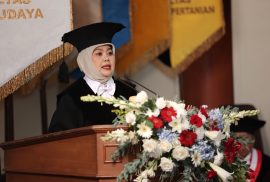
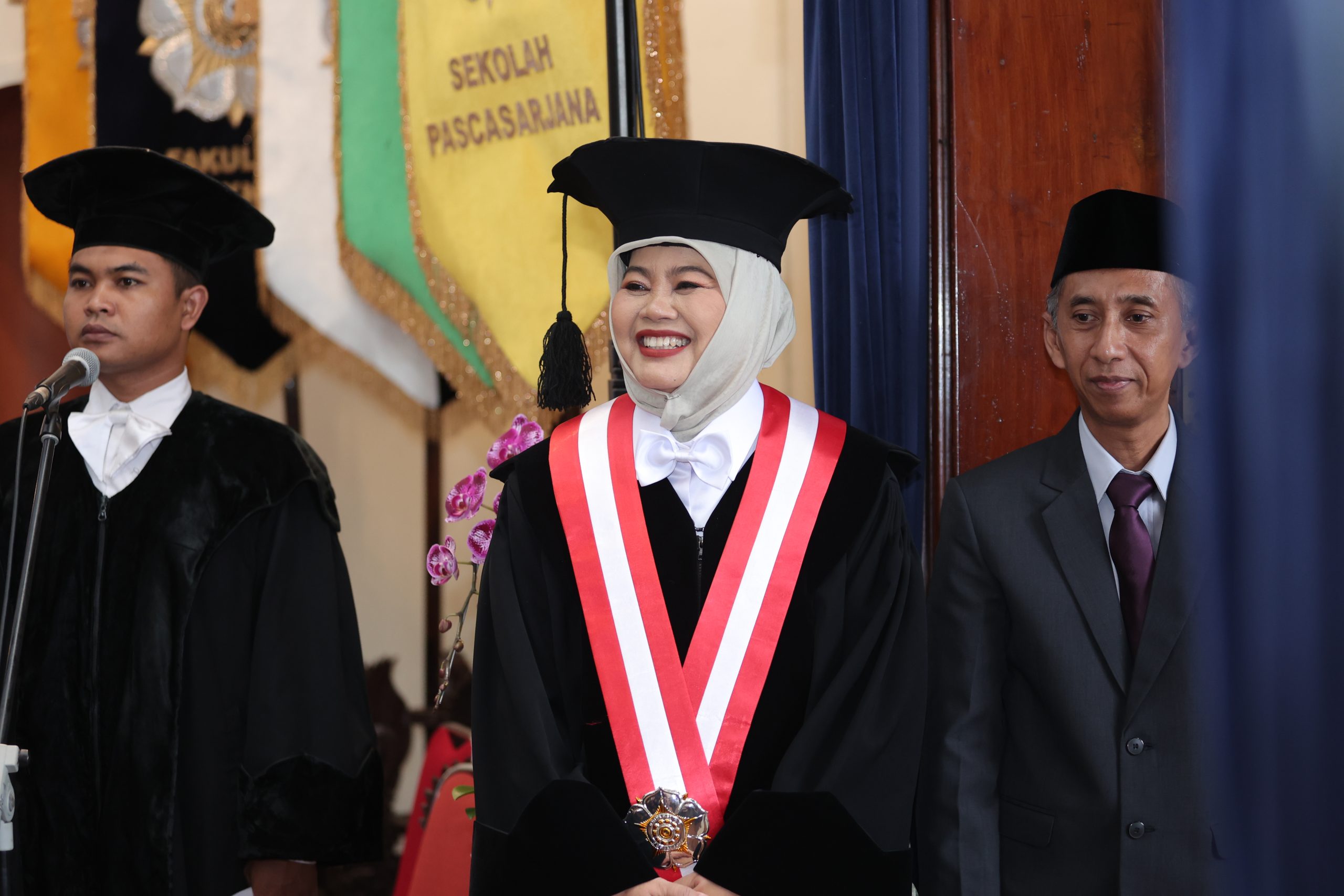
Yogyakarta, April 21, 2026 — Universitas Gadjah Mada (UGM) inaugurated Prof. Dr. Mutiah Amini, M.Hum. as a Professor of Urban Social History at the Faculty of Cultural Sciences. The inauguration ceremony took place at the UGM Central Building. In her inaugural speech, Professor Amini sharply highlighted the gap between city comfort slogans and the reality of the residents’ social spaces.

The inaugural speech was titled “History and Citizens’ Imagination of Urban Social Space.” Professor Amini chose the word imagination as a reflection of various social phenomena in contemporary public spaces. She observed the contradiction between citizens sleeping on the streets seeking pity and the various prideful acronyms used by city governments. Slogans such as Bandung Bermartabat, Semarang Kota ATLAS, Surabaya HEBAT, and Yogyakarta Berhati Nyaman seem to imply the promise of a perfect urban space to live in.

“From this reflection, it is certainly important to question whether the abbreviations or acronyms created remain the aspiration of all city governments and their citizens today. Or conversely, are these acronyms merely a fleeting hope?” explained Professor Amini, introducing her ideas.

Professor Amini then referred to Kartini’s thoughts on comfortable urban spaces as a starting point for discussion. She explained that the idea of creating urban social spaces since the colonial era has actually brought significant impacts that are often overlooked. Society became increasingly aware of the boundaries between private and public spaces. The function of the house during modernization slowly shifted. Houses often lost their role as a place that provides comfort and a sense of belonging for families, turning simply into a physical space for temporary shelter.

Citizens’ imagination of a healthy and harmonious urban space continued to live on until the independence period. The complexity of public spaces raised various concerns regarding floods, evictions, and domestic and industrial waste issues. The middle class then used mass media to voice their resignation through opinion columns. Pleas such as “where should we turn” commonly appeared in newspapers to demand the restoration of lakes and other public spaces.

Unlike the middle class, the urban poor had their own way of realizing their collective imagination. This group tended to occupy available urban public spaces. Professor Amini cited Lefebvre’s view, which refers to this phenomenon as a space of representation. The space is brought to life through various symbols and imaginations of its users as a way to manifest the collective memory of city residents.

Historical facts show that Kartini had thought about urban humanitarian and social issues comprehensively since over a century ago. Professor Amini emphasized this as an important self-criticism for modern-era historians. Kartini paved the way for the idea that all government policy formulations must be drafted carefully and comprehensively.

Urban regional planning ultimately demands a balance between physical development and the fulfillment of basic human rights. The provision of an aesthetic, harmonious, and healthy living space is an absolute prerequisite for the sustainability of a just social system. Inclusive spatial planning policies are the main key to ensuring a city is truly capable of supporting and adequately protecting all its residents for future generations.

[Public Relations of FIB UGM, Candra Solihin]

Inaugurated as Professor of Agrarian History, Prof. Nur Aini Setiawati Highlights Comparisons Between Indonesia and Korea

HEADLINESNews Release Wednesday, 15 April 2026

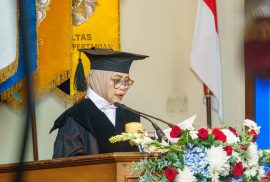
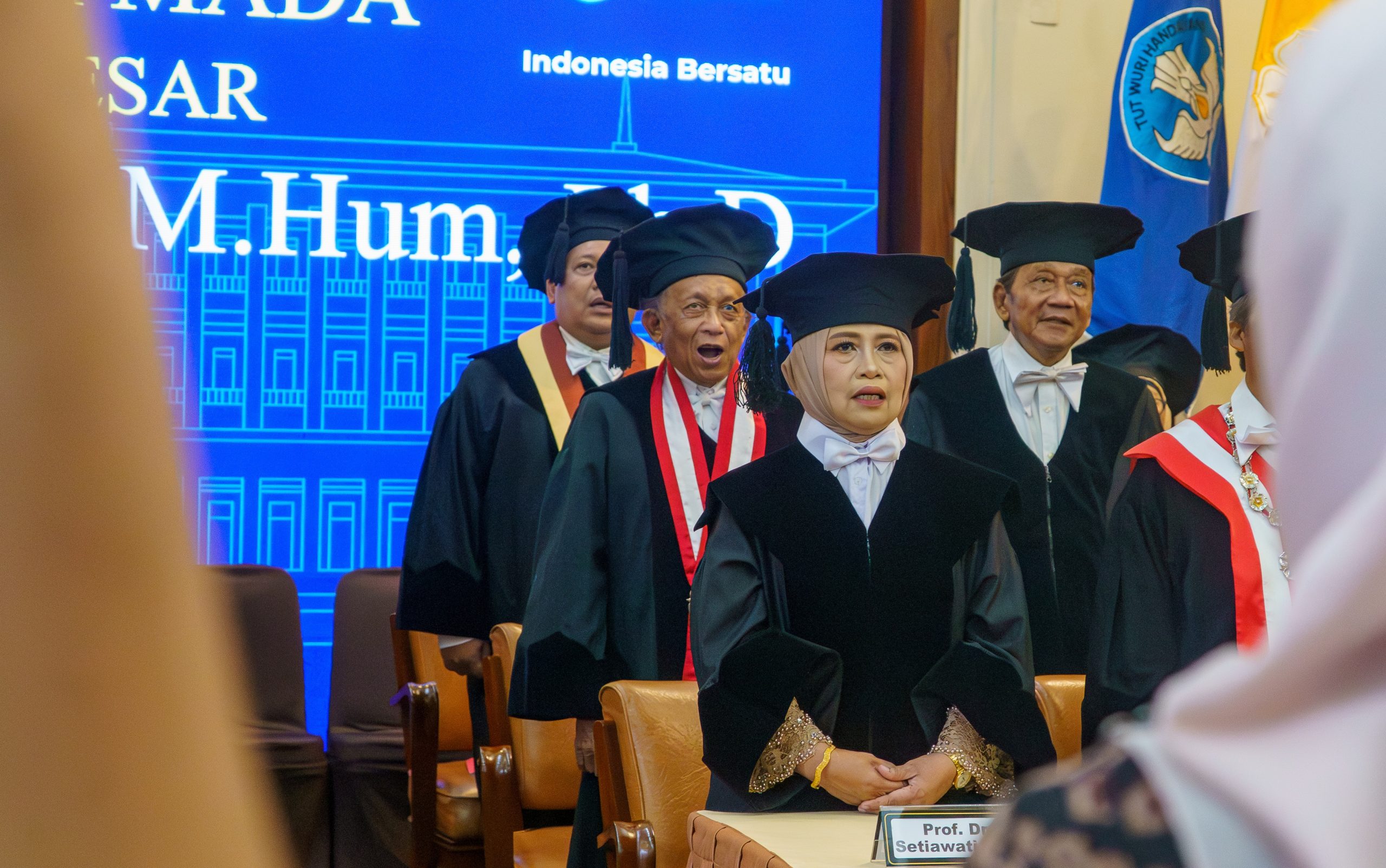
Universitas Gadjah Mada (UGM) has officially inaugurated Professor Dr. Nur Aini Setiawati, M.Hum., Ph.D., as a Professor of Agrarian History at the Faculty of Cultural Sciences. The inauguration ceremony took place at the UGM Central Building on Tuesday, April 14, 2026. In her inauguration speech, she analyzed the dynamics of agrarian reform and its impact on agricultural development through a comparative study between Indonesia and South Korea.

Professor Setiawati delivered a speech titled “From Agrarian Phenomena to Agricultural Development: Indonesia and Korea.” She emphasized that land ownership and control are key factors in determining the success of a country’s development. Using a chronological and thematic historical approach, she evaluated how changes in agricultural production have been heavily influenced by land policies of the past.

“Agrarian reform plays a crucial role in agricultural development. By understanding agrarian issues, this study evaluates changes in agricultural production. The main problem to be addressed in this speech is how the impact of agrarian reform on agricultural development can be re-examined, considering that the issues of agrarian reform and agricultural development since the era of kingdoms have always been a compelling subject,” stated Professor Setiawati in her speech.

In her presentation, she explained South Korea’s success in implementing agrarian reform between 1945 and 1950. The policy successfully increased agricultural productivity by providing incentives to farmers. Consequently, the Korean agricultural sector was able to provide a stable food supply amidst waves of industrialization and urbanization. Furthermore, this reform contributed to the formation of an educated working class and encouraged the emergence of a new capitalist class.

A different situation occurred during the period of 1960 to 1984. Professor Setiawati revealed that Indonesia tended to be trapped in ideological conflicts and weak bureaucracy. National industrialization in Indonesia was not aligned with land reform. Instead, land procurement for industry actually strengthened the concentration of land control by the state and corporations. On the other hand, South Korea placed agrarian reform as the main foundation of their national industrialization.

The failure to equalize land ownership in Indonesia was also triggered by a lack of supervision and resistance from local elites. This stands in stark contrast to South Korea, which successfully distributed land evenly thanks to strong institutional support, such as cooperatives and village development programs. The impact can be seen in farmers’ welfare, where South Korea achieved rice self-sufficiency while Indonesia experienced stagnation due to structural inequality.

These findings indicate that consistent agrarian governance is the main differentiator in transforming land challenges into developmental strengths. Agrarian reform is not merely an economic policy, but a historical process that reflects power relations and the future direction of a nation.

This historical record serves as an important reflection for current policy formulation. Inclusive management of agrarian resources is an absolute prerequisite for ensuring food sovereignty and public welfare in the future. Through the continuity of appropriate policies and social legitimacy, land justice is expected to become an engine of development that provides tangible benefits to all levels of society fairly and equitably.

[Public Relations of FIB UGM, Candra Solihin]

FIB UGM Humanities Research Review Highlights Political Prophecies and Agrarian Conflicts

News Release Friday, 10 April 2026

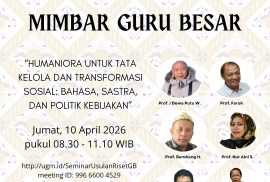
Yogyakarta, April 19, 2026 – The Faculty of Cultural Sciences at Universitas Gadjah Mada (FIB UGM) held the first session of the Professorial Forum titled “Humanities for Governance and Social Transformation: Language, Literature, and Policy Politics.” This academic forum reviewed several proposals and research plans from academics that addressed various strategic issues, ranging from the dynamics of political legitimacy and customary land conflicts to the urgency of forensic linguistics in law enforcement.

The Vice Dean for Research, Community Service, and Alumni at FIB UGM, Dr. Mimi Savitri, emphasized that the theme of this forum aligned with the faculty’s research roadmap. She encouraged researchers to formulate their proposed studies into strategic recommendations for future policymakers.

“The goal is to determine how existing research can be recommended as policy briefs. We hope FIB can make a significant contribution,” said Dr. Savitri during her opening remarks.

She added that the forum intentionally invited doctoral students to motivate them and provide a concrete overview of how to draft a dissertation research proposal.

Moving into the presentation session, Professor Bambang Hudayana presented a research proposal titled “Prophecies on the Legitimacy and Delegitimacy of Indonesian Presidents.” He planned a study to examine how the leadership of Presidents Joko Widodo and Prabowo Subianto intersects with narratives of political prophecies or divine mandates (wangsit) on social media. Through this proposal, Professor Hudayana intends to combine the concept of Javanese power cosmology with networked religion theory. This research plan will explore how political prophecies express the spiritual hopes of the public while also serving as a symbolic instrument to either legitimize or delegitimize the power of leaders.

In the second presentation, Dr. Nur Aini Setiawati reviewed a draft book titled “Customary Land in Indonesia: Policy Politics and the Dynamics of Agrarian Conflict in the 20th Century.” This book draft seeks to bridge normative legal studies and social movement studies regarding agrarian conflicts. Dr. Setiawati explained that agrarian disputes are essentially a clash of two perspectives. There is the communal understanding of society, which views land as a generational living space, colliding with the state’s view of land as a legal and administrative object. Therefore, this book draft will uncover the history of state policy formation and its social consequences at the local level, which frequently trigger the loss of community access to customary territories.

The third presentation featured a linguistic perspective from Professor I Dewa Putu Wijana through a research plan titled “Linguistics and Forensic Linguistics.” He designed this study to respond to social interactions in the digital era, which often give rise to disharmony and verbal abuse. The research plan emphasizes that as public legal awareness increases, forensic linguistics will take on a central role. This applied linguistics approach is projected to resolve various cases of language-based crimes by utilizing branches of linguistics such as phonology, morphology, syntax, semantics, pragmatics, and sociolinguistics.

The various drafts of academic works originating from this forum demonstrate the strong commitment of the humanities in formulating a foundation for solving societal problems. Thorough research planning related to language, culture, and history is highly essential for establishing equitable public governance. Ultimately, the effort to prepare this humanity-based research is expected to help reduce inequalities in living spaces, create an ethical communication climate, and encourage the development of more peaceful and resilient social institutions for the future.

[Public Relations of FIB UGM, Candra Solihin]

Inspiring Journey of Deni, a Farm Worker’s Son Named UGM’s Top Outstanding Student 2026

News Release Wednesday, 8 April 2026

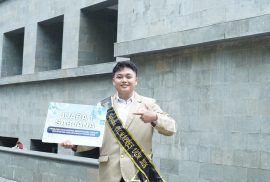
His family’s financial limitations did not deter Deni from achieving remarkable milestones. Coming from a family of farm workers, he was named the 1st Place Outstanding Student (Mapres) of the Undergraduate Program at Universitas Gadjah Mada (UGM) in 2026. He achieved this success through his persistence in securing various prestigious awards and his dedication to designing inclusive literature concepts for persons with disabilities.

Deni stated that his main motivation stemmed from his family’s condition. Both of his parents only graduated from elementary school. He wanted to prove that financial constraints are not an obstacle to dreaming big. His participation in this prestigious competition was an effort to realize his parents’ dreams while expanding the impact of the social initiatives he is currently developing.

“I dedicate this achievement to my mother and my late father, who, despite having only an elementary school education, managed to send their son to study at UGM with a scholarship,” expressed Deni.

The journey to becoming UGM’s 1st Place Outstanding Student required time and careful preparation. Deni began his preparations during his first semester in the Indonesian Language and Literature Study Program with immense gratitude. For five consecutive semesters, this recipient of the Beasiswa Indonesia Maju (BIM) scholarship actively participated in various competitions. He successfully accumulated ten exceptional achievements, comprising six certified international awards and four certified national awards.

The biggest challenge he faced during the Outstanding Student Selection (Pilmapres) was maintaining consistency. Participants in this competition are required to excel academically while building confidence and demonstrating their overall personal qualities. Deni enjoyed the entire process because the existing obstacles actually shaped his mentality to become stronger. He then registered at the exact right time when he felt completely ready.

Deni believes that students have a strategic role as agents of change for society. During his studies, he has been actively involved in empowerment activities. In his field of literature, Deni highlighted the persisting accessibility gap for individuals with hearing impairments in enjoying literary works.

Driven by this concern, he developed a creative idea regarding the development of inclusive literature through poetry learning. He wants literature to become a space for expression as well as a welcoming environment for everyone without exception.

In managing his schedule, Deni applied the SMART method from the beginning of his studies to ensure every target was specific, measurable, achievable, relevant, and time-bound. This method helped him map out his priorities among his studies, competitions, and other activities on a weekly basis. He applied self-directed learning principles to stay focused on his ultimate goals.

“Identify your priorities and goals, create realistic plans, and enjoy the process. It is better to fail than to never try at all,” Deni advised other students. According to him, readiness can be built every day to welcome various future opportunities.

For Deni, the title of UGM’s 1st Place Outstanding Student in 2026 is a mandate to continue growing and to provide broad meaning to society. He plans to realize his inclusive literature concept through collaboration with various relevant parties so that literacy for deaf individuals can become a tangible reality. He firmly holds to the principle that success requires a consistent process.

“You do not have to be fast to be great; what matters is moving forward with determination,” he asserted.

Deni’s story carries a strong message about the importance of creating equal educational and literacy spaces for all levels of society. The effort to provide fair access for disability groups is a crucial stepping stone in building a just civilization, where every individual has an equal opportunity to develop and contribute to the future.

[Public Relations of FIB UGM, Candra Solihin]

INCULS Students Visit DIY Parliament Building and Governor’s Office: Learning Indonesian Politics in the Context of Sustainable Development

HEADLINESNews ReleaseSDGs 11: Sustainable cities and communitiesSDGs 17: Partnerships for the GoalsSDGs 1: No povertySDGs 4: Quality Education Monday, 28 April 2025

Yogyakarta, 22/04/2025 – As part of an effort to deepen understanding of the dynamics of Indonesian politics, Indonesian Culture and Language Study (INCULS) students visited the Yogyakarta Special Region (DIY) DPRD Building and the DIY Governor’s Office. The visit not only provided insight into the legislative and executive processes at the local level, but also implicitly touched on the principles of sustainable development, particularly in terms of inclusive, transparent and accountable governance.

During the visit to the DPRD DIY, INCULS students discussed with the lecturers the role of the legislature in public policy making. They highlighted the importance of community participation in the political process, which is in line with peace processes that emphasize effective, inclusive and transparent governance. At the Governor’s Office, INCULS students had the opportunity to tour and hear about the challenges and strategies of development in Yogyakarta. Topics such as cultural preservation, poverty alleviation, and improving access to education were discussed. The DIY government emphasized the importance of collaboration between academics, communities, and policy makers to achieve sustainable development. Youth and students play a key role in driving innovation and monitoring public policies.

The visit not only enriched students’ understanding of Indonesian politics, but also made them realize that good public policy is the foundation of achieving the SDGs. By understanding the democratic process and governance, INCULS students are expected to become agents of change who promote sustainable development, both locally and globally. Politics is not just about power, but a tool to realize sustainable social and environmental justice. This activity is proof that political education and awareness of sustainable development must go hand in hand to create a better future. 

[Public Relation of INCULS, Thareeq Arkan Falakh]

123…5

Video UGM

[shtmlslider name='shslider_options']
Universitas Gadjah Mada

Faculty of Cultural Sciences
Universitas Gadjah Mada
Jl. Nusantara 1, Bulaksumur Yogyakarta 55281, Indonesia
   fib@ugm.ac.id
   +62 (274) 513096
   +62 (274) 550451

Work Units

  • Office of Journal & Publishing
  • INCULS
  • Information Technology and Database
  • Language Learning Center
  • Library Unit
  • Public Relations
  • Research

Facilities

  • Computer Laboratory
  • Gamelan
  • Guest House
  • Language Library
  • Library
  • Phonetics Library
  • Self Access Unit
  • Student Internet Centre

Importan Links

  • Journal of Humaniora
  • Subscriber Journal
  • Alumni Portal
  • Career
  • Departmens News
  • UGM Streaming

Contacts

  • Academic
  • Administration
  • Dean’s Office
  • Departments / Study Programs
  • Public Relations

© 2024 Faculty of Cultural Sciences Universitas Gadjah Mada

KEBIJAKAN PRIVASI/PRIVACY POLICY

[EN] We use cookies to help our viewer get the best experience on our website. -- [ID] Kami menggunakan cookie untuk membantu pengunjung kami mendapatkan pengalaman terbaik di situs web kami.I Agree / Saya Setuju