
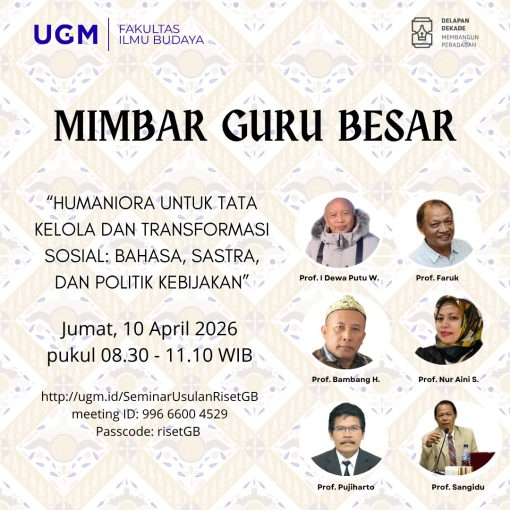
Yogyakarta, April 19, 2026 – The Faculty of Cultural Sciences at Universitas Gadjah Mada (FIB UGM) held the first session of the Professorial Forum titled “Humanities for Governance and Social Transformation: Language, Literature, and Policy Politics.” This academic forum reviewed several proposals and research plans from academics that addressed various strategic issues, ranging from the dynamics of political legitimacy and customary land conflicts to the urgency of forensic linguistics in law enforcement.
The Vice Dean for Research, Community Service, and Alumni at FIB UGM, Dr. Mimi Savitri, emphasized that the theme of this forum aligned with the faculty’s research roadmap. She encouraged researchers to formulate their proposed studies into strategic recommendations for future policymakers.
“The goal is to determine how existing research can be recommended as policy briefs. We hope FIB can make a significant contribution,” said Dr. Savitri during her opening remarks.
She added that the forum intentionally invited doctoral students to motivate them and provide a concrete overview of how to draft a dissertation research proposal.
Moving into the presentation session, Professor Bambang Hudayana presented a research proposal titled “Prophecies on the Legitimacy and Delegitimacy of Indonesian Presidents.” He planned a study to examine how the leadership of Presidents Joko Widodo and Prabowo Subianto intersects with narratives of political prophecies or divine mandates (wangsit) on social media. Through this proposal, Professor Hudayana intends to combine the concept of Javanese power cosmology with networked religion theory. This research plan will explore how political prophecies express the spiritual hopes of the public while also serving as a symbolic instrument to either legitimize or delegitimize the power of leaders.
In the second presentation, Dr. Nur Aini Setiawati reviewed a draft book titled “Customary Land in Indonesia: Policy Politics and the Dynamics of Agrarian Conflict in the 20th Century.” This book draft seeks to bridge normative legal studies and social movement studies regarding agrarian conflicts. Dr. Setiawati explained that agrarian disputes are essentially a clash of two perspectives. There is the communal understanding of society, which views land as a generational living space, colliding with the state’s view of land as a legal and administrative object. Therefore, this book draft will uncover the history of state policy formation and its social consequences at the local level, which frequently trigger the loss of community access to customary territories.
The third presentation featured a linguistic perspective from Professor I Dewa Putu Wijana through a research plan titled “Linguistics and Forensic Linguistics.” He designed this study to respond to social interactions in the digital era, which often give rise to disharmony and verbal abuse. The research plan emphasizes that as public legal awareness increases, forensic linguistics will take on a central role. This applied linguistics approach is projected to resolve various cases of language-based crimes by utilizing branches of linguistics such as phonology, morphology, syntax, semantics, pragmatics, and sociolinguistics.
The various drafts of academic works originating from this forum demonstrate the strong commitment of the humanities in formulating a foundation for solving societal problems. Thorough research planning related to language, culture, and history is highly essential for establishing equitable public governance. Ultimately, the effort to prepare this humanity-based research is expected to help reduce inequalities in living spaces, create an ethical communication climate, and encourage the development of more peaceful and resilient social institutions for the future.
[Public Relations of FIB UGM, Candra Solihin]
