• About UGM
  • Academic Portal
  • IT Center
  • Library
  • Research
  • Webmail
  • Informasi Publik
  • English
    • Indonesia
Universitas Gadjah Mada Faculty of Cultural Sciences
Universitas Gadjah Mada
  • Home
  • Profile
    • History
    • Vision and Mission
    • Organizational structure
    • Administration
    • Staff
    • Faculty Members
  • Academic
    • Academic Calendar
    • Undergraduate Programs
      • Bachelor of Cultural Antrophology
      • Bachelor in Archaeolagy
      • Bachelor in History
      • Bachelor in Tourism
      • Bochetor in Korean Language and Culture
      • Bachelor in Indonesian Language and Culture
      • Bachelor in English
      • Bachelor in Arabic
      • Bachelor in Japanese Language and Culture
      • Bachelor in Javanese Language, Literature and Culture
      • Bachelor in French language and literature
    • Graduate Programs
      • Master in Antrophology
      • Master in ArchaeoIogy
      • Master in History
      • Master in Linguistics
      • Master in Literature
      • Master In American Studies
      • Master in Middle Eastern Cultural Studies
    • Post-Graduate Programs / S3
      • Doctor in Antropology
      • Doctor in American Studies
      • Doctor in Humanities
    • Student Service
  • KPPM
    • Research Information
    • Scientific / Academic Publications
    • Community Service
    • International Cooperation
    • Domestic Cooperation
  • Student Organizations
    • Student Executive Council
    • Semi-Autonomous Organizations
      • KAPALASASTRA
      • Christian Student Alliance
      • LINCAK
      • Saskine
      • Catholic Student Family
      • Dian Budaya
      • Sastra Kanuragan (sasgan)
      • Family of Muslim Cultural Sciences Students (KMIB)
      • Bejo Mulyo
    • Autonomous Organizations
      • Family of Anthropology Students (KEMANT)
      • English Department Student Association
      • Tourism Students Association (HIMAPA)
      • Family of Indonesian Literature Students (KMSI)
      • West Asian Literature Student Association (IMABA)
      • Association of Korean-Language Students (HIMAHARA)
      • Family of Regional Indonesian Literatures Students (KAMASUTRA)
      • The Family Body of History Students (BKMS)
      • The French Literature Students Association (HMSP)
      • Family of Anthropology Students
      • Japanese Student Association (HIMAJE)
  • Admission
    • Student Evaluation
  • Home
  • News Release
  • UGM Inaugurates Professor Mutiah Amini, Highlights Urban Social Space Realities

UGM Inaugurates Professor Mutiah Amini, Highlights Urban Social Space Realities

  • News Release
  • 22 April 2026, 14.02
  • Oleh: Humas FIB
  • 0

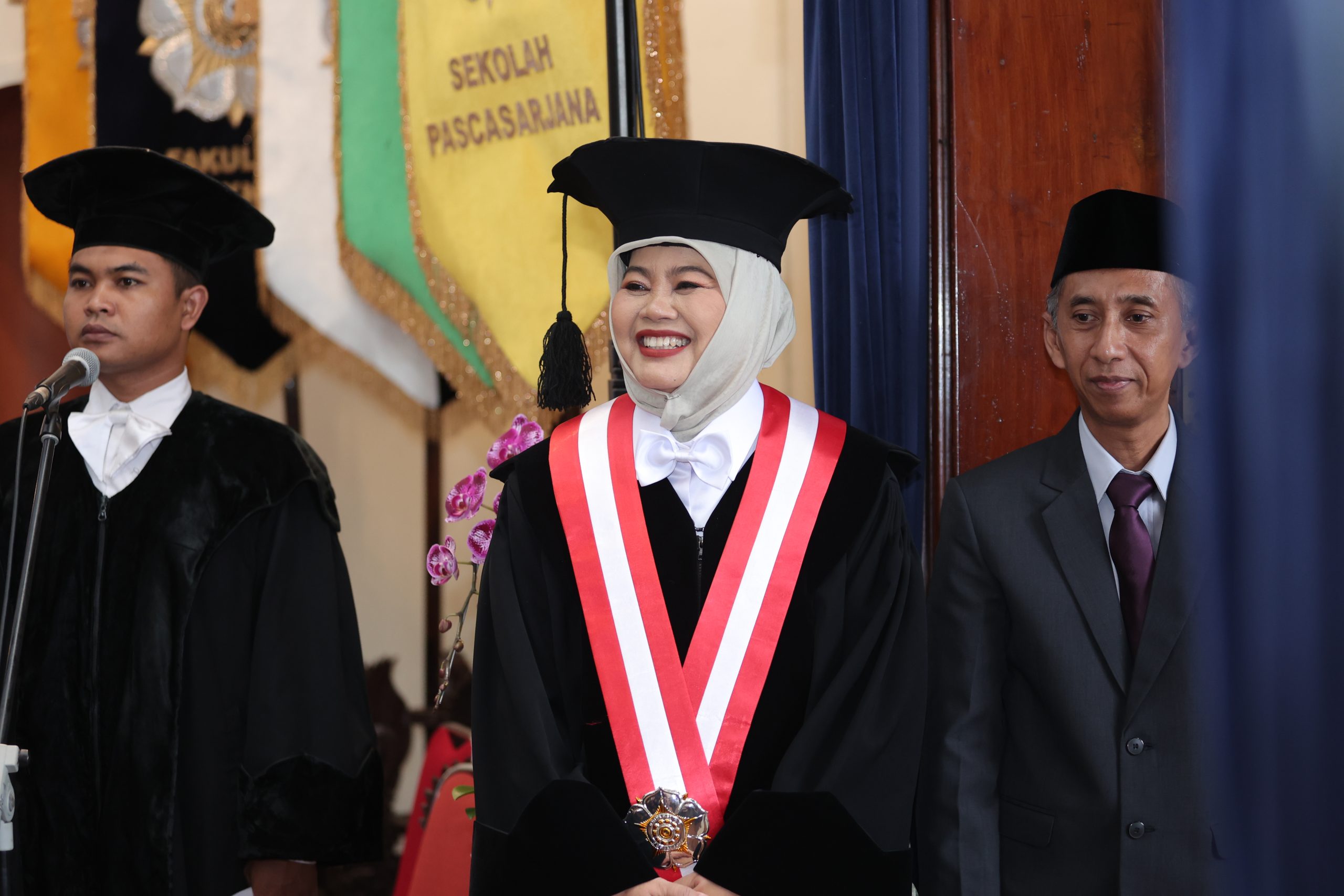
Yogyakarta, April 21, 2026 — Universitas Gadjah Mada (UGM) inaugurated Prof. Dr. Mutiah Amini, M.Hum. as a Professor of Urban Social History at the Faculty of Cultural Sciences. The inauguration ceremony took place at the UGM Central Building. In her inaugural speech, Professor Amini sharply highlighted the gap between city comfort slogans and the reality of the residents’ social spaces.

The inaugural speech was titled “History and Citizens’ Imagination of Urban Social Space.” Professor Amini chose the word imagination as a reflection of various social phenomena in contemporary public spaces. She observed the contradiction between citizens sleeping on the streets seeking pity and the various prideful acronyms used by city governments. Slogans such as Bandung Bermartabat, Semarang Kota ATLAS, Surabaya HEBAT, and Yogyakarta Berhati Nyaman seem to imply the promise of a perfect urban space to live in.

“From this reflection, it is certainly important to question whether the abbreviations or acronyms created remain the aspiration of all city governments and their citizens today. Or conversely, are these acronyms merely a fleeting hope?” explained Professor Amini, introducing her ideas.
Professor Amini then referred to Kartini’s thoughts on comfortable urban spaces as a starting point for discussion. She explained that the idea of creating urban social spaces since the colonial era has actually brought significant impacts that are often overlooked. Society became increasingly aware of the boundaries between private and public spaces. The function of the house during modernization slowly shifted. Houses often lost their role as a place that provides comfort and a sense of belonging for families, turning simply into a physical space for temporary shelter.

Citizens’ imagination of a healthy and harmonious urban space continued to live on until the independence period. The complexity of public spaces raised various concerns regarding floods, evictions, and domestic and industrial waste issues. The middle class then used mass media to voice their resignation through opinion columns. Pleas such as “where should we turn” commonly appeared in newspapers to demand the restoration of lakes and other public spaces.

Unlike the middle class, the urban poor had their own way of realizing their collective imagination. This group tended to occupy available urban public spaces. Professor Amini cited Lefebvre’s view, which refers to this phenomenon as a space of representation. The space is brought to life through various symbols and imaginations of its users as a way to manifest the collective memory of city residents.

Historical facts show that Kartini had thought about urban humanitarian and social issues comprehensively since over a century ago. Professor Amini emphasized this as an important self-criticism for modern-era historians. Kartini paved the way for the idea that all government policy formulations must be drafted carefully and comprehensively.

Urban regional planning ultimately demands a balance between physical development and the fulfillment of basic human rights. The provision of an aesthetic, harmonious, and healthy living space is an absolute prerequisite for the sustainability of a just social system. Inclusive spatial planning policies are the main key to ensuring a city is truly capable of supporting and adequately protecting all its residents for future generations.

[Public Relations of FIB UGM, Candra Solihin]

Tags: Department of History FIB UGM SDGs 10: Reduced Inequalities SDGs 11: Sustainable Cities and Communities SDGs 1: No Poverty UGM Yogyakarta

Video UGM

[shtmlslider name='shslider_options']
Universitas Gadjah Mada

Faculty of Cultural Sciences
Universitas Gadjah Mada
Jl. Nusantara 1, Bulaksumur Yogyakarta 55281, Indonesia
   fib@ugm.ac.id
   +62 (274) 513096
   +62 (274) 550451

Work Units

  • Office of Journal & Publishing
  • INCULS
  • Information Technology and Database
  • Language Learning Center
  • Library Unit
  • Public Relations
  • Research

Facilities

  • Computer Laboratory
  • Gamelan
  • Guest House
  • Language Library
  • Library
  • Phonetics Library
  • Self Access Unit
  • Student Internet Centre

Importan Links

  • Journal of Humaniora
  • Subscriber Journal
  • Alumni Portal
  • Career
  • Departmens News
  • UGM Streaming

Contacts

  • Academic
  • Administration
  • Dean’s Office
  • Departments / Study Programs
  • Public Relations

© 2024 Faculty of Cultural Sciences Universitas Gadjah Mada

KEBIJAKAN PRIVASI/PRIVACY POLICY

[EN] We use cookies to help our viewer get the best experience on our website. -- [ID] Kami menggunakan cookie untuk membantu pengunjung kami mendapatkan pengalaman terbaik di situs web kami.I Agree / Saya Setuju