• About UGM
  • Academic Portal
  • IT Center
  • Library
  • Research
  • Webmail
  • Informasi Publik
  • English
    • Indonesia
Universitas Gadjah Mada Faculty of Cultural Sciences
Universitas Gadjah Mada
  • Home
  • Profile
    • History
    • Vision and Mission
    • Organizational structure
    • Administration
    • Staff
    • Faculty Members
  • Academic
    • Academic Calendar
    • Undergraduate Programs
      • Bachelor of Cultural Antrophology
      • Bachelor in Archaeolagy
      • Bachelor in History
      • Bachelor in Tourism
      • Bochetor in Korean Language and Culture
      • Bachelor in Indonesian Language and Culture
      • Bachelor in English
      • Bachelor in Arabic
      • Bachelor in Japanese Language and Culture
      • Bachelor in Javanese Language, Literature and Culture
      • Bachelor in French language and literature
    • Graduate Programs
      • Master in Antrophology
      • Master in ArchaeoIogy
      • Master in History
      • Master in Linguistics
      • Master in Literature
      • Master In American Studies
      • Master in Middle Eastern Cultural Studies
    • Post-Graduate Programs / S3
      • Doctor in Antropology
      • Doctor in American Studies
      • Doctor in Humanities
    • Student Service
  • KPPM
    • Research Information
    • Scientific / Academic Publications
    • Community Service
    • International Cooperation
    • Domestic Cooperation
  • Student Organizations
    • Student Executive Council
    • Semi-Autonomous Organizations
      • KAPALASASTRA
      • Christian Student Alliance
      • LINCAK
      • Saskine
      • Catholic Student Family
      • Dian Budaya
      • Sastra Kanuragan (sasgan)
      • Family of Muslim Cultural Sciences Students (KMIB)
      • Bejo Mulyo
    • Autonomous Organizations
      • Family of Anthropology Students (KEMANT)
      • English Department Student Association
      • Tourism Students Association (HIMAPA)
      • Family of Indonesian Literature Students (KMSI)
      • West Asian Literature Student Association (IMABA)
      • Association of Korean-Language Students (HIMAHARA)
      • Family of Regional Indonesian Literatures Students (KAMASUTRA)
      • The Family Body of History Students (BKMS)
      • The French Literature Students Association (HMSP)
      • Family of Anthropology Students
      • Japanese Student Association (HIMAJE)
  • Admission
    • Student Evaluation
  • Home
  • American Studies
  • American Studies
  • page. 3
Arsip:

American Studies

National Seminar and Retirement of Prof. Ida Rochani Adi

News ReleaseSDGs 10: Reduced InequalitiesSDGs 16: Peace justice and strong institutionsSDGs 17: Partnerships for the GoalsSDGs 4: Quality EducationSDGs 8: Decent work and economic growth Monday, 10 June 2024

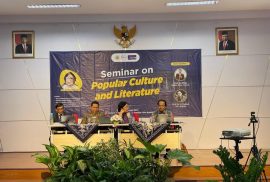
The Visiting Professor National Seminar organized by the American Studies Study Program, Faculty of Cultural Sciences on Monday, February 19, 2024 at the Auditorium of the Soegondo building, Faculty of Cultural Sciences, Universitas Gadjah Mada, is one of a series of events to commemorate the retirement of Prof. Ida Rochani Adi, S.U. The seminar was named “Seminar on Popular Culture and Literature” led by moderator: Dr. Herman Felani, M.A. with Prof. Ida who acted directly as Keynote Speaker. The National Seminar event also presented two professors, both of whom are alumni of the American Studies Program, Faculty of Cultural Sciences, UGM, namely Prof. Mister Gideon Maru from Universitas Negri Manado who acted as the first presenter and Prof. Nuriadi from Mataram University who acted as the second presenter. Both Prof. Gidion and Prof. Nuriadi discussed the social society’s view on the phenomenon of American popular culture and literature and its influence in Indonesia.

According to the view of the speakers at the seminar, literature is something that is always synonymous with “fiction”, “the result of fantasy”, “imagination”, and “fabrications” made up by the author. Although not wrong, this view tends to “degrade” literature as a creative work, and a science in the social humanities. In fact, in a deeper sense, literary works are expressions of feelings, thoughts, views on life, character principles, and ideal visions of life that are owned or dreamed of by a writer either in the form of “fiction” (novels, short stories, folklore, legends, etc.), or “non-fiction” (letters, essays, speeches, biographies, autobiographies, etc.). This discussion can be seen from the themes discussed by the speakers: American Literature in the Puritan Era as well as Popular Culture. The extraordinary discussion was closed with comments from Prof. Ida, then continued with the giving of souvenirs and certificates for moderators and presenters as well as group photos.

In addition to the Seminar in Popular Culture and Literature, another agenda that attracted literature enthusiasts in the series of Prof. Ida Rochadi Adi, S.U.’s After-Duty events was the Book Review [R]EVOLUTION OF SASTRA IN THE DIGITAL ERA: Theoretical and Historical Perspectives whose author is none other than Prof. Ida herself. The agenda, which began at 10.30 at the same place and date, was also one of a series of retirement events for Prof. Dr. Ida Rochani Adi, S.U. Guided by two other moderators, Dr. Anna Sriastuti, M.Hum. from Satya Wacana Christian University, Salatiga and Dr. Rif’ah Innayati, M.A. from Trunojoyo University, Madura. Both explained that the book aims to respond to technological developments that are able to change the mature order of one discipline. While trying to capture the lament of a discipline that faces the dilemma of technological change, the book also tries to offer a framework of thought in responding to the development of the digital world in the world of literature using theoretical and historical perspectives. In addition to providing food for thought and contemplation, the book also provides new ideas on the phenomenon of literary works in the development of the digital world in the modern era. Finally, both speakers strongly recommended reading the book because it can really open up thoughts about literature in the digital era.

Public Lecture: Globalization, Nationalism, and Cosmopolitanism by Prof. Carla Jones, Ph.D.

News ReleaseSDGs 11: Sustainable cities and communitiesSDGs 16: Peace justice and strong institutionsSDGs 17: Partnerships for the GoalsSDGs 4: Quality EducationSDGs 9: Industry innovation and infrastructure Monday, 10 June 2024

On Wednesday, April 25, 2024, the UGM Master of American Studies Program held a Public Lecture on the theme of Globalization, which was presented by Prof. Carla Jones, Ph.D, Professor of Anthropology at the University of Colorado Boulder, United States. This public lecture was held online through the Zoom application which was attended by 20 students who were a combination of students of the Master of American Studies Program and the Middle Eastern Cultural Studies Program, Faculty of Cultural Sciences UGM. In this session, the topic raised in the discussion was “Globalization, Nationalism, and Cosmopolitanism”, which discussed how the impact of globalization on nationalism. The occurrence of mutual influence and the fading of borders between countries causes questions about nationalism.

Prof. Carla explained that in the era of Globalization, it creates a zone of continuous cultural interaction and exchange throughout the world, which can also be referred to as “ecumenism of globalization”. Globalization also creates a situation where previously isolated cultures are constantly colliding. The impact of this global cultural flow is: Homogeneity and cultural chaos. Homogeneity in this context refers to the commonalities that arise when cultures share ideas, goods and media. This then creates confusion and challenges due to the mixing and similarity of cultures.

In addition to this, Prof. Carla also explained about the concept of globalization from Arjun Appadurai, an Indian-American anthropologist. He explained, according to Appadurai, there are five dimensions of cultural flow in globalization: Ethnoscapes (movement or movement of people such as tourists, refugees etc.), Technoscapes: (the movement of technology such as factories, machines, etc.), Financescapes (the movement of money), Mediascapes (the movement of information and images such as TV, newspapers, etc.), Ideoscapes (the spread of ideas and ideology). The 120-minute public lecture then ended with a question and answer session and an open discussion where participants could respond to what had been presented by the speaker.

American Literature and American Society in the Post-Modern Era: How They Unite

News Release Thursday, 16 May 2024

SDGs 4 Quality Education | SDGs 4: Education | SDGs 4: Cultural diversity | SDGs 16 Peace, Justice and Strong Institutions | SDGs 1: Non-discrimination

American Literature is one of the courses in the Master’s Program in American Studies that uses American literary works from the classical era to Post-Modernism as the objects and materials for discussion. This American Literature class provides students with a new experience in exploring the relationship between American literary works and the country itself. Based on the understanding that the narrative of a literary work represents the author’s thoughts on the events they have experienced and the occurrences around them, this class presents various understandings of American literature and how it projects the state of society in each era, such as the Romanticism, Realism, and Harlem Renaissance eras.

In this lecture, the discussion began with an explanation of the Post-Modernism era, which emerged around the 1960s. With the development of new art forms like performance art as a result of World War II, other forms of art, including literary works, were also influenced, especially in terms of characteristics. Some of the characteristics explained in this session include how writers began to focus on the experiences of others with different backgrounds, or write about how power and ideology from those in power can influence society’s perception of their surroundings, while also raising awareness among the public about everything they believe in and hold dear.

Using Amanda Gorman’s work, ‘The Hill We Climb,’ which was recited during President Joe Biden’s inauguration in 2021, the class discussion connected the author, a young Black woman, with America, particularly in its real-world context. Through presentations and discussions between students and the professor, this class produced various interpretations of how this poem depicts American democracy from a minority perspective. After lengthy discussions, the result of these student-professor dialogues and interpretations was that, despite America’s many ‘sins’ in the past, especially towards Black people, this poem serves as a call for all Americans, regardless of race, to pass on a better democracy and country to future generations.

Besides conducting an in-depth discussion on the meaning of a literary work, the conversation also delved into the writing style of Black authors, who use certain linguistic structures, and the presence of intertextuality, or the use of writings from other Black authors to reinforce the message being conveyed. Moreover, the discussion covered the characteristics of post-modernist literature and how ‘The Hill We Climb’ embodies one of these post-modernist traits.

Academic Discussion with the Indonesian Student Association (PPI) in Syria at the Embassy of the Republic of Indonesia (KBRI) in Damascus

News Release Friday, 22 March 2024

SDGs 4: Quality Education | SDGs 17: Partnerships for the Goals

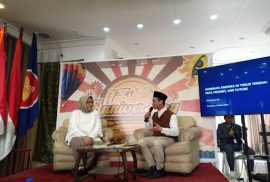
On March 8, 2024, coinciding with the 48th Anniversary of the Indonesian Student Association (PPI) in Syria, Prof. Dr. Ida Rochani Adi, S.U. served as the sole speaker in the Academic Discussion with PPI Syria at the Hall of the Embassy of the Republic of Indonesia in Damascus. The discussion titled “American Dominance in the Middle East: Past, Present, Future” was attended by 86 Indonesian students in Damascus and several staff members of the KBRI. In his opening remarks, the Indonesian Ambassador to Syria, Dr. Wajid Fauzi, expressed his utmost gratitude to the delegation from the Department of Inter-Cultural Studies at UGM consisting of Prof. Dr. Ida Rochani Adi, S.U., Dr. Hindun Ichsan, M. Hum., Dr. Aris Munandar, M.Hum., and Rudi Candra, L.C., M.A. for their willingness to share knowledge with Indonesian students in Syria.

Prof. Ida Rochani Adi, S.U. initiated the discussion by explaining why dominance is an interesting issue to examine. As an expert in American Studies, Prof. Ida explained Gramsci’s Theory of Hegemony as a basis for understanding American hegemony in the Middle East. Furthermore, American Dominance in the Middle East was discussed from a cultural studies perspective.

The discussion sparked many critical questions from students: What is the actual role of America in the Middle East; how to break free from the mindset that the West is superior to believe in equality; why Indonesia, which has tried to break free from American dominance, but invites the dominance of other powers (China); and why Indonesia, which actually has great ideas but has not been able to match the power of Iran, which is under American embargo.

During the session, Prof. Ida provided motivation to the students through the adage: “Squat to jump high.” This means that earnest preparation will lead someone to great achievements. Therefore, while studying in Syria, one should be diligent so that upon returning to the homeland, they can carve out various great achievements.

(Aris Munandar, March 8, 2024)

Guest Lecture and Academic Dialogue with the Indonesian Student Association (PPI) Lebanon

News Release Friday, 22 March 2024

SDGs 4: Quality Education | SDGs 17: Partnerships for the Goals

In the series of visits by the Department of Intercultural Studies, Faculty of Cultural Sciences, Universitas Gadjah Mada to Lebanon, Syria, and Saudi Arabia from March 3rd to March 15th, 2024, the Master’s Program in American Studies collaborated with the Embassy of the Republic of Indonesia in Beirut to provide a guest lecture for Indonesian students in Lebanon. The guest lecture was held on March 5th, 2024, at the Embassy of the Republic of Indonesia’s Auditorium in Beirut. In his opening remarks, the Ambassador of the Republic of Indonesia to Lebanon, Mr. Hajriyanto Y Tohari, conveyed information that the number of Indonesian students in Syria has decreased, with only 65 students currently enrolled. The lecture was delivered by Prof. Dr. Ida Rochani Adi, S.U., discussing the importance of multidisciplinary education and educational standardization to produce graduates with competence. One important aspect emphasized was education as a process of logic maturation.

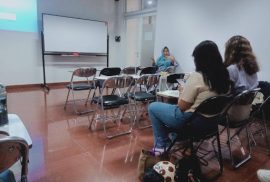
During the dialogue session, students raised many questions related to academic linearity and the development of academic writing skills. Most Indonesian students in Lebanon are studying religious fields and feel they lack understanding of research methodology and academic writing skills. Therefore, they lack confidence in continuing their studies in Indonesia, especially considering the final assignments such as the thesis and dissertation.

Responding to students’ questions regarding academic linearity, Prof. Ida discussed the current development of science, which is moving towards interdisciplinarity and even multidisciplinarity. Regarding the lack of mastery of research methodology and academic writing skills, the advice given was to practice creating specific statements. The dialogue concluded with an emphasis on the fact that the success of studies is determined by the students’ contributions. Therefore, Indonesian students should condition themselves to become active learners who contribute to the learning process.

(Aris Munandar, March 5th, 2024)

1234

Video UGM

[shtmlslider name='shslider_options']
Universitas Gadjah Mada

Faculty of Cultural Sciences
Universitas Gadjah Mada
Jl. Nusantara 1, Bulaksumur Yogyakarta 55281, Indonesia
   fib@ugm.ac.id
   +62 (274) 513096
   +62 (274) 550451

Work Units

  • Office of Journal & Publishing
  • INCULS
  • Information Technology and Database
  • Language Learning Center
  • Library Unit
  • Public Relations
  • Research

Facilities

  • Computer Laboratory
  • Gamelan
  • Guest House
  • Language Library
  • Library
  • Phonetics Library
  • Self Access Unit
  • Student Internet Centre

Importan Links

  • Journal of Humaniora
  • Subscriber Journal
  • Alumni Portal
  • Career
  • Departmens News
  • UGM Streaming

Contacts

  • Academic
  • Administration
  • Dean’s Office
  • Departments / Study Programs
  • Public Relations

© 2024 Faculty of Cultural Sciences Universitas Gadjah Mada

KEBIJAKAN PRIVASI/PRIVACY POLICY

[EN] We use cookies to help our viewer get the best experience on our website. -- [ID] Kami menggunakan cookie untuk membantu pengunjung kami mendapatkan pengalaman terbaik di situs web kami.I Agree / Saya Setuju