• About UGM
  • Academic Portal
  • IT Center
  • Library
  • Research
  • Webmail
  • Informasi Publik
  • English
    • Indonesia
Universitas Gadjah Mada Faculty of Cultural Sciences
Universitas Gadjah Mada
  • Home
  • Profile
    • History
    • Vision and Mission
    • Organizational structure
    • Administration
    • Staff
    • Faculty Members
  • Academic
    • Academic Calendar
    • Undergraduate Programs
      • Bachelor of Cultural Antrophology
      • Bachelor in Archaeolagy
      • Bachelor in History
      • Bachelor in Tourism
      • Bochetor in Korean Language and Culture
      • Bachelor in Indonesian Language and Culture
      • Bachelor in English
      • Bachelor in Arabic
      • Bachelor in Japanese Language and Culture
      • Bachelor in Javanese Language, Literature and Culture
      • Bachelor in French language and literature
    • Graduate Programs
      • Master in Antrophology
      • Master in ArchaeoIogy
      • Master in History
      • Master in Linguistics
      • Master in Literature
      • Master In American Studies
      • Master in Middle Eastern Cultural Studies
    • Post-Graduate Programs / S3
      • Doctor in Antropology
      • Doctor in American Studies
      • Doctor in Humanities
    • Student Service
  • KPPM
    • Research Information
    • Scientific / Academic Publications
    • Community Service
    • International Cooperation
    • Domestic Cooperation
  • Student Organizations
    • Student Executive Council
    • Semi-Autonomous Organizations
      • KAPALASASTRA
      • Christian Student Alliance
      • LINCAK
      • Saskine
      • Catholic Student Family
      • Dian Budaya
      • Sastra Kanuragan (sasgan)
      • Family of Muslim Cultural Sciences Students (KMIB)
      • Bejo Mulyo
    • Autonomous Organizations
      • Family of Anthropology Students (KEMANT)
      • English Department Student Association
      • Tourism Students Association (HIMAPA)
      • Family of Indonesian Literature Students (KMSI)
      • West Asian Literature Student Association (IMABA)
      • Association of Korean-Language Students (HIMAHARA)
      • Family of Regional Indonesian Literatures Students (KAMASUTRA)
      • The Family Body of History Students (BKMS)
      • The French Literature Students Association (HMSP)
      • Family of Anthropology Students
      • Japanese Student Association (HIMAJE)
  • Admission
    • Student Evaluation
  • Home
  • Post by
Post by :

Humas FIB

Smart Classroom Based on IoT Begins Implementation in Four Rooms at FIB UGM

News Release Wednesday, 17 December 2025

Yogyakarta, December, 12, 2025 – The Faculty of Cultural Sciences, Universitas Gadjah Mada (FIB UGM), officially launched the Implementation of an Internet of Things (IoT)–Based Smart Classroom System for Room Temperature Automation and Monitoring on the 7th floor of the R. Soegondo Building.

This activity is part of the UGM Sustainability Campus Action Program of the Faculty of Cultural Sciences 2025, which aims to optimize the management of learning spaces through the efficient and sustainable use of digital technology. In its initial phase, the IoT-based Smart Classroom system has been installed and operated in four rooms within the Faculty of Cultural Sciences as an effort to enhance comfort and effectiveness in academic activities.

During the launching event, the FIB UGM Information Technology Team presented the application dashboard used to operate the Smart Classroom system. The dashboard enables centralized control and remote monitoring of room temperature. The system operates using the UGM WiFi network as its main infrastructure. As long as the WiFi connection is active, the system can function optimally; however, when the network is unavailable or disrupted, the automation system will also cease to operate.

The launching event was attended by faculty leaders, representatives of lecturers, educational staff, students, and technical support teams. The series of activities included remarks from faculty leadership, implementation briefings, a technical presentation by the FIB IT Team, and the official launch of the IoT-based Smart Classroom system. In the final session, participants were invited to visit the rooms that have been equipped with IoT-based temperature control devices to observe the system’s implementation firsthand.

The implementation of the IoT-based Smart Classroom aligns with FIB UGM’s commitment to supporting the Sustainable Development Goals (SDGs). The provision of a comfortable and adaptive learning environment supports SDG 4 (Quality Education). Energy efficiency through automated temperature control contributes to SDG 7 (Affordable and Clean Energy) and SDG 13 (Climate Action). Furthermore, the use of technological innovation in campus facility management reflects support for SDG 9 (Industry, Innovation, and Infrastructure).

Through the implementation of this system, FIB UGM reaffirms its commitment to continuously integrating technology, humanistic values, and sustainability principles in the development of its academic environment.

[Public Relations of FIB UGM, Alma Syahwalani]

The Implementation of Neuroscience-Based Language Teaching Emphasized in Language Learning Activities at FIB UGM

News Release Wednesday, 17 December 2025

Yogyakarta, December, 16, 2025 – The Neuroscience-Based Language Teaching approach became the central focus of an academic activity held at the Faculty of Cultural Sciences (FIB), Universitas Gadjah Mada. The event aimed to introduce and discuss language learning strategies that emphasize the role of emotions, focus, and meaningful learning experiences grounded in how the human brain works.

The activity opened with the singing of the Indonesian national anthem Indonesia Raya and the Gadjah Mada Hymn, followed by opening remarks from the course lecturer. The program then continued with the screening of instructional videos and educational animations illustrating the application of neuroscience in the language learning process, before proceeding to an interactive talk show session.

In their presentations, the speakers emphasized that emotional elements play a vital role in language learning. Positive emotions, a sense of trust, and learner engagement have been shown to support the formation of emotional memory, making the learning process more meaningful and the material easier to retain. This was demonstrated through various examples of interactive learning media, including animated videos and educational games.

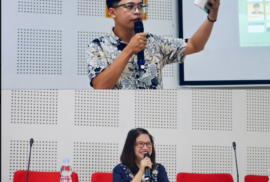
The first talk show session was moderated by Rizky Ramadhani under the theme “Languages Through Gamification: A Neuroscience-Based Approach.” Several language education practitioners served as speakers, namely Tabinda Putri, Eva Pras, Fajri, and Elvina. They shared their experiences in applying neuroscience-based approaches through gamification methods in language teaching.

Elvina, an English course instructor whose students range in age from 17 to 25, highlighted the characteristics of Generation Z learners, who tend to become easily bored. To address this challenge, she developed learning media in the form of a snakes-and-ladders–style board game as well as web-based games. According to her, language learning does not need to begin with a strong emphasis on grammar, but can be packaged in a more engaging way through games that train learners’ focus and participation.

Meanwhile, Tabinda Putri, an instructor of Indonesian for Speakers of Other Languages (BIPA), emphasized the importance of building emotional rapport with learners before introducing the core material. She explained that light conversations about students’ names, interests, and backgrounds serve as an effective initial approach to building trust. This trust fosters positive feelings that influence learners’ memory and comprehension of the learning material.

The speakers also underlined the importance of adjusting teaching methods to learners’ preferred learning styles—visual, auditory, and kinesthetic. The use of images, videos, writing on the board, role play, and games was considered effective in accommodating this diversity of learning styles. At the same time, Fajri highlighted challenges related to limited technological facilities in certain learning contexts, which need to be collectively addressed in the development of innovative teaching methods.

This activity reflects FIB UGM’s commitment to providing inclusive, innovative, and research-based language education. The Neuroscience-Based Language Teaching approach aligns with the Sustainable Development Goals (SDGs), particularly Goal 4 on Quality Education through the strengthening of effective, learner-centered teaching methods. In addition, the activity supports Goal 10 on Reduced Inequalities by promoting access to adaptive learning, as well as Goal 9 on Industry, Innovation, and Infrastructure through the use of innovative media and technology in language education.

[Public Relations of FIB UGM, Alma Syahwalani]

Three UGM Arabic Literature Students Achieve Success at an International Language Olympiad

ChampionshipNews Release Wednesday, 17 December 2025

Shah Alam, 18 December 2025 – Three students from the Arabic Literature program at Universitas Gadjah Mada recorded notable achievements at the Modern Languages Olympiad 3.0, held at Universiti Teknologi MARA UiTM in Shah Alam, Malaysia. The international competition brought together participants from various countries in a series of multilingual contests, with the main events culminating on 18 December 2025.

In the Arabic Poetry Recital category, Pandhita Hapsari, an Arabic Literature student from the 2023 cohort, won first place and also received the award for Best Script. Another student, Muhammad Hayyi’ Rosyada from the 2024 cohort, secured third place in the same category. Meanwhile, Haris Arfakhsyadz Azka Maula, also from the 2024 cohort, achieved second place in the Arabic Champion Orator category and earned a special award for Best Impromptu Speech. Throughout their participation in Malaysia, the students were officially accompanied by Dr. Zurfa Purnamawati, M.Hum., a lecturer in Arabic Literature at the Faculty of Cultural Sciences UGM, who supported during the competition.

MLO 3.0 was organized by the Academy of Language Studies at UiTM as a language competition featuring four main categories: Malay, English, Arabic, and Mandarin. The event series began with participant registration on 30 October 2025, followed by video submissions for the preliminary round until 6 November 2025. The judging process took place from 10 to 15 November 2025, with the announcement of preliminary results on 18 November 2025. The face-to-face final round was held on 16 December 2025 and concluded with a closing ceremony the following day.

In its official description, the organizing committee stated that the Poetry Recital category is a multilingual poetry writing and recitation competition that encourages expression in multiple languages while celebrating cultural diversity and unity. The Orator Champion category is described as a multilingual speech competition that facilitates the exchange of ideas across traditions, enriching the cultural value of public speaking.

These achievements reflect the students’ strong academic capacity and competitive language skills at the international level. Active participation in global forums of this kind reinforces the role of language as a bridge for intercultural dialogue and highlights the importance of education development that promotes cross-national collaboration for a more sustainable future.

[Public Relations of FIB UGM, Candra Solihin]

Archaeopreneur Bazaar by the Archaeology Study Program of FIB UGM Showcases Creative Local Products

News Release Wednesday, 17 December 2025

Yogyakarta, 15 December 2025 – The Archaeology Study Program of the Faculty of Cultural Sciences (FIB), Universitas Gadjah Mada, held the Archaeopreneur Bazaar as part of the fulfillment of the Final Semester Examination (UAS) assignment for the Archaeopreneur course. The course is taught by Sektiadi, S.S., M.Hum., a lecturer in Archaeology at FIB UGM, and aims to encourage students to develop creativity and an entrepreneurial mindset grounded in archaeological knowledge.

The bazaar featured eight booths representing student groups enrolled in the Archaeopreneur course. Each group showcased a variety of locally produced creative items, including bag charms, tumblers, scarves, illustrated pins, bags, and many other products. These creations not only emphasized aesthetic value but also embodied philosophical meanings inspired by cultural values.

Through this activity, students were trained to transform archaeological knowledge into creative products with both commercial and educational value. The Archaeopreneur Bazaar served as a contextual learning space that bridges academic studies and entrepreneurial practice, enabling students not only to understand theory but also to apply it in real-world contexts.

This activity aligns with the spirit of the Sustainable Development Goals (SDGs), particularly Goal 4 on Quality Education through the strengthening of practice-based learning and student creativity. In addition, the bazaar supports SDG Goal 8 on Decent Work and Economic Growth by fostering young entrepreneurship, as well as Goal 12 on Responsible Consumption and Production through the development of local products that prioritize cultural values and sustainability.

[Public Relations of FIB UGM, Alma Syahwalani]

Emotional Approach Highlighted in Neuroscience-Based Language Teaching Talk Show at FIB UGM

News ReleaseStudent's Activity Tuesday, 16 December 2025

Yogyakarta, December 16, 2025 – The second session of the Neuroscience-Based Language Teaching Talk Show, themed Teaching with Emotion: How Affective Neuroscience Enhances Language, was held at R. Soegondo Building, Room 709, Faculty of Cultural Sciences, Universitas Gadjah Mada. The event discussed the role of emotions in language learning and how a neuroscience-based approach can improve teaching effectiveness.

Moderated by Reski Ramadhani, the talk show featured four speakers: Natasya Ayu, Asmaul Husna, Luailik Mushffa, and Tisa Aini. The discussion focused on teachers’ practical experiences in managing both student and teacher emotions while ensuring that academic objectives are achieved effectively.

One of the speakers, Asmaul Husna, shared her experience conducting a teaching experiment in a basic speaking class at Kampung Inggris. She compared two approaches implemented in different periods, namely a content-focused approach and an emotionally driven approach. “When we build emotional closeness with students, they feel truly valued,” Asmaul said. She added that students who received emotional support showed greater appreciation and more positive feedback at the end of the course.

Luailik Mushffa highlighted the challenges of applying a neuroscience-based approach in the classroom, particularly in relation to teachers’ emotional readiness. She explained that teachers need to regulate their emotions before teaching in order to create a positive learning atmosphere. “In this neuroscience approach, we focus on students’ emotions. However, teachers’ emotions also need to be managed before entering the classroom,” she explained. She also emphasized the importance of maintaining a balance between emotional management and the achievement of learning objectives.

Practical advice was delivered by Tisa Aini, who encouraged teachers to engage in self-reflection before teaching. “Please take five to ten minutes before entering the classroom for a self-check,” she said. According to her, teachers’ emotions are easily transmitted to students, making emotional stability a key foundation for creating a sense of safety in the learning process.

Meanwhile, Natasya Ayu stressed the importance of developing a positive mindset among students toward language learning. She reminded teachers not to frame language learning as something difficult and encouraged the use of contextual and realistic learning materials. In her view, making mistakes while speaking is a natural part of the journey toward language fluency.

Overall, the talk show illustrated that language teaching cannot be separated from emotional aspects, both for students and teachers. A more humane and emotionally aware approach is seen as essential in creating a supportive, sustainable learning environment that remains relevant to learners’ future needs.

[Public Relations of FIB UGM, Candra Solihin]

123…215

Video UGM

[shtmlslider name='shslider_options']
Universitas Gadjah Mada

Faculty of Cultural Sciences
Universitas Gadjah Mada
Jl. Nusantara 1, Bulaksumur Yogyakarta 55281, Indonesia
   fib@ugm.ac.id
   +62 (274) 513096
   +62 (274) 550451

Work Units

  • Office of Journal & Publishing
  • INCULS
  • Information Technology and Database
  • Language Learning Center
  • Library Unit
  • Public Relations
  • Research

Facilities

  • Computer Laboratory
  • Gamelan
  • Guest House
  • Language Library
  • Library
  • Phonetics Library
  • Self Access Unit
  • Student Internet Centre

Importan Links

  • Journal of Humaniora
  • Subscriber Journal
  • Alumni Portal
  • Career
  • Departmens News
  • UGM Streaming

Contacts

  • Academic
  • Administration
  • Dean’s Office
  • Departments / Study Programs
  • Public Relations

© 2024 Faculty of Cultural Sciences Universitas Gadjah Mada

KEBIJAKAN PRIVASI/PRIVACY POLICY

[EN] We use cookies to help our viewer get the best experience on our website. -- [ID] Kami menggunakan cookie untuk membantu pengunjung kami mendapatkan pengalaman terbaik di situs web kami.I Agree / Saya Setuju