• About UGM
  • Academic Portal
  • IT Center
  • Library
  • Research
  • Webmail
  • Informasi Publik
  • English
    • Indonesia
Universitas Gadjah Mada Faculty of Cultural Sciences
Universitas Gadjah Mada
  • Home
  • Profile
    • History
    • Vision and Mission
    • Organizational structure
    • Administration
    • Staff
    • Faculty Members
  • Academic
    • Academic Calendar
    • Undergraduate Programs
      • Bachelor of Cultural Antrophology
      • Bachelor in Archaeolagy
      • Bachelor in History
      • Bachelor in Tourism
      • Bochetor in Korean Language and Culture
      • Bachelor in Indonesian Language and Culture
      • Bachelor in English
      • Bachelor in Arabic
      • Bachelor in Japanese Language and Culture
      • Bachelor in Javanese Language, Literature and Culture
      • Bachelor in French language and literature
    • Graduate Programs
      • Master in Antrophology
      • Master in ArchaeoIogy
      • Master in History
      • Master in Linguistics
      • Master in Literature
      • Master In American Studies
      • Master in Middle Eastern Cultural Studies
    • Post-Graduate Programs / S3
      • Doctor in Antropology
      • Doctor in American Studies
      • Doctor in Humanities
    • Student Service
  • KPPM
    • Research Information
    • Scientific / Academic Publications
    • Community Service
    • International Cooperation
    • Domestic Cooperation
  • Student Organizations
    • Student Executive Council
    • Semi-Autonomous Organizations
      • KAPALASASTRA
      • Christian Student Alliance
      • LINCAK
      • Saskine
      • Catholic Student Family
      • Dian Budaya
      • Sastra Kanuragan (sasgan)
      • Family of Muslim Cultural Sciences Students (KMIB)
      • Bejo Mulyo
    • Autonomous Organizations
      • Family of Anthropology Students (KEMANT)
      • English Department Student Association
      • Tourism Students Association (HIMAPA)
      • Family of Indonesian Literature Students (KMSI)
      • West Asian Literature Student Association (IMABA)
      • Association of Korean-Language Students (HIMAHARA)
      • Family of Regional Indonesian Literatures Students (KAMASUTRA)
      • The Family Body of History Students (BKMS)
      • The French Literature Students Association (HMSP)
      • Family of Anthropology Students
      • Japanese Student Association (HIMAJE)
  • Admission
    • Student Evaluation
  • Home
  • News Release
  • UGM Arabic Literature Student Explores Mandarin and Taiwanese Culture through Summer Course

UGM Arabic Literature Student Explores Mandarin and Taiwanese Culture through Summer Course

  • News Release
  • 15 September 2026, 10.42
  • Oleh: Humas FIB
  • 0

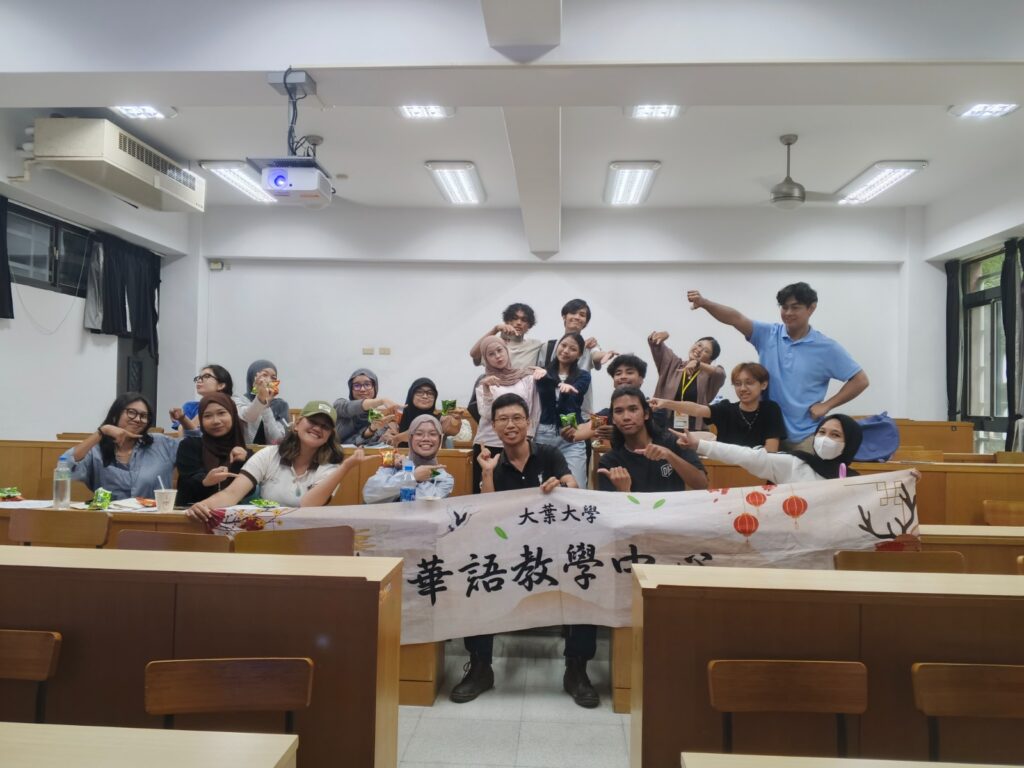
YOGYAKARTA – Learning a foreign language does not always have to begin with textbooks and classrooms. This was the experience of Shang Narendra, a 2022 student of Arabic Literature at Universitas Gadjah Mada (UGM), who became the university’s sole representative in the 2026 Mandarin Summer Camp Short Term Study Program in Taiwan. The program, subsidized by Taiwan’s Ministry of Education, was held at Da Yeh University (大葉大學) in Changhua, Taiwan, from July 22 to August 4, 2026.

Organized through the Official Taiwan Education Center Indonesia in collaboration with universities in Taiwan, the program brought together international students to learn Mandarin while gaining firsthand exposure to Taiwanese culture. For Shang Narendra, who is often called Adam, the opportunity stemmed from his desire to learn a foreign language directly in an environment where it is spoken. As an Arabic Literature student, he is accustomed to viewing language not only through its structure and vocabulary but also through the culture, society, and context in which it is used.

During the program, participants attended Mandarin classes in the morning and took part in various cultural activities in the afternoon. Upon arriving at Da Yeh University, participants first took the Test of Chinese as a Foreign Language (TOCFL) to assess their Mandarin proficiency and determine their class placement. Classroom learning was complemented by hands-on activities, including cooking, handicrafts, aromatherapy, fabric painting, traditional Chinese calligraphy, and making a Taiwanese-style mosquito repellent spray.

The cross-cultural experience also extended into everyday life in the dormitory. Participants from different universities and countries lived together, creating opportunities to communicate in various languages, particularly English and Mandarin. Adam occasionally used Google Translate when language barriers interrupted conversations. He also interacted directly with local residents while purchasing daily necessities. Through these experiences, he learned that the courage to communicate and the ability to adapt can be just as important as mastering grammar.

One of Adam’s most memorable experiences was the final project, which involved a role-play performed with a group of six students from different backgrounds. Within a relatively short period, Adam and his group members had to use Mandarin to discuss ideas, divide tasks, and prepare their performance. The program also took participants to Sun Moon Lake in Nantou, giving them an opportunity to explore another side of Taiwan beyond the university campus.
For Adam, learning Mandarin in Taiwan also broadened his perspective as an Arabic Literature student. He came to see more clearly that language learning cannot be separated from the culture and society of its speakers. The experience also strengthened his listening and speaking skills, contextual understanding, and ability to adapt to a new environment. Learning another language gave him a new perspective on understanding Arabic more broadly, beyond the theories he studies in the classroom.

The summer course also provided Adam with an opportunity to step outside his comfort zone. He found that students of Arabic Literature can explore other languages and cultures without leaving behind the field they are studying. By becoming familiar with more languages and societies, students can gain new perspectives on Arabic while preparing themselves to communicate and engage in increasingly multicultural environments.


Author : Indana Zulfa Maulida

Tags: Arabic Literature Arabic Literature UGM FIB UGM Sastra Arab SDGs 16: Peace Justice and Strong Institutions SDGs 17: Partnerships for the Goals SDGs 4: Quality Education UGM Yogyakarta

Video UGM

[shtmlslider name='shslider_options']
Universitas Gadjah Mada

Faculty of Cultural Sciences
Universitas Gadjah Mada
Jl. Nusantara 1, Bulaksumur Yogyakarta 55281, Indonesia
   fib@ugm.ac.id
   +62 (274) 513096
   +62 (274) 550451

Work Units

  • Office of Journal & Publishing
  • INCULS
  • Information Technology and Database
  • Language Learning Center
  • Library Unit
  • Public Relations
  • Research

Facilities

  • Computer Laboratory
  • Gamelan
  • Guest House
  • Language Library
  • Library
  • Phonetics Library
  • Self Access Unit
  • Student Internet Centre

Importan Links

  • Journal of Humaniora
  • Subscriber Journal
  • Alumni Portal
  • Career
  • Departmens News
  • UGM Streaming

Contacts

  • Academic
  • Administration
  • Dean’s Office
  • Departments / Study Programs
  • Public Relations

© 2024 Faculty of Cultural Sciences Universitas Gadjah Mada

KEBIJAKAN PRIVASI/PRIVACY POLICY

[EN] We use cookies to help our viewer get the best experience on our website. -- [ID] Kami menggunakan cookie untuk membantu pengunjung kami mendapatkan pengalaman terbaik di situs web kami.I Agree / Saya Setuju