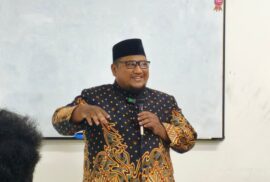
Students of the Arabic Literature Study Program at Universitas Gadjah Mada (UGM) attended a course on Entrepreneurship and Personal Development featuring a guest lecture on “Arabic-Based Entrepreneurship Opportunities” delivered by Kuwat Prasetya, S.S. on September 14, 2026. During the session, Kuwat highlighted the importance of mapping out and planning one’s dreams, then turning them into systems and habits as a form of commitment and consistency in achieving them. He also emphasized that small habits practiced repeatedly can create a significant impact. In explaining this concept, he referred to the key principles presented in Atomic Habits.
After raising students’ awareness of the importance of building systems and habits to achieve their future aspirations, Kuwat shifted the discussion toward the importance of Arabic language proficiency and the career opportunities that can be developed through this skill. According to him, Arabic proficiency is becoming increasingly valuable in the workplace, particularly when complemented by English language skills.
“Don’t come only when you need a job. Come with value,” he said.
Kuwat explained that the value of Arabic Literature graduates is not determined solely by their academic achievements or degree certificates, but also by the competencies they possess, particularly their Arabic language skills. He noted that Arabic proficiency should not be limited to fusha Arabic, but should also include amiyah, the variety of Arabic commonly used in everyday communication.
He encouraged students to start learning amiyah, particularly Saudi amiyah, for those interested in pursuing careers in the Hajj and Umrah sector. Proficiency in amiyah can help individuals communicate more closely with Arab communities while gaining a better understanding of their cultural and everyday contexts.
Beyond the Hajj and Umrah sector, Kuwat also outlined various career opportunities available to Arabic Literature graduates, including diplomacy, business and trade, hospitality, translation, digital media, and education, including Arabic Language Education.
“Build an identity, not just a target,” Kuwat said.
Through this course, Arabic Literature students are expected not only to identify their aspirations and future career opportunities, but also to understand the competencies they need to develop from an early stage. The experience and insights gained from the speaker are expected to serve as valuable preparation for students to take concrete steps, develop productive habits, and pursue their goals through small actions carried out consistently, rather than leaving those goals as mere ideas in their minds.
Author : Hashifa Zara Ahfiyani