
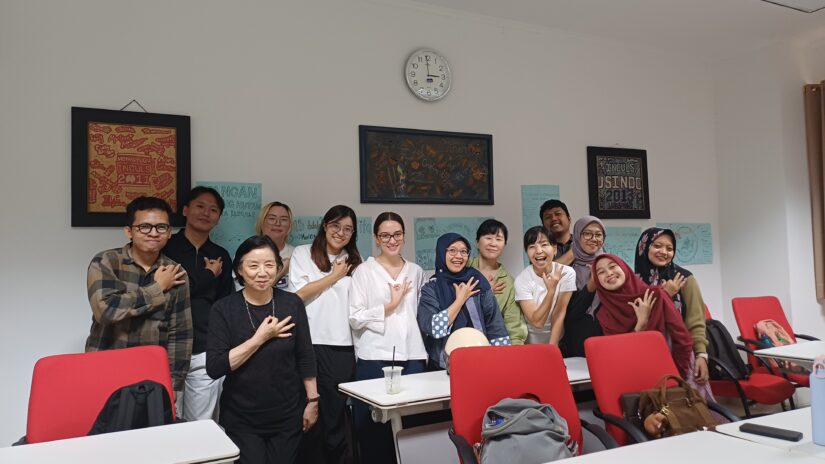
Learning in the Second Language Acquisition course of the Master’s Program in Linguistics, Faculty of Cultural Sciences, Universitas Gadjah Mada (UGM), provides students with an experience that goes beyond theoretical learning by giving them opportunities to directly observe and engage in the process of second language acquisition.
One of the highlights of the course is an intermediate conversation class involving international students who are learning Indonesian. In this activity, Master’s students enrolled in the Second Language Acquisition course take on the role of tutors, assisting international students in learning and practicing Indonesian.
The activity provides a learning space that connects academic perspectives on second language acquisition with actual language-learning practices. Through interactions between tutors and learners, students can observe how a second language is learned and used in authentic communicative situations. Concepts discussed in the course—including interaction, language environment, individual factors, language transfer, and the cognitive and social processes involved in second language acquisition—can be explored more concretely through this hands-on experience.
The Second Language Acquisition course covers major theories, approaches, and key findings in the field of second language acquisition. Students are encouraged to analyze the cognitive, social, and environmental processes that influence second language acquisition, while also examining the differences between first and second language acquisition. The course further explores individual factors such as age and motivation, as well as language transfer and its implications for language teaching.
The involvement of international students as Indonesian language learners provides an authentic context for Master’s students to understand that second language acquisition does not occur in a uniform manner. Learners may have different needs, strategies, responses, and patterns of linguistic development. These differences provide valuable material for students to connect theoretical concepts with actual phenomena observed in second language acquisition.
In addition to conversation practice, the course incorporates weekly active seminar discussions, critical reading and academic article reviews, case studies based on authentic acquisition data, the integration of second-language (L2) corpus data or recorded interlanguage data, and collaborative mini research projects. Indonesian is used as the language of instruction throughout the course.
Through this learning approach, students are expected not only to explain and evaluate major theories and their development in second language acquisition, but also to critically analyze acquisition data and connect second language acquisition theories with language teaching practices. The experience of serving as tutors in the intermediate conversation class provides an important form of contextual learning that deepens students’ understanding of the complexities of second language acquisition.
The activity also demonstrates that learning in the Master’s Program in Linguistics extends beyond mastering theoretical concepts. Students are encouraged to bring theory into real-world contexts, observe linguistic phenomena directly, and reflect on their observations as part of their academic development and research training in linguistics.
Author: Master of Linguistics Program
