• About UGM
  • Academic Portal
  • IT Center
  • Library
  • Research
  • Webmail
  • Informasi Publik
  • English
    • Indonesia
Universitas Gadjah Mada Faculty of Cultural Sciences
Universitas Gadjah Mada
  • Home
  • Profile
    • History
    • Vision and Mission
    • Organizational structure
    • Administration
    • Staff
    • Faculty Members
  • Academic
    • Academic Calendar
    • Undergraduate Programs
      • Bachelor of Cultural Antrophology
      • Bachelor in Archaeolagy
      • Bachelor in History
      • Bachelor in Tourism
      • Bochetor in Korean Language and Culture
      • Bachelor in Indonesian Language and Culture
      • Bachelor in English
      • Bachelor in Arabic
      • Bachelor in Japanese Language and Culture
      • Bachelor in Javanese Language, Literature and Culture
      • Bachelor in French language and literature
    • Graduate Programs
      • Master in Antrophology
      • Master in ArchaeoIogy
      • Master in History
      • Master in Linguistics
      • Master in Literature
      • Master In American Studies
      • Master in Middle Eastern Cultural Studies
    • Post-Graduate Programs / S3
      • Doctor in Antropology
      • Doctor in American Studies
      • Doctor in Humanities
    • Student Service
  • KPPM
    • Research Information
    • Scientific / Academic Publications
    • Community Service
    • International Cooperation
    • Domestic Cooperation
  • Student Organizations
    • Student Executive Council
    • Semi-Autonomous Organizations
      • KAPALASASTRA
      • Christian Student Alliance
      • LINCAK
      • Saskine
      • Catholic Student Family
      • Dian Budaya
      • Sastra Kanuragan (sasgan)
      • Family of Muslim Cultural Sciences Students (KMIB)
      • Bejo Mulyo
    • Autonomous Organizations
      • Family of Anthropology Students (KEMANT)
      • English Department Student Association
      • Tourism Students Association (HIMAPA)
      • Family of Indonesian Literature Students (KMSI)
      • West Asian Literature Student Association (IMABA)
      • Association of Korean-Language Students (HIMAHARA)
      • Family of Regional Indonesian Literatures Students (KAMASUTRA)
      • The Family Body of History Students (BKMS)
      • The French Literature Students Association (HMSP)
      • Family of Anthropology Students
      • Japanese Student Association (HIMAJE)
  • Admission
    • Student Evaluation
  • Home
  • Magister Linguistik
Arsip:

Magister Linguistik

2026 Alumni Gathering of the Master’s Program in Linguistics FIB UGM: Strengthening Connections and Alumni Networks

News Release Tuesday, 29 September 2026

Yogyakarta, September 11, 2026 — The Master’s Program in Linguistics, Faculty of Cultural Sciences, Universitas Gadjah Mada (FIB UGM), held the 2026 Alumni Gathering of the Master’s Program in Linguistics FIB UGM on Friday, September 11, 2026. The gathering took place in a warm and convivial atmosphere, providing an opportunity for alumni to reconnect, strengthen relationships, and build a stronger alumni network.

The gathering served as a meaningful occasion for alumni to come together, share experiences, and exchange ideas on the development of the Master’s Program in Linguistics FIB UGM. Through informal conversations and discussions, alumni shared valuable feedback and suggestions that are expected to contribute to the continued development of the program.

One of the key highlights of the event was the establishment of the Alumni Association management board of the Master’s Program in Linguistics FIB UGM. The formation of this board marks an important step toward strengthening communication and coordination among alumni, creating opportunities for collaboration, and encouraging alumni to contribute more actively to their alma mater.

In addition to the gathering and discussions, the event featured various entertainment activities that added to the warmth and lively atmosphere of the occasion. The convivial setting reflected the spirit of togetherness and community that the program hopes to foster among its alumni.

Through this gathering, the Master’s Program in Linguistics FIB UGM hopes that the alumni network will continue to grow and serve as a platform for meaningful collaboration in academic, professional, and other areas that benefit alumni, the program, and the wider community.

The 2026 Alumni Gathering reaffirmed that the relationship between an alma mater and its alumni does not end upon graduation. Continued communication, friendship, and collaboration are essential to building a strong alumni community and supporting the ongoing development of the Master’s Program in Linguistics FIB UGM.

From our almamater, staying connected and growing together.


Author: Magister of Linguistics Program
Master’s Linguistics Students Gain Hands-on Experience in Second Language Acquisition through Intermediate Conversation Class

News Release Monday, 7 September 2026

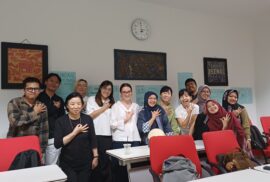
Learning in the Second Language Acquisition course of the Master’s Program in Linguistics, Faculty of Cultural Sciences, Universitas Gadjah Mada (UGM), provides students with an experience that goes beyond theoretical learning by giving them opportunities to directly observe and engage in the process of second language acquisition.

One of the highlights of the course is an intermediate conversation class involving international students who are learning Indonesian. In this activity, Master’s students enrolled in the Second Language Acquisition course take on the role of tutors, assisting international students in learning and practicing Indonesian.

The activity provides a learning space that connects academic perspectives on second language acquisition with actual language-learning practices. Through interactions between tutors and learners, students can observe how a second language is learned and used in authentic communicative situations. Concepts discussed in the course—including interaction, language environment, individual factors, language transfer, and the cognitive and social processes involved in second language acquisition—can be explored more concretely through this hands-on experience.

The Second Language Acquisition course covers major theories, approaches, and key findings in the field of second language acquisition. Students are encouraged to analyze the cognitive, social, and environmental processes that influence second language acquisition, while also examining the differences between first and second language acquisition. The course further explores individual factors such as age and motivation, as well as language transfer and its implications for language teaching.

The involvement of international students as Indonesian language learners provides an authentic context for Master’s students to understand that second language acquisition does not occur in a uniform manner. Learners may have different needs, strategies, responses, and patterns of linguistic development. These differences provide valuable material for students to connect theoretical concepts with actual phenomena observed in second language acquisition.

In addition to conversation practice, the course incorporates weekly active seminar discussions, critical reading and academic article reviews, case studies based on authentic acquisition data, the integration of second-language (L2) corpus data or recorded interlanguage data, and collaborative mini research projects. Indonesian is used as the language of instruction throughout the course.

Through this learning approach, students are expected not only to explain and evaluate major theories and their development in second language acquisition, but also to critically analyze acquisition data and connect second language acquisition theories with language teaching practices. The experience of serving as tutors in the intermediate conversation class provides an important form of contextual learning that deepens students’ understanding of the complexities of second language acquisition.

The activity also demonstrates that learning in the Master’s Program in Linguistics extends beyond mastering theoretical concepts. Students are encouraged to bring theory into real-world contexts, observe linguistic phenomena directly, and reflect on their observations as part of their academic development and research training in linguistics.


Author: Master of Linguistics Program

Dialectology Fieldwork: UGM Linguistics Graduate Students Study Javanese Language Variations in Magelang

News Release Wednesday, 10 June 2026

Students of the Dialectology class from the Master’s Program in Linguistics, Faculty of Cultural Sciences, Universitas Gadjah Mada conducted a fieldwork program in Ngablak District, Magelang Regency, Central Java, as part of strengthening their linguistic research competencies. The activity focused on the study of Javanese dialect variations based on the geographical and social aspects of its speech communities.

Javanese is one of the regional languages with the largest number of speakers in Indonesia and is widely spoken across various parts of the archipelago. Through this fieldwork program, the students carried out dialectological research to observe the phonological, lexical, and semantic variations of Javanese used by communities in five villages in Ngablak District, namely Ngablak, Seloprojo, Genikan, Kanigoro, and Tejosari. These areas were selected due to their highland geographical characteristics, where vegetable farming serves as the primary economic activity of the local communities.

The social and geographical characteristics of the Ngablak community are considered to have a strong influence on the development of language variation. The communication patterns of agrarian communities, differences in altitude, and the geographical conditions of mountainous areas potentially contribute to the emergence of distinctive lexical variations, particularly those related to agricultural terminology and local wisdom.

The research was conducted through direct interviews with local residents using a 200-word Swadesh list as the research instrument. Conversations between the students and informants were recorded with the consent of the participants as part of the linguistic data documentation process. The recorded data were then transcribed phonetically to identify lexical variations found in each research location.

Furthermore, the collected linguistic data will be analyzed using dialectometric methods to map the levels of similarity and difference among dialects across villages. Through this activity, students not only gained direct experience in field-based linguistic research but also contributed to the documentation and mapping of regional language diversity in Indonesia.

This Dialectology fieldwork program reflects the commitment of the UGM Master’s Program in Linguistics to developing research-based learning while strengthening linguistic studies oriented toward the preservation of local languages and cultures.

The Implementation of Neuroscience-Based Language Teaching Emphasized in Language Learning Activities at FIB UGM

News Release Wednesday, 17 December 2025

Yogyakarta, December, 16, 2025 – The Neuroscience-Based Language Teaching approach became the central focus of an academic activity held at the Faculty of Cultural Sciences (FIB), Universitas Gadjah Mada. The event aimed to introduce and discuss language learning strategies that emphasize the role of emotions, focus, and meaningful learning experiences grounded in how the human brain works.

The activity opened with the singing of the Indonesian national anthem Indonesia Raya and the Gadjah Mada Hymn, followed by opening remarks from the course lecturer. The program then continued with the screening of instructional videos and educational animations illustrating the application of neuroscience in the language learning process, before proceeding to an interactive talk show session.

In their presentations, the speakers emphasized that emotional elements play a vital role in language learning. Positive emotions, a sense of trust, and learner engagement have been shown to support the formation of emotional memory, making the learning process more meaningful and the material easier to retain. This was demonstrated through various examples of interactive learning media, including animated videos and educational games.

The first talk show session was moderated by Rizky Ramadhani under the theme “Languages Through Gamification: A Neuroscience-Based Approach.” Several language education practitioners served as speakers, namely Tabinda Putri, Eva Pras, Fajri, and Elvina. They shared their experiences in applying neuroscience-based approaches through gamification methods in language teaching.

Elvina, an English course instructor whose students range in age from 17 to 25, highlighted the characteristics of Generation Z learners, who tend to become easily bored. To address this challenge, she developed learning media in the form of a snakes-and-ladders–style board game as well as web-based games. According to her, language learning does not need to begin with a strong emphasis on grammar, but can be packaged in a more engaging way through games that train learners’ focus and participation.

Meanwhile, Tabinda Putri, an instructor of Indonesian for Speakers of Other Languages (BIPA), emphasized the importance of building emotional rapport with learners before introducing the core material. She explained that light conversations about students’ names, interests, and backgrounds serve as an effective initial approach to building trust. This trust fosters positive feelings that influence learners’ memory and comprehension of the learning material.

The speakers also underlined the importance of adjusting teaching methods to learners’ preferred learning styles—visual, auditory, and kinesthetic. The use of images, videos, writing on the board, role play, and games was considered effective in accommodating this diversity of learning styles. At the same time, Fajri highlighted challenges related to limited technological facilities in certain learning contexts, which need to be collectively addressed in the development of innovative teaching methods.

This activity reflects FIB UGM’s commitment to providing inclusive, innovative, and research-based language education. The Neuroscience-Based Language Teaching approach aligns with the Sustainable Development Goals (SDGs), particularly Goal 4 on Quality Education through the strengthening of effective, learner-centered teaching methods. In addition, the activity supports Goal 10 on Reduced Inequalities by promoting access to adaptive learning, as well as Goal 9 on Industry, Innovation, and Infrastructure through the use of innovative media and technology in language education.

[Public Relations of FIB UGM, Alma Syahwalani]

Dialectology Field Trip: We Speak the Same Language but Why Don’t We Understand?

News ReleaseSDG 4 (Quality Education) Tuesday, 25 June 2024

A varied dialect within a multilingual country might emerge as a phenomenon where the people speak the same language but still can’t understand what other people say from another area. For instance, the Javanese people who live in the Special Region of Yogyakarta and East Java speak and hold Javanese culture. However, they might be confused or clueless about what the listener says in a conversation. Thanks to the language variation that brought so-called dialect.

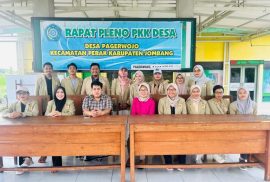
Dialectology, a linguistics study focusing on how language differs based on geography and social factors, comes to assist in answering the question. In this case, 14 students from dialectology class attempted to study vocabulary (words or phrases) variation specific to certain regions. They went to Jombang, East Java on May 10-11, 2024, to find the vocabulary variation of the Javanese language.

“There are 14 students in our class and they spread into 5 groups. Each group went to different sub-districts, which were Perak, Wonosalam, Diwek, and Peterongan. We brought 200 Swadesh word lists to find out the changes from the Javanese standard by interviewing an informant in each sub-district,” Eduar explained. Those sub-districts were chosen based on their hypothesis. “Diwek and Perak are in the west of Jombang, so we predict that the people still use the Mataraman dialect while Wonosalam and Petarongan are in the east. Thus, the people are most likely to use the Surabayanan dialect,” Dina added. From the data gathered, they compared and mapped the changes.

The students said that this field trip was a priceless experience. It gave a clear picture of how a linguist collects the data such as planning the program, coordinating with the locals, and interacting as well as interviewing them. “It was fun and always be a valuable experience for me. As a Javanese native speaker, I learned a lot from this experience. For instance, I didn’t know that the word kenceng means lurus (go straight on) in their dialect. All I know kenceng is banter or kencang (fast). It, of course, enhances my knowledge,” Dinda illustrated what she felt.

“I think it would be fantastic if we could continue to hold field trips like this in the future. We learned a lot. I hope the department, the faculty, or the parties involved will always support this sort of activity,” said Ningrum.

12

Video UGM

[shtmlslider name='shslider_options']
Universitas Gadjah Mada

Faculty of Cultural Sciences
Universitas Gadjah Mada
Jl. Nusantara 1, Bulaksumur Yogyakarta 55281, Indonesia
   fib@ugm.ac.id
   +62 (274) 513096
   +62 (274) 550451

Work Units

  • Office of Journal & Publishing
  • INCULS
  • Information Technology and Database
  • Language Learning Center
  • Library Unit
  • Public Relations
  • Research

Facilities

  • Computer Laboratory
  • Gamelan
  • Guest House
  • Language Library
  • Library
  • Phonetics Library
  • Self Access Unit
  • Student Internet Centre

Importan Links

  • Journal of Humaniora
  • Subscriber Journal
  • Alumni Portal
  • Career
  • Departmens News
  • UGM Streaming

Contacts

  • Academic
  • Administration
  • Dean’s Office
  • Departments / Study Programs
  • Public Relations

© 2024 Faculty of Cultural Sciences Universitas Gadjah Mada

KEBIJAKAN PRIVASI/PRIVACY POLICY

[EN] We use cookies to help our viewer get the best experience on our website. -- [ID] Kami menggunakan cookie untuk membantu pengunjung kami mendapatkan pengalaman terbaik di situs web kami.I Agree / Saya Setuju