
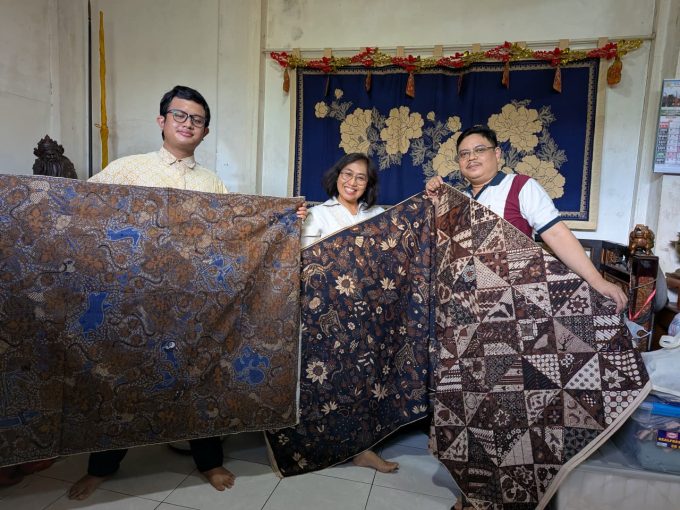
The Department of Javanese Language, Literature, and Culture, Faculty of Cultural Sciences, Universitas Gadjah Mada, has produced many alumni who have contributed to the preservation and development of the Javanese language, literature, and culture. One of them is Aji Setyowijaya, a member of the 2008 cohort who is now dedicated to the world of batik as a craftsman of traditional Yogyakarta batik.
The Department of Javanese Language, Literature, and Culture had the opportunity to visit and interview Aji Setyowijaya, hereafter referred to as Mas Aji, in person on Tuesday, 21 July 2026. The 2008 alumnus, who was also a recipient of a scholarship from Yayasan Arsari Djojohadikusumo (YAD), also known as Yayasan Keluarga Hasyim Djojohadikusumo (YKHD), explained that his interest in batik began with his admiration for inherited batik cloths. He often came across old batik fabrics of exceptional quality and beauty, but they had become so fragile that they were no longer suitable for use. “I used to enjoy looking at inherited batik cloths. The fabrics were beautiful and I wanted to wear them, but they had become too fragile. Eventually, I was motivated to try reproducing old batik cloths. At the same time, during my university years, I also enjoyed wearing rasukan, or traditional Javanese attire,” he said.
This interest encouraged him to begin learning batik-making in 2009. He studied various batik techniques by observing and learning directly at several batik centers in Yogyakarta. During this early period, Mas Aji focused on understanding the principles and techniques of traditional Yogyakarta batik as the primary foundation before developing his own works.
Building on this understanding, between approximately 2013 and 2015, Mas Aji began producing antique batik, also known as batik kama or batik lawasan. According to him, during that period both the public and collectors highly appreciated batik lawasan because it was assumed to have originated several decades earlier. “At that time, in the batik trade, people appreciated antique batik, or kama, or lawasan, with the assumption that the batik was 50–70 years old,” he explained.
However, this experience also gave rise to a sense of concern. According to Mas Aji, batik should not merely be regarded as a classical work that ends with reproducing the past. Batik should continue to develop without abandoning its traditional roots. Based on this perspective, he began incorporating his personal identity into every work he created while also expanding his exploration beyond the characteristic style of Yogyakarta batik.
In line with this spirit, since 2018 Mas Aji has devoted himself to studying natural dye techniques for traditional Yogyakarta batik. For him, learning about natural dyes is not merely about producing a wider range of colors, but also about rediscovering the technical knowledge inherited from earlier generations of batik artisans.
In his creative process, Mas Aji does not work alone. He collaborates with his colleague, Yahya Adi Sutikno, who focuses on the design process, while Mas Aji is primarily responsible for production. This collaboration enables them to produce a wide range of batik works through complementary approaches.
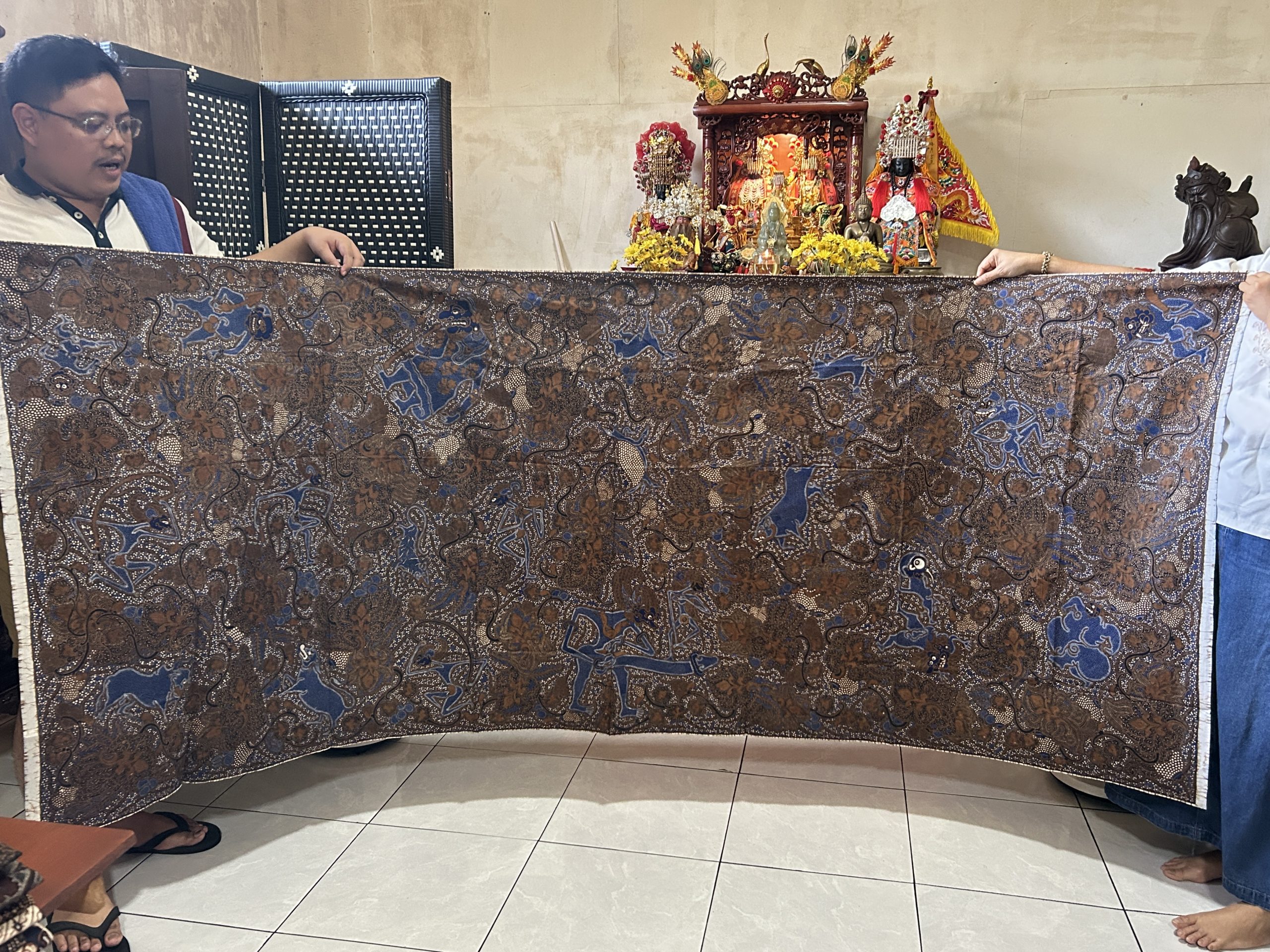
Their works include sample pieces featuring various batik motifs on a single piece of cloth consisting of 27, 260, and even 480 motif samples, as well as replicated batik, batik lawasan, and batik resulting from transformation, media transfer, and various forms of creative batik. Their exploration extends beyond batik cloth itself to other textile media, such as sarung and other types of fabric.
In addition to producing batik cloth, Mas Aji is also active in Perkumpulan Wastra Indonesia, a community that brings together enthusiasts and advocates of Indonesian traditional textiles. His dedication to batik is also reflected in his contribution to the book Pesona Padu Padan Wastra Indonesia as a fashion contributor featuring the use of traditional Yogyakarta batik.
Behind all of these creative processes, Mas Aji believes that one aspect that must continue to be preserved in the world of batik is technical knowledge. According to him, discussions of batik have largely focused on philosophical meanings, symbolism, and cultural values, while knowledge of batik-making techniques is at risk of disappearing if it is not documented and passed on. “In my opinion, that domain (philosophy) is not easily lost because there is already abundant literature about it. But technical knowledge can disappear. For example, where should a parang motif begin, and in which direction should it be made? There are specific ways and methods.” For Mas Aji, preserving technical knowledge is just as important as preserving the philosophical values of batik because both are integral parts of the batik-making tradition.
Toward the end of the interview, Mas Aji also shared a message for students of the Department of Javanese Language, Literature, and Culture, encouraging them not to be afraid of exploring opportunities beyond the classroom. “Make big problems smaller, and ignore the small ones. Do not hesitate or be afraid to try and explore. Also, do not limit your horizons to classroom learning alone.”
Mas Aji Setyowijaya’s journey demonstrates that the study of the Javanese language, literature, and culture does not end within the academic sphere, but can also be realized through cultural preservation practices that benefit society. Through his dedication to studying batik-making techniques, reproducing traditional batik, developing innovations grounded in established principles, and continuously exploring new possibilities in the world of wastra, Mas Aji has shown that cultural heritage can continue to live and develop with the times without losing its identity.
For mahadaya who would like to learn more about Mas Aji’s works and activities, they may visit his Instagram account, @setyowijaya, and his Facebook page, Batik Setyowijaya. Through these social media platforms, Mas Aji shares his creative processes, his works, and his activities in preserving and developing the art of batik.
Author : Haryo Untoro
