• About UGM
  • Academic Portal
  • IT Center
  • Library
  • Research
  • Webmail
  • Informasi Publik
  • English
    • Indonesia
Universitas Gadjah Mada Faculty of Cultural Sciences
Universitas Gadjah Mada
  • Home
  • Profile
    • History
    • Vision and Mission
    • Organizational structure
    • Administration
    • Staff
    • Faculty Members
  • Academic
    • Academic Calendar
    • Undergraduate Programs
      • Bachelor of Cultural Antrophology
      • Bachelor in Archaeolagy
      • Bachelor in History
      • Bachelor in Tourism
      • Bochetor in Korean Language and Culture
      • Bachelor in Indonesian Language and Culture
      • Bachelor in English
      • Bachelor in Arabic
      • Bachelor in Japanese Language and Culture
      • Bachelor in Javanese Language, Literature and Culture
      • Bachelor in French language and literature
    • Graduate Programs
      • Master in Antrophology
      • Master in ArchaeoIogy
      • Master in History
      • Master in Linguistics
      • Master in Literature
      • Master In American Studies
      • Master in Middle Eastern Cultural Studies
    • Post-Graduate Programs / S3
      • Doctor in Antropology
      • Doctor in American Studies
      • Doctor in Humanities
    • Student Service
  • KPPM
    • Research Information
    • Scientific / Academic Publications
    • Community Service
    • International Cooperation
    • Domestic Cooperation
  • Student Organizations
    • Student Executive Council
    • Semi-Autonomous Organizations
      • KAPALASASTRA
      • Christian Student Alliance
      • LINCAK
      • Saskine
      • Catholic Student Family
      • Dian Budaya
      • Sastra Kanuragan (sasgan)
      • Family of Muslim Cultural Sciences Students (KMIB)
      • Bejo Mulyo
    • Autonomous Organizations
      • Family of Anthropology Students (KEMANT)
      • English Department Student Association
      • Tourism Students Association (HIMAPA)
      • Family of Indonesian Literature Students (KMSI)
      • West Asian Literature Student Association (IMABA)
      • Association of Korean-Language Students (HIMAHARA)
      • Family of Regional Indonesian Literatures Students (KAMASUTRA)
      • The Family Body of History Students (BKMS)
      • The French Literature Students Association (HMSP)
      • Family of Anthropology Students
      • Japanese Student Association (HIMAJE)
  • Admission
    • Student Evaluation
  • Home
  • SDGs 12: Responsible Consumption and Production
Arsip:

SDGs 12: Responsible Consumption and Production

Preserving the Yogyakarta Batik Tradition through the Work of Aji Setyowijaya, an Alumnus of the Department of Javanese Language, Literature, and Culture

News Release Monday, 3 August 2026

The Department of Javanese Language, Literature, and Culture, Faculty of Cultural Sciences, Universitas Gadjah Mada, has produced many alumni who have contributed to the preservation and development of the Javanese language, literature, and culture. One of them is Aji Setyowijaya, a member of the 2008 cohort who is now dedicated to the world of batik as a craftsman of traditional Yogyakarta batik.

The Department of Javanese Language, Literature, and Culture had the opportunity to visit and interview Aji Setyowijaya, hereafter referred to as Mas Aji, in person on Tuesday, 21 July 2026. The 2008 alumnus, who was also a recipient of a scholarship from Yayasan Arsari Djojohadikusumo (YAD), also known as Yayasan Keluarga Hasyim Djojohadikusumo (YKHD), explained that his interest in batik began with his admiration for inherited batik cloths. He often came across old batik fabrics of exceptional quality and beauty, but they had become so fragile that they were no longer suitable for use. “I used to enjoy looking at inherited batik cloths. The fabrics were beautiful and I wanted to wear them, but they had become too fragile. Eventually, I was motivated to try reproducing old batik cloths. At the same time, during my university years, I also enjoyed wearing rasukan, or traditional Javanese attire,” he said.

This interest encouraged him to begin learning batik-making in 2009. He studied various batik techniques by observing and learning directly at several batik centers in Yogyakarta. During this early period, Mas Aji focused on understanding the principles and techniques of traditional Yogyakarta batik as the primary foundation before developing his own works.

Building on this understanding, between approximately 2013 and 2015, Mas Aji began producing antique batik, also known as batik kama or batik lawasan. According to him, during that period both the public and collectors highly appreciated batik lawasan because it was assumed to have originated several decades earlier. “At that time, in the batik trade, people appreciated antique batik, or kama, or lawasan, with the assumption that the batik was 50–70 years old,” he explained.

However, this experience also gave rise to a sense of concern. According to Mas Aji, batik should not merely be regarded as a classical work that ends with reproducing the past. Batik should continue to develop without abandoning its traditional roots. Based on this perspective, he began incorporating his personal identity into every work he created while also expanding his exploration beyond the characteristic style of Yogyakarta batik.

In line with this spirit, since 2018 Mas Aji has devoted himself to studying natural dye techniques for traditional Yogyakarta batik. For him, learning about natural dyes is not merely about producing a wider range of colors, but also about rediscovering the technical knowledge inherited from earlier generations of batik artisans.

In his creative process, Mas Aji does not work alone. He collaborates with his colleague, Yahya Adi Sutikno, who focuses on the design process, while Mas Aji is primarily responsible for production. This collaboration enables them to produce a wide range of batik works through complementary approaches.

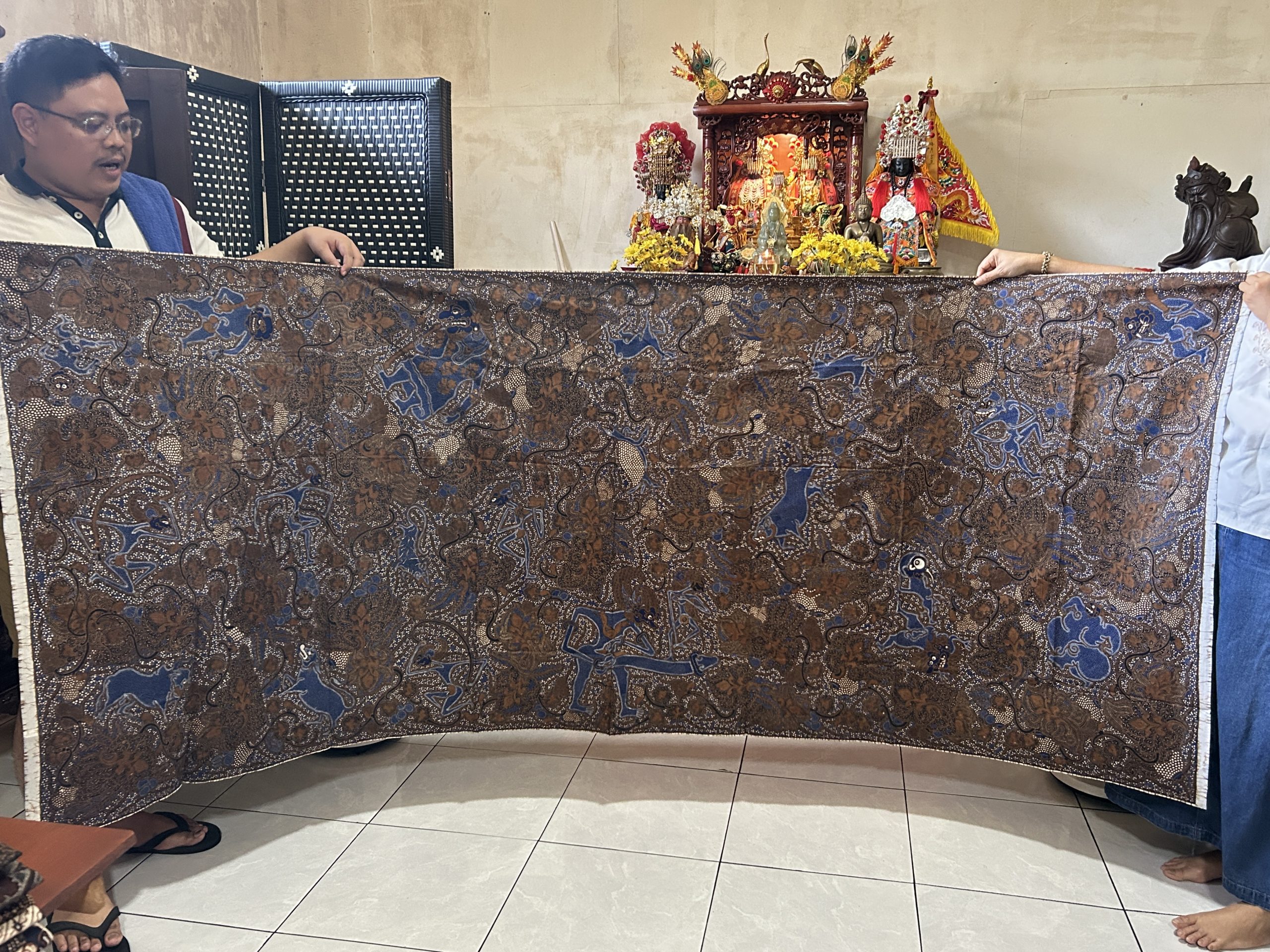
Their works include sample pieces featuring various batik motifs on a single piece of cloth consisting of 27, 260, and even 480 motif samples, as well as replicated batik, batik lawasan, and batik resulting from transformation, media transfer, and various forms of creative batik. Their exploration extends beyond batik cloth itself to other textile media, such as sarung and other types of fabric.

In addition to producing batik cloth, Mas Aji is also active in Perkumpulan Wastra Indonesia, a community that brings together enthusiasts and advocates of Indonesian traditional textiles. His dedication to batik is also reflected in his contribution to the book Pesona Padu Padan Wastra Indonesia as a fashion contributor featuring the use of traditional Yogyakarta batik.

Behind all of these creative processes, Mas Aji believes that one aspect that must continue to be preserved in the world of batik is technical knowledge. According to him, discussions of batik have largely focused on philosophical meanings, symbolism, and cultural values, while knowledge of batik-making techniques is at risk of disappearing if it is not documented and passed on. “In my opinion, that domain (philosophy) is not easily lost because there is already abundant literature about it. But technical knowledge can disappear. For example, where should a parang motif begin, and in which direction should it be made? There are specific ways and methods.” For Mas Aji, preserving technical knowledge is just as important as preserving the philosophical values of batik because both are integral parts of the batik-making tradition.

Toward the end of the interview, Mas Aji also shared a message for students of the Department of Javanese Language, Literature, and Culture, encouraging them not to be afraid of exploring opportunities beyond the classroom. “Make big problems smaller, and ignore the small ones. Do not hesitate or be afraid to try and explore. Also, do not limit your horizons to classroom learning alone.”

Mas Aji Setyowijaya’s journey demonstrates that the study of the Javanese language, literature, and culture does not end within the academic sphere, but can also be realized through cultural preservation practices that benefit society. Through his dedication to studying batik-making techniques, reproducing traditional batik, developing innovations grounded in established principles, and continuously exploring new possibilities in the world of wastra, Mas Aji has shown that cultural heritage can continue to live and develop with the times without losing its identity.

For mahadaya who would like to learn more about Mas Aji’s works and activities, they may visit his Instagram account, @setyowijaya, and his Facebook page, Batik Setyowijaya. Through these social media platforms, Mas Aji shares his creative processes, his works, and his activities in preserving and developing the art of batik. 


Author : Haryo Untoro

FIB UGM Provides Staff with IoT Scale Training

News Release Friday, 17 July 2026

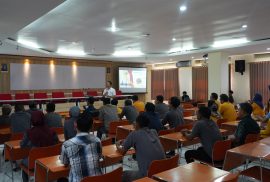
Yogyakarta, July 17, 2026 — On Friday, July 17, 2026, the Faculty of Cultural Sciences at UGM held an informational session on IoT scales as part of the 2026 UGM Sustainability Campus Action program. The event took place in the Multimedia Room of the Margono Building and featured Dr. Ir. Thomas Oka Pratama, S.T., M.Eng., IPP, from UGM’s Sensor and Controlled Systems Laboratory. This session served as training for educational support staff on managing the faculty’s waste using IoT scales.

IoT scales are devices that measure the weight of waste generated at collection points (pick-up points) in real time, integrated with the Internet of Things (IoT) system. The weight data is used for digital monitoring, evaluation, and planning of waste management policies. During the session, participants were instructed on how to use the IoT scales to manage waste generation. FIB support staff were also asked to practice using the IoT scales.

Through the implementation of IoT scales, FIB UGM aims to strengthen a waste management system that is more accurate, measurable, and data-driven. The use of this technology is expected to enhance the capacity of support staff to support sustainable waste management while also contributing to UGM’s Sustainability Campus Action 2026 commitment. This initiative aligns with efforts to achieve the Sustainable Development Goals (SDGs), particularly SDGs point 12: Responsible Consumption and Production, and also supports SDGs point 11: Sustainable Cities and Communities and SDGs point 13: Climate Action.

[Humas FIB, Maylafaizza Nafisha Zifa]

Understanding Human and Nature Relations in Dragon Fruit Farming in Wringinputih, Banyuwangi

News Release Tuesday, 30 June 2026

The night atmosphere in Wringinputih Tourism Village, Muncar District, Banyuwangi Regency, looks different from typical rural areas due to the vast fields brightly illuminated by thousands of hanging lights. This unique phenomenon was witnessed directly by the UGM Student Community Service (KKN-PPM) team of Muncar Memancar 2026, who participated in dragon fruit farming activities with local farmers on June 26, 2026. Through direct involvement in the field, the students had the opportunity to learn about the local knowledge systems and cultural adaptations that the community applies to optimize their agricultural yields.

This intensive nighttime farming activity occurs because dragon fruit flowers only fully bloom at night and will wither the next morning. Due to the lack of natural pollinating agents in the plantation during those hours, local farmers take over this role by conducting manual artificial pollination, which the locals often refer to as “marrying” the flowers. In addition to manual pollination, the installation of hanging lights among the plants also serves to provide artificial lighting. This ensures the plants receive longer light exposure, stimulating the dragon fruit trees to continue flowering and producing out of season.

Besides pollination techniques and light manipulation, the students also gained new insights into the farmers’ strategies for dealing with bad weather. When it rains at night precisely when the flowers are blooming, the farmers swiftly snap the flower stem fibers slightly so that the flower faces downward without detaching from the tree. This tactical step is intentionally taken so the upper part of the flower crown can act as a natural umbrella. It protects the sensitive pollen from the rain, ensuring the fertilization process does not fail due to rotting.

The farming practices in Wringinputih Village ultimately form a circular and sustainable integrated agricultural agroecosystem. As a substitute for concrete pillars, farmers utilize live kapok trees as supporting poles and shade to prevent the dragon fruit stems from being damaged by extreme sun exposure. When the kapok tree leaves grow too thick, farmers trim them to be used as feed for cattle or goats. The manure from these farm animals is then reprocessed through fermentation into organic fertilizer to re-enrich the dragon fruit plants and the kapok trees.

This close interaction between human activities, technology utilization, and environmental management attracts attention from a social and cultural sciences perspective. Adinda, an Anthropology student from the UGM Faculty of Cultural Sciences class of 2023 who was involved in the KKN activities, shared her views during this field learning process.

“From the dragon fruit pollination technique, we can see that in farming practices, humans play a role in helping to optimize natural processes so that the production yield is maximized. When viewed from an anthropological perspective, this indicates a reciprocal relationship between humans and the environment. Humans use the knowledge they have to support the pollination process, while nature remains the source of life that sustains human activities,” she explained.

Adinda further explained that this dragon fruit farming knowledge is not simply generated overnight, but is shaped through continuous experience, observation, and interaction with the environment. From that process, the community can understand when the flowers bloom, how to assist their pollination, and the steps that can be taken to ensure the plants produce fruit more optimally. This relationship shows that agriculture is not solely seen as a production process, but also as a form of interaction, adaptation, and knowledge built by humans in living side by side with their environment.

Through the integration of local knowledge, the use of lighting technology, and the application of an integrated farming system, the community of Wringinputih Village has successfully created independent economic resilience. The dynamics of this nocturnal farming activity prove that the success of a commodity does not solely depend on large-scale equipment modernization. Rather, it depends on the human ability to read nature’s signs, adapt, and build harmony with the surrounding ecosystem.

[Public Relations of FIB UGM, Candra Solihin]

FIB Encourages a Sustainable Campus Culture Through Waste Management Training

HEADLINESNews Release Tuesday, 18 November 2025

Yogyakarta, 14 November 2025 — The Faculty of Cultural Sciences at Universitas Gadjah Mada (FIB UGM) reaffirmed its commitment to developing an environmentally responsible campus by organizing a Workshop on Waste Management and Recycling at the Multimedia Room, RM Margono Building. The program forms part of the UGM Sustainability Campus Action FIB 2025 initiative and serves as a concrete effort to support the Sustainable Development Goals (SDGs), particularly SDG 11 (Sustainable Cities and Communities), SDG 12 (Responsible Consumption and Production), and SDG 13 (Climate Action).

In her opening remarks, the Vice Dean for Research, Community Service, Cooperation, and Alumni of FIB UGM, Dr. Mimi Savitri, M.A., Ph.D., emphasized the essential role of the academic community in maintaining environmental sustainability. She noted that an eco-conscious culture can only be achieved through shared awareness and collective participation across all campus components. The workshop thus served as both a discussion forum and a practical training platform to build new perspectives and habits in waste management, especially for administrative staff, cleaning personnel, the landscaping team, and representatives of LEM FIB UGM, all of whom participated enthusiastically.

The main session featured Prof. Ir. Wiratni, S.T., M.T., Ph.D., IPM., an environmental engineering expert who presented the fundamental concepts of waste management based on the 3R principles—Reduce, Reuse, Recycle. During her presentation, Prof. Wiratni elaborated on the importance of separating organic and inorganic waste, simple recycling techniques applicable in office settings, and case studies of waste management implementation in other campuses. She also highlighted the challenges UGM continues to face in reducing waste production and outlined practical strategies that each work unit can adopt to contribute to long-term solutions.

The event continued with an interactive discussion session between the audience and the speaker. Student participants conveyed their evaluations and aspirations regarding improved facilities to foster a cleaner faculty environment and strengthen discipline in waste sorting. Meanwhile, representatives from the cleaning team shared various ongoing efforts in handling inorganic waste such as leaves and food remnants. “Food waste has thankfully been managed by turning it into animal feed. As for fallen leaves, some are discarded, shredded, and processed into compost,” explained one of the FIB cleaning staff members. The dialogue remained lively as participants exchanged insights on waste management practices currently implemented across UGM, particularly within FIB.

The workshop produced several positive outcomes, including improved staff understanding of waste categories and management methods, as well as stronger collective awareness of the urgency of waste reduction on campus. Several work units also expressed their commitment to implementing continuous waste sorting practices. As a follow-up, FIB UGM plans to provide additional waste-sorting facilities around the faculty and conduct regular monitoring led by the FIB Sustainability Team. These steps align with the faculty’s long-term efforts to support UGM’s green campus goals in accordance with the SDGs.

Through this initiative, FIB UGM hopes that all staff and students can become agents of change in creating a cleaner, healthier, and more resource-efficient academic environment. The workshop reinforces FIB UGM’s dedication to advancing a culture of sustainability and strengthening its contribution to global sustainable development goals, positioning the campus as a real-world model of environmentally friendly practices for the broader community.

[Public Relations of FIB UGM, Candra Solihin]

The Seventh Entrepreneurship Class: Arabic Study Program Students Learn Financial Management in Business

HEADLINESNews Release Wednesday, 22 October 2025

Yogyakarta, October 13, 2025 – The Arabic Study Program, Faculty of Cultural Sciences, Universitas Gadjah Mada, continued its Entrepreneurship course series with the seventh session featuring a new speaker, Diyah Wikan Rakhmatika, S.S., M.A.—an academic and business practitioner with extensive experience in Islamic economics and financial management. In this session, Arabic Study Program students explored the crucial topic of Financial Management in Entrepreneurship.

During the lecture, Diyah emphasized that financial management is the backbone of business sustainability, where maintaining a balance between income and expenditure must be grounded in transparency and accountability. She highlighted that many entrepreneurs, especially in the UMKM sector, struggle to grow because they mix personal and business finances. Therefore, students were encouraged to understand the importance of financial separation, regular transaction recording, proper budgeting, and periodic financial evaluations to assess business performance effectively.

The lecture also covered three essential financial reports that every aspiring entrepreneur should master: the income statement, cash flow statement, and simple balance sheet. These reports serve as critical tools for measuring profitability, maintaining positive cash flow, and understanding the overall financial health of a business. Diyah further introduced the concepts of cash flow management and reinvestment strategy as strategic approaches to maintaining financial stability and supporting long-term business growth.

Beyond the technical aspects, Diyah also discussed the ethical and social responsibilities of financial management. She linked sound financial practices with the principles of sustainability, emphasizing that business profits should not solely benefit the owner but also contribute to the well-being of employees, communities, and the environment—such as through corporate social responsibility (CSR) initiatives.

Through this seventh session, students of the Arabic Study Program at UGM were expected not only to understand financial management theory but also to apply it in their ongoing business plan projects. With strong financial literacy, students can build ventures that are not only profitable but also ethical and sustainable.

This entrepreneurship class also aligns with the United Nations’ Sustainable Development Goals (SDGs), particularly SDG 4 (Quality Education) by providing practical entrepreneurship education, SDG 8 (Decent Work and Economic Growth) by fostering competent young entrepreneurs, and SDG 12 (Responsible Consumption and Production) by instilling values of efficient and ethical resource management.


Author: Muhammad Ardiansyah

123…20

Video UGM

[shtmlslider name='shslider_options']
Universitas Gadjah Mada

Faculty of Cultural Sciences
Universitas Gadjah Mada
Jl. Nusantara 1, Bulaksumur Yogyakarta 55281, Indonesia
   fib@ugm.ac.id
   +62 (274) 513096
   +62 (274) 550451

Work Units

  • Office of Journal & Publishing
  • INCULS
  • Information Technology and Database
  • Language Learning Center
  • Library Unit
  • Public Relations
  • Research

Facilities

  • Computer Laboratory
  • Gamelan
  • Guest House
  • Language Library
  • Library
  • Phonetics Library
  • Self Access Unit
  • Student Internet Centre

Importan Links

  • Journal of Humaniora
  • Subscriber Journal
  • Alumni Portal
  • Career
  • Departmens News
  • UGM Streaming

Contacts

  • Academic
  • Administration
  • Dean’s Office
  • Departments / Study Programs
  • Public Relations

© 2024 Faculty of Cultural Sciences Universitas Gadjah Mada

KEBIJAKAN PRIVASI/PRIVACY POLICY

[EN] We use cookies to help our viewer get the best experience on our website. -- [ID] Kami menggunakan cookie untuk membantu pengunjung kami mendapatkan pengalaman terbaik di situs web kami.I Agree / Saya Setuju