
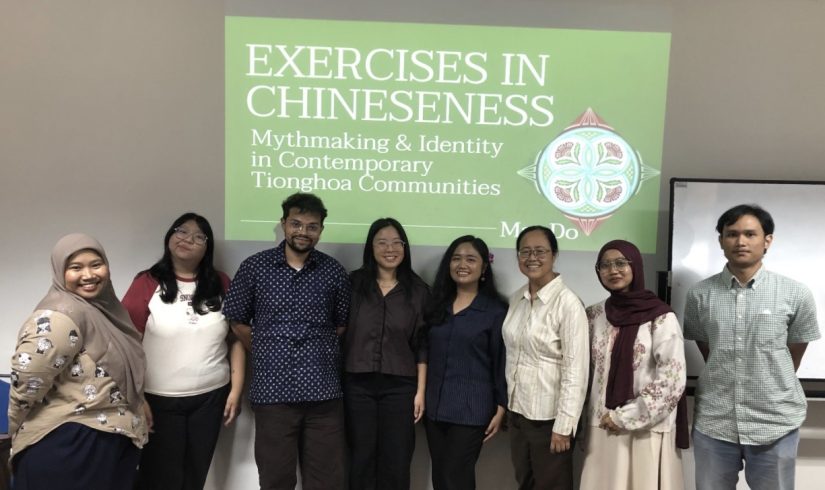
The Master’s Program in Literature once again held a public discussion titled “Exercises in Chineseness: Literature, Mythmaking & Identity in Contemporary Tionghoa Communities” at Room 105 Soegondo, Faculty of Cultural Sciences, Universitas Gadjah Mada, on Wednesday (20/5/2026). The event featured researcher Alexandra Masri Do from Cornell University, moderated by Naria Nur Iftitah from the Master’s Program in Literature, FIB UGM. The discussion explored contemporary Chinese Indonesian identity through literature, collective memory, and everyday cultural practices.
In her presentation, Alexandra highlighted the position of Chinese Indonesians as part of the world’s largest Chinese diaspora population. She explained that Chinese communities in the Indonesian archipelago existed long before the emergence of the modern nation-state, with records of settlements dating back to the seventh century. According to her, “Chinese” identity in Indonesia has never been singular, but rather continuously negotiated through language, culture, historical experience, and intergenerational social relations.
Alexandra also examined how the legacy of Dutch colonialism created social stratifications whose effects continue to persist today. She referred to 1965 and 1998 as two traumatic historical moments deeply embedded in the collective memory of Chinese Indonesian communities. The political circumstances of those periods, she argued, shaped the ways Chinese Indonesians viewed themselves, the state, and the very idea of citizenship.
Through several contemporary literary works, Alexandra demonstrated how the experience of being Chinese in Indonesia is articulated through personal narratives. She quoted The Longing by Alberta Natasia Adji, which portrays the younger generation’s disconnection from their ancestral cultural roots: “I’m a copy of my mother, but I speak the language of the locals. The closest thing I’ve got to my Chinese heritage now is eating noodles with chopsticks and checking my luck according to the Chinese horoscope.”
Referring to the passage, Alexandra noted that Chinese identity often survives only through simple cultural symbols such as chopsticks or zodiac beliefs, while ancestral languages gradually disappear from everyday life.
Beyond literature, Alexandra presented field documentation that she described as both collective and deeply personal, gathered from areas such as Glodok, Pantjoran PIK, Jambi, and Yogyakarta. Photographs of Chinese temples, Chinese schools, markets, and even citizenship archives from 1953 illustrated how Chinese identity continues to be reproduced through social spaces and cultural practices. She referred to this process as “mythmaking,” or the construction of collective narratives surrounding who Chinese Indonesians are and how they are understood.
Alexandra’s research also explored the aspirations of contemporary Chinese Indonesians, particularly the post-1998 generation. She questioned whether the idea of “homeland” is understood as Indonesia, China, or an in-between space of identity. These questions emerge alongside social change, globalization, and the increasing mobility of younger generations.
During the discussion, Alexandra emphasized the importance of fiction and literature as mediums for understanding minority experiences that are often absent from official historical narratives. In her view, literary works are capable of capturing the emotions, anxieties, and hopes of Chinese Indonesian communities more intimately than formal historical documents.
The event proceeded interactively with enthusiastic participation from students and academics. The discussion expanded to issues of discrimination, nationalism, and the representation of Chinese Indonesians in Indonesian popular culture. Through this public lecture, participants were encouraged to see Chinese identity not as a static category, but as an experience continually shaped by history, politics, culture, and everyday life.
[Magister Sastra, Khotibul Umam]
