• About UGM
  • Academic Portal
  • IT Center
  • Library
  • Research
  • Webmail
  • Informasi Publik
  • English
    • Indonesia
Universitas Gadjah Mada Faculty of Cultural Sciences
Universitas Gadjah Mada
  • Home
  • Profile
    • History
    • Vision and Mission
    • Organizational structure
    • Administration
    • Staff
    • Faculty Members
  • Academic
    • Academic Calendar
    • Undergraduate Programs
      • Bachelor of Cultural Antrophology
      • Bachelor in Archaeolagy
      • Bachelor in History
      • Bachelor in Tourism
      • Bochetor in Korean Language and Culture
      • Bachelor in Indonesian Language and Culture
      • Bachelor in English
      • Bachelor in Arabic
      • Bachelor in Japanese Language and Culture
      • Bachelor in Javanese Language, Literature and Culture
      • Bachelor in French language and literature
    • Graduate Programs
      • Master in Antrophology
      • Master in ArchaeoIogy
      • Master in History
      • Master in Linguistics
      • Master in Literature
      • Master In American Studies
      • Master in Middle Eastern Cultural Studies
    • Post-Graduate Programs / S3
      • Doctor in Antropology
      • Doctor in American Studies
      • Doctor in Humanities
    • Student Service
  • KPPM
    • Research Information
    • Scientific / Academic Publications
    • Community Service
    • International Cooperation
    • Domestic Cooperation
  • Student Organizations
    • Student Executive Council
    • Semi-Autonomous Organizations
      • KAPALASASTRA
      • Christian Student Alliance
      • LINCAK
      • Saskine
      • Catholic Student Family
      • Dian Budaya
      • Sastra Kanuragan (sasgan)
      • Family of Muslim Cultural Sciences Students (KMIB)
      • Bejo Mulyo
    • Autonomous Organizations
      • Family of Anthropology Students (KEMANT)
      • English Department Student Association
      • Tourism Students Association (HIMAPA)
      • Family of Indonesian Literature Students (KMSI)
      • West Asian Literature Student Association (IMABA)
      • Association of Korean-Language Students (HIMAHARA)
      • Family of Regional Indonesian Literatures Students (KAMASUTRA)
      • The Family Body of History Students (BKMS)
      • The French Literature Students Association (HMSP)
      • Family of Anthropology Students
      • Japanese Student Association (HIMAJE)
  • Admission
    • Student Evaluation
  • Home
  • UGM Yogyakarta
  • UGM Yogyakarta
Arsip:

UGM Yogyakarta

Three UGM Arabic Literature Students Achieve Success at an International Language Olympiad

ChampionshipNews Release Wednesday, 17 December 2025

Shah Alam, 18 December 2025 – Three students from the Arabic Literature program at Universitas Gadjah Mada recorded notable achievements at the Modern Languages Olympiad 3.0, held at Universiti Teknologi MARA UiTM in Shah Alam, Malaysia. The international competition brought together participants from various countries in a series of multilingual contests, with the main events culminating on 18 December 2025.

In the Arabic Poetry Recital category, Pandhita Hapsari, an Arabic Literature student from the 2023 cohort, won first place and also received the award for Best Script. Another student, Muhammad Hayyi’ Rosyada from the 2024 cohort, secured third place in the same category. Meanwhile, Haris Arfakhsyadz Azka Maula, also from the 2024 cohort, achieved second place in the Arabic Champion Orator category and earned a special award for Best Impromptu Speech. Throughout their participation in Malaysia, the students were officially accompanied by Dr. Zurfa Purnamawati, M.Hum., a lecturer in Arabic Literature at the Faculty of Cultural Sciences UGM, who supported during the competition.

MLO 3.0 was organized by the Academy of Language Studies at UiTM as a language competition featuring four main categories: Malay, English, Arabic, and Mandarin. The event series began with participant registration on 30 October 2025, followed by video submissions for the preliminary round until 6 November 2025. The judging process took place from 10 to 15 November 2025, with the announcement of preliminary results on 18 November 2025. The face-to-face final round was held on 16 December 2025 and concluded with a closing ceremony the following day.

In its official description, the organizing committee stated that the Poetry Recital category is a multilingual poetry writing and recitation competition that encourages expression in multiple languages while celebrating cultural diversity and unity. The Orator Champion category is described as a multilingual speech competition that facilitates the exchange of ideas across traditions, enriching the cultural value of public speaking.

These achievements reflect the students’ strong academic capacity and competitive language skills at the international level. Active participation in global forums of this kind reinforces the role of language as a bridge for intercultural dialogue and highlights the importance of education development that promotes cross-national collaboration for a more sustainable future.

[Public Relations of FIB UGM, Candra Solihin]

Emotional Approach Highlighted in Neuroscience-Based Language Teaching Talk Show at FIB UGM

News ReleaseStudent's Activity Tuesday, 16 December 2025

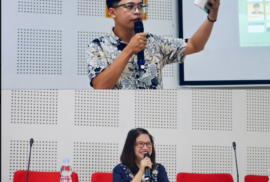
Yogyakarta, December 16, 2025 – The second session of the Neuroscience-Based Language Teaching Talk Show, themed Teaching with Emotion: How Affective Neuroscience Enhances Language, was held at R. Soegondo Building, Room 709, Faculty of Cultural Sciences, Universitas Gadjah Mada. The event discussed the role of emotions in language learning and how a neuroscience-based approach can improve teaching effectiveness.

Moderated by Reski Ramadhani, the talk show featured four speakers: Natasya Ayu, Asmaul Husna, Luailik Mushffa, and Tisa Aini. The discussion focused on teachers’ practical experiences in managing both student and teacher emotions while ensuring that academic objectives are achieved effectively.

One of the speakers, Asmaul Husna, shared her experience conducting a teaching experiment in a basic speaking class at Kampung Inggris. She compared two approaches implemented in different periods, namely a content-focused approach and an emotionally driven approach. “When we build emotional closeness with students, they feel truly valued,” Asmaul said. She added that students who received emotional support showed greater appreciation and more positive feedback at the end of the course.

Luailik Mushffa highlighted the challenges of applying a neuroscience-based approach in the classroom, particularly in relation to teachers’ emotional readiness. She explained that teachers need to regulate their emotions before teaching in order to create a positive learning atmosphere. “In this neuroscience approach, we focus on students’ emotions. However, teachers’ emotions also need to be managed before entering the classroom,” she explained. She also emphasized the importance of maintaining a balance between emotional management and the achievement of learning objectives.

Practical advice was delivered by Tisa Aini, who encouraged teachers to engage in self-reflection before teaching. “Please take five to ten minutes before entering the classroom for a self-check,” she said. According to her, teachers’ emotions are easily transmitted to students, making emotional stability a key foundation for creating a sense of safety in the learning process.

Meanwhile, Natasya Ayu stressed the importance of developing a positive mindset among students toward language learning. She reminded teachers not to frame language learning as something difficult and encouraged the use of contextual and realistic learning materials. In her view, making mistakes while speaking is a natural part of the journey toward language fluency.

Overall, the talk show illustrated that language teaching cannot be separated from emotional aspects, both for students and teachers. A more humane and emotionally aware approach is seen as essential in creating a supportive, sustainable learning environment that remains relevant to learners’ future needs.

[Public Relations of FIB UGM, Candra Solihin]

FIB UGM Academic Community Enlivens the 76th Nitilaku Cultural Parade

News Release Monday, 15 December 2025

Yogyakarta, 14 December 2025. The academic community of the Faculty of Cultural Sciences, Universitas Gadjah Mada, took part in enlivening the Nitilaku Cultural Parade held in celebration of UGM’s 76th anniversary. The FIB UGM delegation, consisting of students, educational staff, and lecturers, joined the cultural procession along a route from the UGM Boulevard Gate to the courtyard of the UGM Rectorate Building. The 2025 Nitilaku Cultural Parade carried the theme Ruwat Rawat Kebangsaan.

During the event, FIB UGM presented a series of artistic performances, including the Bekasak Dance, Buchaechum, Talchum, and a gamelan ensemble, with artistic direction by Jhony and Adhya. Despite the rain that fell throughout the parade, the participants remained enthusiastic and performed their choreography in full. One member of the FIB UGM delegation stated, “The rain did not become an obstacle for us to continue presenting art and conveying cultural messages to the public.”

The Bekasak Dance, a work by Raden Bagus Kusuma, was performed in sustainability-themed costumes made from environmentally friendly materials such as pineapple fiber, bamboo baskets, and vetiver roots. The participation of FIB UGM in the Nitilaku Cultural Parade reflects the role of the academic community in preserving tradition, strengthening national values, and fostering awareness of the importance of harmony among culture, humanity, and the environment in a sustainable manner.

[Public Relations of FIB UGM, Candra Solihin]

UGM Arabic Study Program Students Conduct Field Study in Kudus–Demak to Explore Arab–Islamic and Javanese Cultural Acculturation

News ReleaseStudent's Activity Friday, 12 December 2025

Central Java, 4 December 2025 — Students of the Arabic Study Program, class of 2023, Universitas Gadjah Mada carried out a field study in the cities of Kudus and Demak as part of the course Arabic Literature and Culture in Indonesia. The program was designed to provide empirical learning experiences on the dynamics of Indonesian culture and the historical connections between Arab–Islamic heritage and the development of local civilization.

Kudus and Demak were selected as the field study destinations due to their significant roles in the spread of Islam in Java. Through this field activity, students were expected to observe and analyze cultural heritage on-site and relate their findings to the theories studied in class.

The first destination visited was the Menara Kudus Mosque, also known as the Al-Aqsha Mosque, located in Kauman Village, Kudus, Central Java. Students examined firsthand how the mosque’s architecture, particularly its red-brick tower resembling a Majapahit-style temple, stands as strong evidence of acculturation between Islam and Hindu–Javanese culture. At the Menara Kudus Mosque, students observed Sunan Kudus’ cultural approach to da’wah, from preserving local traditions to utilizing Javanese arts and architectural forms that enabled Islam to be accepted peacefully by the local community. Traditions such as the prohibition of slaughtering cows, as well as Javanese songs and performing arts developed by Sunan Kudus, became part of the learning experience.

The field study continued at the Mubarok Jenang Museum, the first jenang museum in Indonesia, which highlights the history of Kudus’ jenang industry since 1930. Here, UGM Arabic Study Program students learned local wisdoms, particularly the values of Gusjigang (being morally good, mastering religious knowledge, and being skilled in trade) which shaped Kudus’ economic culture and intertwined with the Islamic teachings of Sunan Kudus. The museum offered a distinct experience, enabling students to observe how tradition, family-run industry, and regional identity are presented as public education and developed into creative economic potential.

The students then deepened their understanding of early Islamic da’wah in Java through a visit to the Great Mosque of Demak, a historical Wali Songo site and a central landmark of the Demak Sultanate. They examined the mosque’s traditional Javanese architectural form featuring a three-tiered pyramidal roof and the iconic saka guru pillars, including the legendary saka tatal. This visit provided richer insight into a model of da’wah rooted in local culture, dialogue, and gentle persuasion, reflected in the mosque’s architecture, traditions, and the social life of the surrounding community.

Through this series of field visits, students gained firsthand experience that history is not merely textual, but a living narrative present in buildings, traditions, and societal practices. The field study underscored the importance of understanding acculturation as a key element in the development of Islam in the archipelago which is visible in mosque architecture, local economies, and enduring cultural values.

This field study is expected to broaden the perspectives of Arabic Literature students and strengthen their analytical abilities in interpreting Indonesian cultural phenomena in a more comprehensive and applied manner.


Author: Jihan Pertiwi

UGM Arabic Study Program Students Refresh Their Minds Before Final Exams Through an Outing Class Titled “Lu’bah Arabiyyah”

News Release Wednesday, 10 December 2025

Yogyakarta, 3 December 2025 — A total of 68 first-year students from the Arabic Study Program at Universitas Gadjah Mada (UGM) attend an outing class at Wisdom Park UGM on Wednesday, 3 December 2025. The activity, titled Lu’bah Arabiyyah, served as a collaborative program for Arabic Writing, Arabic Speaking, and Tasrif courses to help students review lesson material through interactive games while refreshing their minds ahead of final exams. The event was accompanied by lecturers from the Arabic Study Program and supported by student tutors from the 2022 and 2023 cohorts.

During Lu’bah Arabiyyah, students are invited to do a series of game stations set up across Wisdom Park. Each game required them to actively use and recall their Arabic skills in preparation for the final exams. Among the activities were Sentence Relay, Puzzle Tasrif, and Arabic crossword puzzles. After completing all stations, the outing concluded with a communal meal and a shared rujak session with lecturers.

The 2025 cohort participated enthusiastically from start to finish. Many students expressed that Lu’bah Arabiyyah boosted their confidence and motivation ahead of the Final Examinations, as the activities helped them recall and reinforce material learned throughout the semester. Beyond academic preparation, the event also strengthened collaborations and intimacy among students, tutors, and lecturers, which is an important foundation for smoother communication and collaboration in future learning processes.


Author: Muhammad Ardiansyah

123…25

Video UGM

[shtmlslider name='shslider_options']
Universitas Gadjah Mada

Faculty of Cultural Sciences
Universitas Gadjah Mada
Jl. Nusantara 1, Bulaksumur Yogyakarta 55281, Indonesia
   fib@ugm.ac.id
   +62 (274) 513096
   +62 (274) 550451

Work Units

  • Office of Journal & Publishing
  • INCULS
  • Information Technology and Database
  • Language Learning Center
  • Library Unit
  • Public Relations
  • Research

Facilities

  • Computer Laboratory
  • Gamelan
  • Guest House
  • Language Library
  • Library
  • Phonetics Library
  • Self Access Unit
  • Student Internet Centre

Importan Links

  • Journal of Humaniora
  • Subscriber Journal
  • Alumni Portal
  • Career
  • Departmens News
  • UGM Streaming

Contacts

  • Academic
  • Administration
  • Dean’s Office
  • Departments / Study Programs
  • Public Relations

© 2024 Faculty of Cultural Sciences Universitas Gadjah Mada

KEBIJAKAN PRIVASI/PRIVACY POLICY

[EN] We use cookies to help our viewer get the best experience on our website. -- [ID] Kami menggunakan cookie untuk membantu pengunjung kami mendapatkan pengalaman terbaik di situs web kami.I Agree / Saya Setuju