• About UGM
  • Academic Portal
  • IT Center
  • Library
  • Research
  • Webmail
  • Informasi Publik
  • English
    • Indonesia
Universitas Gadjah Mada Faculty of Cultural Sciences
Universitas Gadjah Mada
  • Home
  • Profile
    • History
    • Vision and Mission
    • Organizational structure
    • Administration
    • Staff
    • Faculty Members
  • Academic
    • Academic Calendar
    • Undergraduate Programs
      • Bachelor of Cultural Antrophology
      • Bachelor in Archaeolagy
      • Bachelor in History
      • Bachelor in Tourism
      • Bochetor in Korean Language and Culture
      • Bachelor in Indonesian Language and Culture
      • Bachelor in English
      • Bachelor in Arabic
      • Bachelor in Japanese Language and Culture
      • Bachelor in Javanese Language, Literature and Culture
      • Bachelor in French language and literature
    • Graduate Programs
      • Master in Antrophology
      • Master in ArchaeoIogy
      • Master in History
      • Master in Linguistics
      • Master in Literature
      • Master In American Studies
      • Master in Middle Eastern Cultural Studies
    • Post-Graduate Programs / S3
      • Doctor in Antropology
      • Doctor in American Studies
      • Doctor in Humanities
    • Student Service
  • KPPM
    • Research Information
    • Scientific / Academic Publications
    • Community Service
    • International Cooperation
    • Domestic Cooperation
  • Student Organizations
    • Student Executive Council
    • Semi-Autonomous Organizations
      • KAPALASASTRA
      • Christian Student Alliance
      • LINCAK
      • Saskine
      • Catholic Student Family
      • Dian Budaya
      • Sastra Kanuragan (sasgan)
      • Family of Muslim Cultural Sciences Students (KMIB)
      • Bejo Mulyo
    • Autonomous Organizations
      • Family of Anthropology Students (KEMANT)
      • English Department Student Association
      • Tourism Students Association (HIMAPA)
      • Family of Indonesian Literature Students (KMSI)
      • West Asian Literature Student Association (IMABA)
      • Association of Korean-Language Students (HIMAHARA)
      • Family of Regional Indonesian Literatures Students (KAMASUTRA)
      • The Family Body of History Students (BKMS)
      • The French Literature Students Association (HMSP)
      • Family of Anthropology Students
      • Japanese Student Association (HIMAJE)
  • Admission
    • Student Evaluation
  • Home
  • SDGs 17: Partnerships for the Goals
  • SDGs 17: Partnerships for the Goals
  • page. 49
Arsip:

SDGs 17: Partnerships for the Goals

Cucuk Lampah Procession by Ratnaraya at the Graduation Ceremony of Postgraduate Program Period III Academic Year 2023/2024 – July 2024

HEADLINESNews ReleaseSDGs 17: Partnerships for the GoalsSDGs 4: Quality Education Wednesday, 31 July 2024

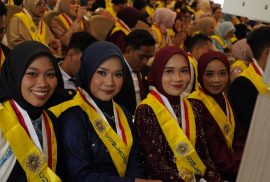
On Wednesday, July 24, 2024, Universitas Gadjah Mada (UGM) held a graduate program graduation for period III of the 2023/2024 academic year with a different feel. The event that took place at Grha Sabha Pramana was opened with a cucuk lampah procession by students of the Javanese Language, Literature, and Culture Study Program who are members of Ratnaraya, the Javanese Language, Literature, and Culture Study Program Student Dance unit.

The students who performed in the cucuk lampah procession included Dhiny, Nanda, Audrey, and Ganes. The procession was followed by the rector of Universitas Gadjah Mada, Prof. dr. Ova Emilia, M.Med.Ed., Sp.OG(K)., Ph.D., chairman of Kagama Pusat, Ganjar Pranowo, and the deans of Universitas Gadjah Mada’s master program. They were accompanied by gending Sesanti Gadjah Mada, a composition created by Djoko Walujo.

In an interview conducted on July 26, 2024, Audrey, one of the students who participated in the procession, expressed her experience. “Usually we perform traditional dances in an event, but this time we did the cucuk lampah tradition, accompanying the Rector, Mr. Ganjar, and the postgraduate deans. This is a very memorable new experience for us,” she explained.

Reported in desatepus.gunungkidulkab.go.id (2023, September 07), the cucuk lampah tradition is a traditional Javanese wedding tradition in the form of a procession, accompanying the bride and groom to the aisle. The position of the cucuk lampah dancers is in front, followed by pager ayu and pager bagus, the bride and groom, and the bridal family. The purpose of cucuk lampah for Javanese people is as a repellent that can interfere with marriage. However, in this postgraduate graduation ceremony, the tradition is adjusted so that it is relevant to the atmosphere and purpose of the event.

The preservation of Indonesian traditions and culture has deep aesthetic, teaching, and philosophical values. Activities such as these demonstrate effective efforts in preserving and passing on the nation’s identity with adjustments to the relevance of the times. Cooperation from various parties is needed to encourage cultural preservation and inheritance. By presenting cucuk lampah in the graduation ceremony, thus, the presence of cucuk lampah in the graduate program graduation ceremony is in accordance with the 4th point of the Sustainable Development Goals (SDG’s), namely improving the quality of education, and the 17th point, namely partnerships to achieve goals.

Author: Haryo Untoro

BIBLIOGRAPHY

Desatepus.gunungkidulkab.go.id (2023, September 07), Cucuk Lampah dalam Pernikahan Jawa: Simbolisme dan Tradisi yang Mengesankan. Diakses pada 29 Juli 2024, dari https://desatepus.gunungkidulkab.go.id/first/artikel/2708-Cucuk-Lampah-dalam-Pernikahan-Jawa–Simbolisme-dan-Tradisi-yang-Mengesankan#:~:text=Cucuk%20Lampah%20adalah%20salah%20satu,keindahan%20dan%20makna%20dalam%20pernikahan.

Students from the Korean Language and Culture Program at UGM Win First Place in the 2024 Korean-Indonesian Translation Competition by the Korean Cultural Center Indonesia

HEADLINESNews ReleaseSDGs 11: Sustainable cities and communitiesSDGs 17: Partnerships for the GoalsSDGs 4: Quality Education Wednesday, 31 July 2024

Jakarta, May 27, 2024 – The Korean Language and Culture Program at UGM sent six students to participate in the Translation Competition organized by the Korean Cultural Center Indonesia. The six students were Aisyah Dian Safitri, Amarapallevi, Vanesa Olivia, Melisa Azzahra Tania, Nisa Khairuna Sabilla, and Pingkan Widiana Retno Utami.

The event began with an opening ceremony. Following the opening, the competition sessions commenced. The competition was divided into two sessions. The first session involved translating from Indonesian to Korean. After this session, there was a break. The second session then began, which involved translating from Korean to Indonesian. The event concluded with a closing ceremony.

The winners were announced a few weeks after the competition took place. Students from the Korean Language and Culture Program won honorable mentions in this competition. The two students were Vanesa Olivia and Amarapallevi.

This competition provided a platform for students to showcase their potential, specifically their translation skills from Indonesian to Korean and vice versa. This ability is one of the key competencies that the Korean Language and Culture Program at UGM aims for each of its students to possess. Of course, this achievement was made possible by the students’ courage and willingness, as well as the guidance provided by all the program’s lecturers.


Photo 1.1: Competition Participants

Two Lecturers and a Student of Javanese Language, Literature, and Culture Join the International Intensive Course in Old Javanese Language

HEADLINESNews ReleaseSDGs 10: Reduced InequalitiesSDGs 17: Partnerships for the GoalsSDGs 4: Quality Education Tuesday, 30 July 2024

The National Library and École française d’Extrême-Orient (EFEO) collaborated and held an international intensive course in Old Javanese on July 01-10, 2024. This activity took place at The Cangkringan Jogja Villas & Spa, Umbulharjo, Cangkringan, Sleman, Yogyakarta, and was attended by 25 participants from various backgrounds. Experts in the field of Old Javanese were present to train the participants to understand the intricacies of the Old Javanese language.

The Javanese Language, Literature, and Culture Study Program, Faculty of Cultural Sciences, Universitas Gadjah Mada (FIB UGM), participated in this activity. Two lecturers of the Javanese Language, Literature, and Culture Study Program, namely Nurmalia Habibah, S.S., M.A., and Zakariya Pamuji Aminullah, S.S., M.A., attended as lecturers. In addition, Haryo Untoro, a student from the same study program, became one of the participants in the intensive course.

For 10 days, the participants practiced the Old Javanese language. In the first five days, the first thing to understand was the morphosyntax of the Old Javanese language. The next five days, the participants began to explore works that use the Old Javanese language, such as Adiparwa, Kakawin Ramayana, Pararaton, Landa Inscription, and others. In addition, participants also participated in an excursion program to several ancient sites of the Hindu-Buddhist period, namely Sewu Temple, Plaosan Temple, and Ratu Boko Temple.

The intensive course in Old Javanese aims to train philologists in the field of Old Javanese and encourage international collaboration in this rare field. The field of Old Javanese plays an important role in revealing various treasures of the past, both in culture, knowledge, history, and other matters. Exploring these treasures is an effort to reveal the identity of the nation and improve the quality of education. To achieve these goals, cooperation from various parties is needed to realize the sustainability of the Old Javanese field and be relevant to the times.

Author : Haryo Untoro

Learning and Delving into Parenting Issues through the Workshop ‘Existence is Care: Health, care, and support structures in postcolonial contexts of high cultural diversity

HEADLINESNews ReleaseSDGs 10: Reduced InequalitiesSDGs 17: Partnerships for the GoalsSDGs 4: Quality Education Tuesday, 30 July 2024

From Monday to Wednesday, July 15-17, 2024, the Department of Anthropology at FIB UGM, in collaboration with the University of Münster, Germany, held the Workshop ‘Existence is Care: Health, care, and support structures in postcolonial contexts of high cultural diversity.’ The selection of this workshop theme was based on the increasingly dynamic field of health studies, especially in the context of global caregiving. This workshop aimed to provide a forum to discuss its impact on everyday health services and broader health services in various forms and meanings. The global caregiving system, characterized by the standardization of therapy and taxonomy—which continues despite uneven resource distribution—raises the question: what are the implications of efforts to homogenize caregiving and kinship relationships in Indonesia?

The event was attended by academics and care practitioners from various fields of study such as Anthropology, Psychology, and Medicine. Over three days, participants attended public lectures by guest speakers from Germany and the United States and presented research designs related to caregiving issues from various regional contexts. Prof. Dr. Pujo Semedi Hargo Yuwono, M.A., opened the event and served as the keynote speaker on the first day, followed by commentary from Prof. Dr. Thomas Stodulka from the University of Münster. To conclude the first day’s discussion and provide deeper context on the issue, the film ‘The Sacrifice’ by Prof. Robert Lemelson was screened.

On the second day, Prof. Byron Good from Harvard University presented his research from the book ‘Haunted by Aceh: Toward an Anthropological Hauntology (Hantuologi)’ followed by presentations from several participants, including:

  • “Caring through the unknown. The uncertainty of navigating complex cultural contexts of severe mental pain” by Florin Cristea
  • “‘Ngemong’: Caring for Person with Schizophrenia in Java” by Yohanes K. Herdiyanto, Subandi, Wenty M. Minza
  • “Pasung: The practice of caring? Family’s challenges of giving care to persons with serious and persistent mental illness” by Tri Hayuning Tyas
  • “In the Name of Virtue: Religion in the Care Work of Community Health Worker” by Chusna Cahya Marhaeni
  • “Sacred Service: Unveiling the Drive and Hurdles of Volunteer Nurses in Indonesia” by Irmayani Said
  • “The Hypnotist’s Dilemma: Mystical Recuperation and Counterproductive Care in Postcolonial Indonesia” by Nick Long
  • “Care (and) Work in the Female Sphere” by Mona Elisa Behnke
  • “Making it Inclusive: Caring for Refugee Patients in Indonesian Puskesmas” by Elan Lazuardi & Realisa Masardi
  • “Early Child Care in Indonesian Dual Breadwinner Family” by Nuzul Solekhah
  • “Where Do We Go from the Doorstep? Demystifying Family and Imagining the Collective through Queer Care” by Pychita Julinanda
  • “Collective care initiative as a means to share the potentiality for a space of hope” by Khairunnisa

On the final day, the event concluded with a discussion by Prof. Mary-Jo Delvecchio-Good from Harvard University, Retna Siwi Padmawati from Medicine, FKKMK UGM, and Lintang Sagoro from Harvard Medical School, discussing ‘Care at the End of Life in Indonesia’ and a Closing Discussion by Ciptaning Larastiti & Khairunnisa moderated by Dr. Elan Lazuardi on the topic ‘Imagine! Once we stopped caring? Care as Methodology.’ The entire workshop series then concluded with a dinner at Yabbiekayu Resto, Bantul.

Photo credit: Puspita Anindya/Novilatul/Daiva Keefe

Author: Asmi Ramiyanti

Editor: Okky Chandra Baskoro

A Visit from Queen Mary University of London and SOAS University of London

HEADLINESNews ReleaseSDGs 17: Partnerships for the GoalsSDGs 4: Quality Education Tuesday, 30 July 2024

On Wednesday, 18 July 2024, english Department UGM received a  visit from Prof. Angus James Nicholls, Ph.D, professor of Comparative Literature and German Language of  Queen Mary University of London and Dr. Soe Tjen Marching, a lecturer in South East Asian studies in School of Oriental and African Studies (SOAS) University of London. The purpose of Prof. Angus James Nicholls, Ph.D and Dr. Soe Tjen Marching’s visit was to discuss a possibility of partnership between the Faculty of Cultural Sciences UGM, especially the English Literature Program and Department of Language and Literature, with Queen Mary University of London and SOAS University of London to fulfil IKU 6. The discussion was conducted at the Faculty of Cultural Sciences UGM, led by Dr. Nur Saktiningrum, M.Hum., Vice Dean of Academic and Student Affairs and a lecturer in the English Department UGM. 

The topic regarding the challenges of teaching literature in the era of technological development was discussed in the meeting. One of the challenges is how to anticipate the use of AI in literary studies. AI’s ability to automatically generate text can be an obstacle in the learning process if being abused by students. Another example of the challenges is how to teach literature to Gen Z, through digital media and social media. 

Apart from the discussion about challenges in teaching literature in the current era, there was also a discussion about the forms of collaboration that can be implemented between the Faculty of Cultural Sciences UGM, especially the English Literature Program and Department of Language and Literature, with Queen Mary University of London and SOAS University of London. The potential collaborations can be done through some courses (such as World Literature and COmparative Literature) and a collaborative class in the form of team teaching. These collaborations have many possibilities to be developed in the future.

1…4748495051…64

Video UGM

[shtmlslider name='shslider_options']
Universitas Gadjah Mada

Faculty of Cultural Sciences
Universitas Gadjah Mada
Jl. Nusantara 1, Bulaksumur Yogyakarta 55281, Indonesia
   fib@ugm.ac.id
   +62 (274) 513096
   +62 (274) 550451

Work Units

  • Office of Journal & Publishing
  • INCULS
  • Information Technology and Database
  • Language Learning Center
  • Library Unit
  • Public Relations
  • Research

Facilities

  • Computer Laboratory
  • Gamelan
  • Guest House
  • Language Library
  • Library
  • Phonetics Library
  • Self Access Unit
  • Student Internet Centre

Importan Links

  • Journal of Humaniora
  • Subscriber Journal
  • Alumni Portal
  • Career
  • Departmens News
  • UGM Streaming

Contacts

  • Academic
  • Administration
  • Dean’s Office
  • Departments / Study Programs
  • Public Relations

© 2024 Faculty of Cultural Sciences Universitas Gadjah Mada

KEBIJAKAN PRIVASI/PRIVACY POLICY

[EN] We use cookies to help our viewer get the best experience on our website. -- [ID] Kami menggunakan cookie untuk membantu pengunjung kami mendapatkan pengalaman terbaik di situs web kami.I Agree / Saya Setuju