• About UGM
  • Academic Portal
  • IT Center
  • Library
  • Research
  • Webmail
  • Informasi Publik
  • English
    • Indonesia
Universitas Gadjah Mada Faculty of Cultural Sciences
Universitas Gadjah Mada
  • Home
  • Profile
    • History
    • Vision and Mission
    • Organizational structure
    • Administration
    • Staff
    • Faculty Members
  • Academic
    • Academic Calendar
    • Undergraduate Programs
      • Bachelor of Cultural Antrophology
      • Bachelor in Archaeolagy
      • Bachelor in History
      • Bachelor in Tourism
      • Bochetor in Korean Language and Culture
      • Bachelor in Indonesian Language and Culture
      • Bachelor in English
      • Bachelor in Arabic
      • Bachelor in Japanese Language and Culture
      • Bachelor in Javanese Language, Literature and Culture
      • Bachelor in French language and literature
    • Graduate Programs
      • Master in Antrophology
      • Master in ArchaeoIogy
      • Master in History
      • Master in Linguistics
      • Master in Literature
      • Master In American Studies
      • Master in Middle Eastern Cultural Studies
    • Post-Graduate Programs / S3
      • Doctor in Antropology
      • Doctor in American Studies
      • Doctor in Humanities
    • Student Service
  • KPPM
    • Research Information
    • Scientific / Academic Publications
    • Community Service
    • International Cooperation
    • Domestic Cooperation
  • Student Organizations
    • Student Executive Council
    • Semi-Autonomous Organizations
      • KAPALASASTRA
      • Christian Student Alliance
      • LINCAK
      • Saskine
      • Catholic Student Family
      • Dian Budaya
      • Sastra Kanuragan (sasgan)
      • Family of Muslim Cultural Sciences Students (KMIB)
      • Bejo Mulyo
    • Autonomous Organizations
      • Family of Anthropology Students (KEMANT)
      • English Department Student Association
      • Tourism Students Association (HIMAPA)
      • Family of Indonesian Literature Students (KMSI)
      • West Asian Literature Student Association (IMABA)
      • Association of Korean-Language Students (HIMAHARA)
      • Family of Regional Indonesian Literatures Students (KAMASUTRA)
      • The Family Body of History Students (BKMS)
      • The French Literature Students Association (HMSP)
      • Family of Anthropology Students
      • Japanese Student Association (HIMAJE)
  • Admission
    • Student Evaluation
  • Home
  • SDGs 17: Partnership for the Goals
  • SDGs 17: Partnership for the Goals
  • page. 5
Arsip:

SDGs 17: Partnership for the Goals

Noviyanti Alfitri Inaugurated as The Diajeng of Gunungkidul 2025

HEADLINESNews ReleaseSDGs 11: Sustainable cities and communitiesSDGs 17: Partnerships for the GoalsStudent's Activity Thursday, 27 March 2025

Yogyakarta, 27/3/2025 – Noviyanti Alfitri (NIM 24/533646/SA/22795), a 2024 student from the Javanese Language, Literature, and Culture study program, inaugurated as a Diajeng Gunungkidul 2025 at the end of February. Diajeng is a representation of a young woman from a regency—in this case, Gunungkidul Regency—specifically in the field of tourism. Usually Diajeng is paired with Dimas (as a representation of youngman). They promote nature and culture-based tourism in their district and become icons for young people.

The selection process for the Dimas-Diajeng icon began in December 2024. Starting from the selection of files and administration, written selection, interview selection, then the announcement of 15 finalists who were quarantined, and officially crowned on the coronation night on February 22, 2025.

As the holder of the title Diajeng Gunungkidul, Noviyanti or who is familiarly called Upik has the main responsibility of assisting in the marketing sector at the Tourism Office in promoting tourism in Gunungkidul Regency.

Not the coronation night, according to Upik, the most memorable experience during the Dimas-Diajeng selection process was during quarantine. During the quarantine period, Upik gained a lot of knowledge ranging from tourism, culture, regional specialties, public speaking, and others. This increased Upik’s knowledge and Upik learned a lot of new things during the quarantine period.

In addition to the most memorable moments, Upik also said that she had difficulty in time management. Because of the tight timeline of the selection process, Upik had to adjust her lecture schedule at UGM with her other activities. However, fortunately Upik was able to go through everything smoothly by making a priority scale.

Even though she has been named Diajeng Gunungkidul 2025, Upik realizes that she is still part of the UGM Javanese Language, Literature, and Culture students. Therefore, Upik wants to contribute a lot to her study program. She wants to do several things; become a writer or participant in the Ubud Writers & Readers Festival in Bali, become a talent or production team in the Gugur Gunung activity, and maybe take part in a competition to bring the name of the study program. In addition, Upik also has an ambition to be able to write her own anthology. 

Wow, it seems like Upik has so many desires and ambitions! Hopefully, all of Upik’s ambitions can be achieved smoothly without any significant obstacles. With this story, hopefully other students will also be motivated to do what they like and develop themselves even more!

[Public Relations of Javanese Literature, Fega Achillea Maydena]

INCULS Regular Program Registration Opens Now!

HEADLINESNews ReleaseSDGs 17: Partnerships for the GoalsSDGs 4: Quality Education Wednesday, 26 March 2025

Yogyakarta, 26/3/2025 –   Get ready for an exciting learning journey in the Odd Semester 2025/2026! Join the INCULS Regular Program at UGM, where you can enhance your Indonesian language skills while experiencing Indonesia’s rich culture.

Registration Period: March 21 – May 26, 2025

Location: Online at admission.ugm.ac.id/registration

Program: INCULS Regular Program (Odd Semester 2025/2026)

Register now and be part of an international learning experience!

Open to the public!

Regular Program

An offline learning program held in 15-17 weeks (1 semester). Every year, INCULS holds two semesters of the regular program. The 1st semester begins in early August and the 2nd semester begins in February for each academic year. 

In this program, students in the beginner level are assigned to take 12 credits (12 hours/week). Students in the intermediate level must register for a minimum of 8 credits and maximum of12 credits. Students in the advanced level must register for a minimum of 6 credits and maximum of 12 credits. 

Aside from the language courses (reading, writing, conversation, listening, grammar, and vocabulary), INCULS also provides elective courses such as Translation of English Indonesian, Translation of Japanese-Indonesian, Indonesian for Research, Translation of Korean-Indonesian, Indonesian History, Indonesian Culture, Indonesian Politics, Indonesian Language and Literature, and Indonesian Tourism. 

All subjects are taught by professors of the Faculty of Cultural Sciences, UGM. At the end of the course, students will receive a certificate of completion and transcript signed by the Dean of the Faculty of Cultural Sciences, Gadjah Mada University.

For More Information: https://bit.ly/INCULSBrochure

How To Apply: https://bit.ly/INCULSHowtoApply

Apply Here: admission.ugm.ac.id/registration

[Public Relations of INCULS, Decika Syahda Maharani]

Synergy between UGM’s Tourism Study Program and Saxion University: Opportunities for Academic Collaboration to Encourage Quality Education in the Tourism Sector with Global Standards

HEADLINESNews ReleaseSDGs 17: Partnerships for the GoalsSDGs 4: Quality Education Tuesday, 25 March 2025

Yogyakarta, 25/3/2025 – Tourism Study Program, Faculty of Cultural Sciences (FIB), Universitas Gadjah Mada (UGM) held a cooperation meeting with Saxion University on Friday, February 28, 2025. This visit is part of the ongoing cooperation established between the two institutions in recent years and is an important momentum in strengthening academic collaboration globally. The visit was attended by representatives from Saxion University, Jan Willem Meijerhof, as Head of Internationalization, Hospitality Business School, and Jasja Bos, Manager International Partnerships.

The discussion at FIB campus focused on curriculum comparison between the two institutions. The meeting further aims to initiate curriculum alignment as well as explore opportunities for more collaborative program development in the future. With this exchange of insights, it is expected to create a curriculum that is increasingly relevant to the needs of the global tourism industry and produce graduates who are ready to compete at the international level.

Mimi Savitri, M.A. Ph. D., Vice Dean for Research, Community Service, Cooperation, and Alumni of FIB UGM, expressed her hope that cooperation with Saxion University will continue to help implement the vision of the Tourism Study Program in providing quality education with international collaborations. Cooperation between universities, both locally and globally, is a key factor in improving the quality of education, especially in the tourism sector which is dynamic and cross-cultural.

One form of cooperation that is possible to be implemented in the near future is a student exchange program. This program is expected to provide cross-cultural learning experiences for students of both institutions and broaden their horizons in the field of tourism and hospitality. With the exchange program, students are expected to gain broader and new perspectives, understand best practices in various countries, and develop professional networks early on.

The collaboration between the Tourism Study Program of FIB UGM and Saxion University is in line with the commitment to support sustainable development goals, especially SDG 4: Quality Education and SDG 17: Partnerships to Achieve Goals. Hopefully, this collaboration will not only strengthen academic collaboration at the global level but also improve the standard of tourism education in Indonesia, create excellent graduates, and contribute to the development of a more sustainable and inclusive tourism industry.

[Public Relations of Tourism  Department FIB UGM, Muhammad Alif]

Enhancing Educational Collaboration for Quality Human Resources: Darunnajah University, Tazakka Modern Islamic Boarding School, and KBTT FIB UGM Discuss Sustainable Human Resource Development

HEADLINESNews ReleaseSDGs 16: Peace justice and strong institutionsSDGs 17: Partnerships for the GoalsSDGs 4: Quality Education Tuesday, 25 March 2025

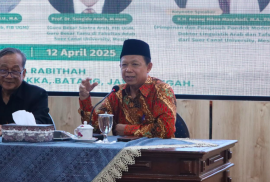
Yogyakarta, 25/3/2025 – To enhance collaboration and improve human resources (HR) quality for the next generation, the Middle Eastern Cultural Studies Masters Program (KBTT) at the Faculty of Cultural Sciences, Universitas Gadjah Mada (FIB UGM), hosted a visit from strategic partners on Thursday, March 6, 2025. Representatives from Darunnajah University Jakarta, along with the Head of Pondok Modern Tazakka in Batang and Mr. Irman Adi Purwanto Moefti, the Trade Attaché of the Indonesian Embassy in Cairo, participated in discussions regarding the challenges and opportunities for HR development in various educational institutions. The visit was warmly received by Prof. Dr. Sangidu, M.Hum., the Head of the Intercultural Department at FIB UGM, who highlighted the importance of synergy between educational institutions in producing exceptional graduates capable of contributing to sustainable development.

The productive discussion emphasized the crucial role of higher education in enhancing the quality of human resources at Islamic boarding schools and universities. Prof. Dr. Sangidu, M.Hum., stated that higher education should serve as a strong foundation for students to develop their potential across various fields, particularly in the context of globalization and sustainability. This view is shared by KH. Hadiyanto Arief, S.H., M.Bs., from Darunnajah University Jakarta, who stressed the importance of academic support for students to prepare them for future challenges. Additionally, KH. Anang Rikza Masyhadi, M.A., Ph.D., Head of the Tazakka Modern Islamic Boarding School, highlighted the necessity of ongoing academic collaboration by sending Islamic boarding school cadres to the KBTT Study Program at FIB UGM. This initiative aims to cultivate competent future leaders who can transform Islamic boarding schools into responsible institutions.

This activity not only strengthens the relationships between partners but also opens up new opportunities for community service and more inclusive academic development. Through this discussion, we aim to create strategic programs that support the achievement of the Sustainable Development Goals (SDGs), particularly in the area of quality education (SDG 4). The collaboration between the KBTT UGM Study Program, Darunnajah University, and Pondok Modern Tazakka is a significant step towards implementing SDG 17, which focuses on partnerships to achieve the goals of building exceptional human resources. These resources will not only be academically competent but also possess a strong social awareness, contributing to the progress of both the nation and the world.

[Public Relations Master of Middle East Faculty of Cultural Sciences UGM, Nafila Azzahra]

Kemant Visits the Department of Mechanical and Industrial Engineering Library

HEADLINESNews ReleaseSDGs 17: Partnerships for the GoalsSDGs 4: Quality EducationSDGs 9: Industry innovation and infrastructure Tuesday, 25 March 2025

Yogyakarta, 24/3/2025 – On Friday, March 21st, 2025, Keluarga Mahasiswa Antropologi (Kemant) UGM went westward to the Faculty of Engineering, to visit the Library of the Department of Mechanical and Civil Engineering (DTMI). DTMI has been sending invitations to student bodies all across the university to visit their library, to share what they’ve been developing these past few months: a library that provides a comfortable public space for students. The library sits on the southern part of the department building, right next to the parking lot. The space inside it is moderately big, about twice the size of the Anthropology Reading Room on the fifth floor of Soegondo. In front of the entrance, sits a locker for students to put their bags in.  Next to that is the receptionist table, and next to that are rows of tall bookshelves filled all the way to the top. Books of many different kinds can be found; from the typical engineering books about Autocad and metallurgy, to fictional novels and even some biographies. Beside these bookshelves, many students are sitting in an arrangement of tables – some are doing their homework, some are playing board games, and some are merely socializing with each other. The library has a built-in decibel-meter, used to measure the sound level in the room; it beeps loudly when the sound goes over a certain threshold, a reminder to the students to keep it down. Aside from the main room with shelves and tables, the library also holds two isolated rooms – walled up with glass – to serve as meeting/reading rooms, where students who need more silence can go and sit.

Dhika, a third-year mechanical engineering student serving part-time as the library keeper, explained that this vibrant atmosphere is a relatively new experience. Back then, the DTMI Library was a cramped space that seldom held visitors. With dreams of an easy and accessible public space for students, Dhika and a few friends of his then advocated for the improvement of the library. The space was renovated, lifting up the ceiling and widening the interior. The book collection was expanded to hold more kinds of books, not just limited to engineering guides. Some professors also donated to the library’s collection; not just books, but also board games to enrich the place. Another thing that changed was the opening hours. Whereas back then the library was only open during working hours on Monday to Friday, nowadays the place can be accessed by students from morning until night, seven days a week. With these changes, the library became a gathering place where students can spend their time on campus, facilitated by the existence of myriad books and games in the library. The once-barren place is now filled with student activity, and the whole place became more lively.

After the tour, the Kemant representatives were free to explore the library by themselves. Some read the new book additions that haven’t been sorted into shelves, but most tried to play the board games that are available. While accompanying the excited students, Dhika reiterated the point of this visit: spreading awareness to students from all over UGM about the importance of a common space such as the DTMI Library, and to help realize the dream of a public space for students from all faculties and departments.

[Public Relations of Cultural Anthropology, Amadeus Abhirama Paramanindita]

1…34567…13

Video UGM

[shtmlslider name='shslider_options']
Universitas Gadjah Mada

Faculty of Cultural Sciences
Universitas Gadjah Mada
Jl. Nusantara 1, Bulaksumur Yogyakarta 55281, Indonesia
   fib@ugm.ac.id
   +62 (274) 513096
   +62 (274) 550451

Work Units

  • Office of Journal & Publishing
  • INCULS
  • Information Technology and Database
  • Language Learning Center
  • Library Unit
  • Public Relations
  • Research

Facilities

  • Computer Laboratory
  • Gamelan
  • Guest House
  • Language Library
  • Library
  • Phonetics Library
  • Self Access Unit
  • Student Internet Centre

Importan Links

  • Journal of Humaniora
  • Subscriber Journal
  • Alumni Portal
  • Career
  • Departmens News
  • UGM Streaming

Contacts

  • Academic
  • Administration
  • Dean’s Office
  • Departments / Study Programs
  • Public Relations

© 2024 Faculty of Cultural Sciences Universitas Gadjah Mada

KEBIJAKAN PRIVASI/PRIVACY POLICY

[EN] We use cookies to help our viewer get the best experience on our website. -- [ID] Kami menggunakan cookie untuk membantu pengunjung kami mendapatkan pengalaman terbaik di situs web kami.I Agree / Saya Setuju