• About UGM
  • Academic Portal
  • IT Center
  • Library
  • Research
  • Webmail
  • Informasi Publik
  • English
    • Indonesia
Universitas Gadjah Mada Faculty of Cultural Sciences
Universitas Gadjah Mada
  • Home
  • Profile
    • History
    • Vision and Mission
    • Organizational structure
    • Administration
    • Staff
    • Faculty Members
  • Academic
    • Academic Calendar
    • Undergraduate Programs
      • Bachelor of Cultural Antrophology
      • Bachelor in Archaeolagy
      • Bachelor in History
      • Bachelor in Tourism
      • Bochetor in Korean Language and Culture
      • Bachelor in Indonesian Language and Culture
      • Bachelor in English
      • Bachelor in Arabic
      • Bachelor in Japanese Language and Culture
      • Bachelor in Javanese Language, Literature and Culture
      • Bachelor in French language and literature
    • Graduate Programs
      • Master in Antrophology
      • Master in ArchaeoIogy
      • Master in History
      • Master in Linguistics
      • Master in Literature
      • Master In American Studies
      • Master in Middle Eastern Cultural Studies
    • Post-Graduate Programs / S3
      • Doctor in Antropology
      • Doctor in American Studies
      • Doctor in Humanities
    • Student Service
  • KPPM
    • Research Information
    • Scientific / Academic Publications
    • Community Service
    • International Cooperation
    • Domestic Cooperation
  • Student Organizations
    • Student Executive Council
    • Semi-Autonomous Organizations
      • KAPALASASTRA
      • Christian Student Alliance
      • LINCAK
      • Saskine
      • Catholic Student Family
      • Dian Budaya
      • Sastra Kanuragan (sasgan)
      • Family of Muslim Cultural Sciences Students (KMIB)
      • Bejo Mulyo
    • Autonomous Organizations
      • Family of Anthropology Students (KEMANT)
      • English Department Student Association
      • Tourism Students Association (HIMAPA)
      • Family of Indonesian Literature Students (KMSI)
      • West Asian Literature Student Association (IMABA)
      • Association of Korean-Language Students (HIMAHARA)
      • Family of Regional Indonesian Literatures Students (KAMASUTRA)
      • The Family Body of History Students (BKMS)
      • The French Literature Students Association (HMSP)
      • Family of Anthropology Students
      • Japanese Student Association (HIMAJE)
  • Admission
    • Student Evaluation
  • Home
  • American Studies
  • American Studies
Arsip:

American Studies

American Studies Guest Lecture “Huck Finn’s Back Pages: or, Bob Dylan and Major Problems in American Literature.”

News Release Tuesday, 23 June 2026

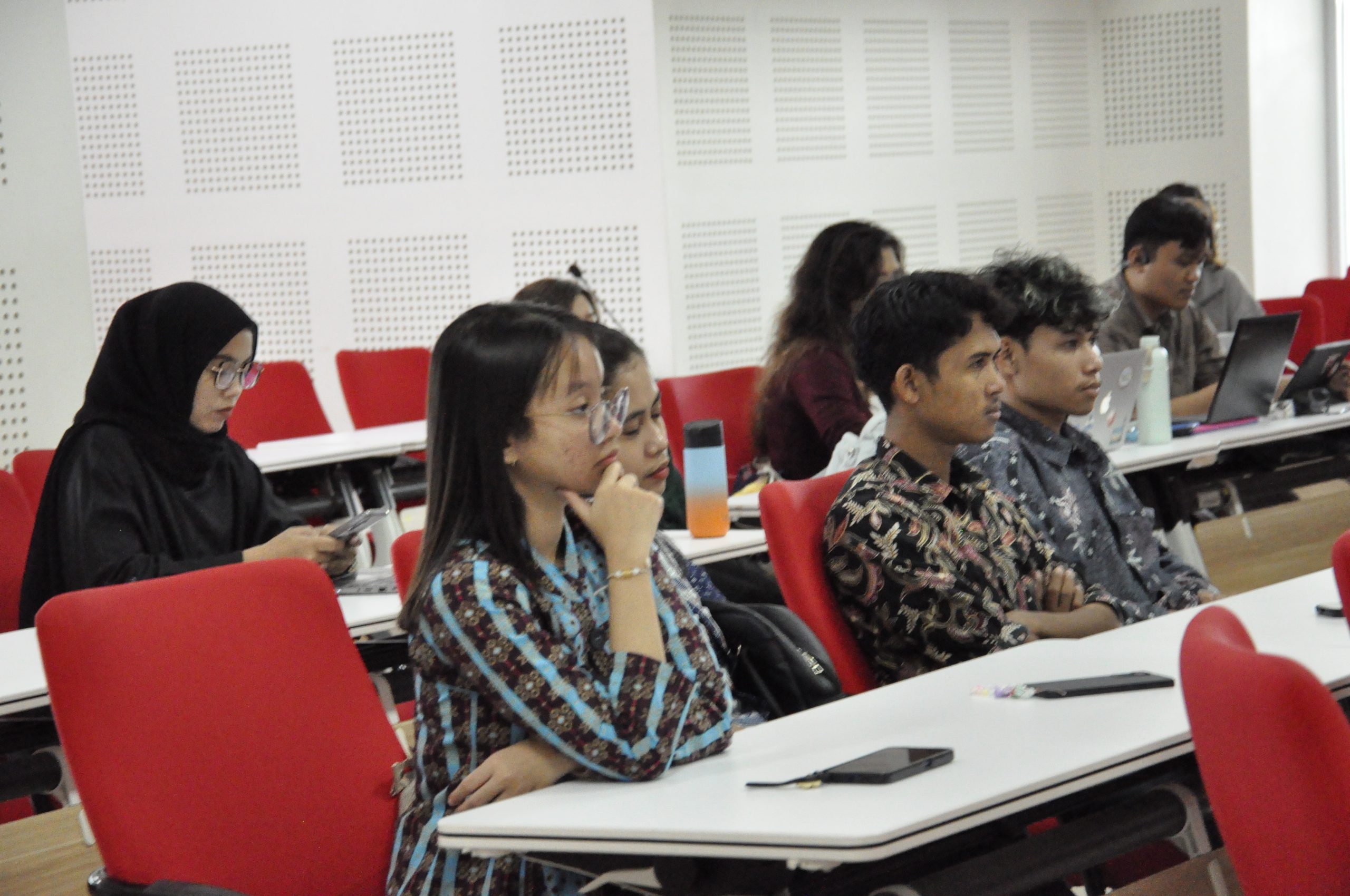
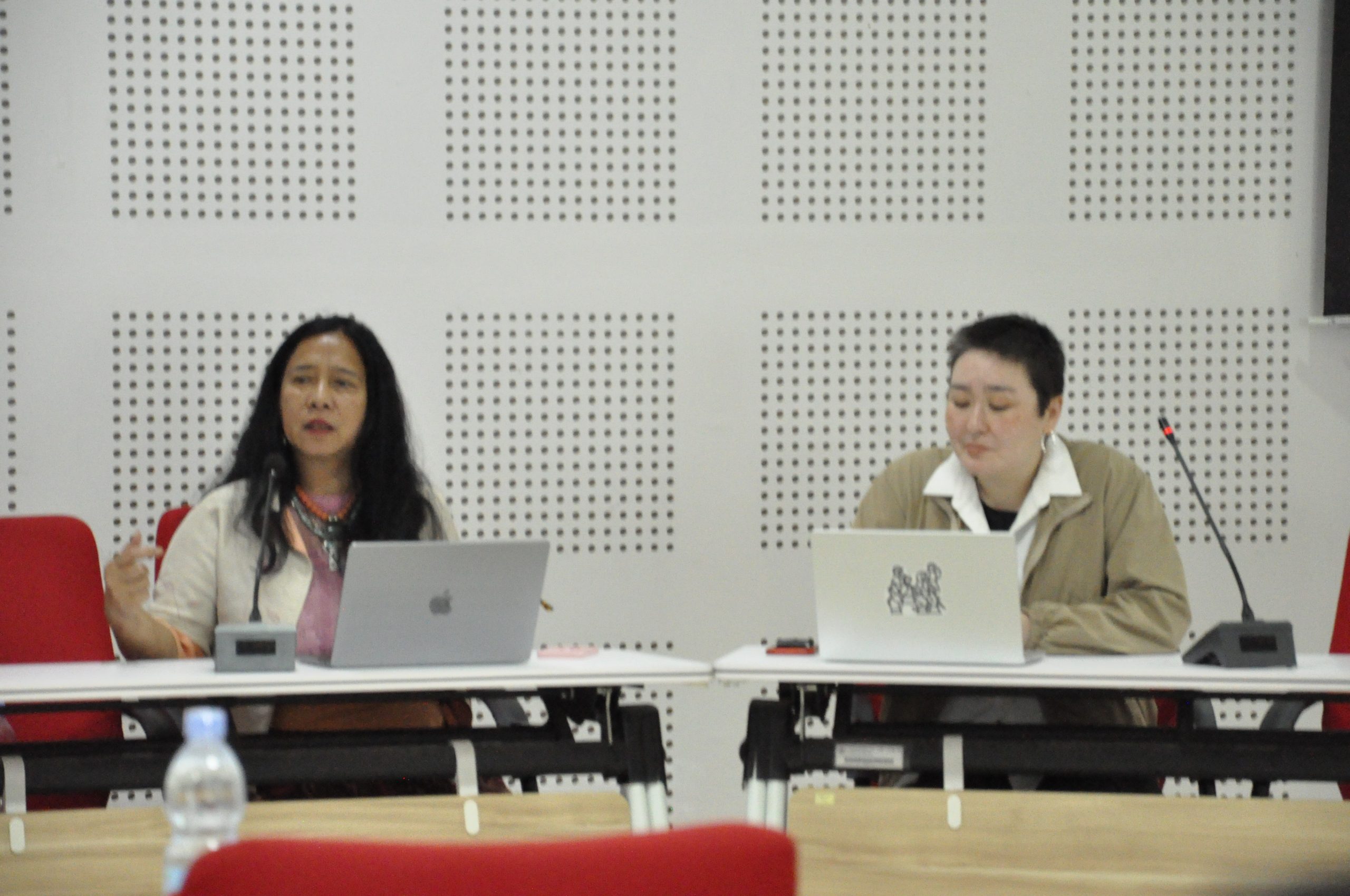
Yogyakarta, June 2026 —  The American Studies Program was honored to welcome Professor of English from Brigham Young University and also a Fulbright Senior Scholar, Brian Russel Roberts, for a guest lecture titled “Huck Finn’s Back Pages: or, Bob Dylan and Major Problems in American Literature”, on Friday, June 5th, 2026 at Ruang Sidang 1, Poerbatjaraka building.

Widely recognized as one of the most influential musicians of the twentieth century, Bob Dylan has left a mark not only on music but also on literature and American culture. In this lecture, Professor Brian invited participants to explore Dylan’s relationship with American literature and examined why his work continues to spark discussions about the boundaries of literature itself. 

The lecture focused on Dylan’s connection to Mark Twain’s classic novel Adventures of Huckleberry Finn. At first glance, a folk singer and a fictional boy traveling down the Mississippi River may seem unrelated. However, Professor Brian showed how both Dylan and Huck Finn not only share the same style of hat but also share themes of freedom, questioning authority, and challenging social norms. 
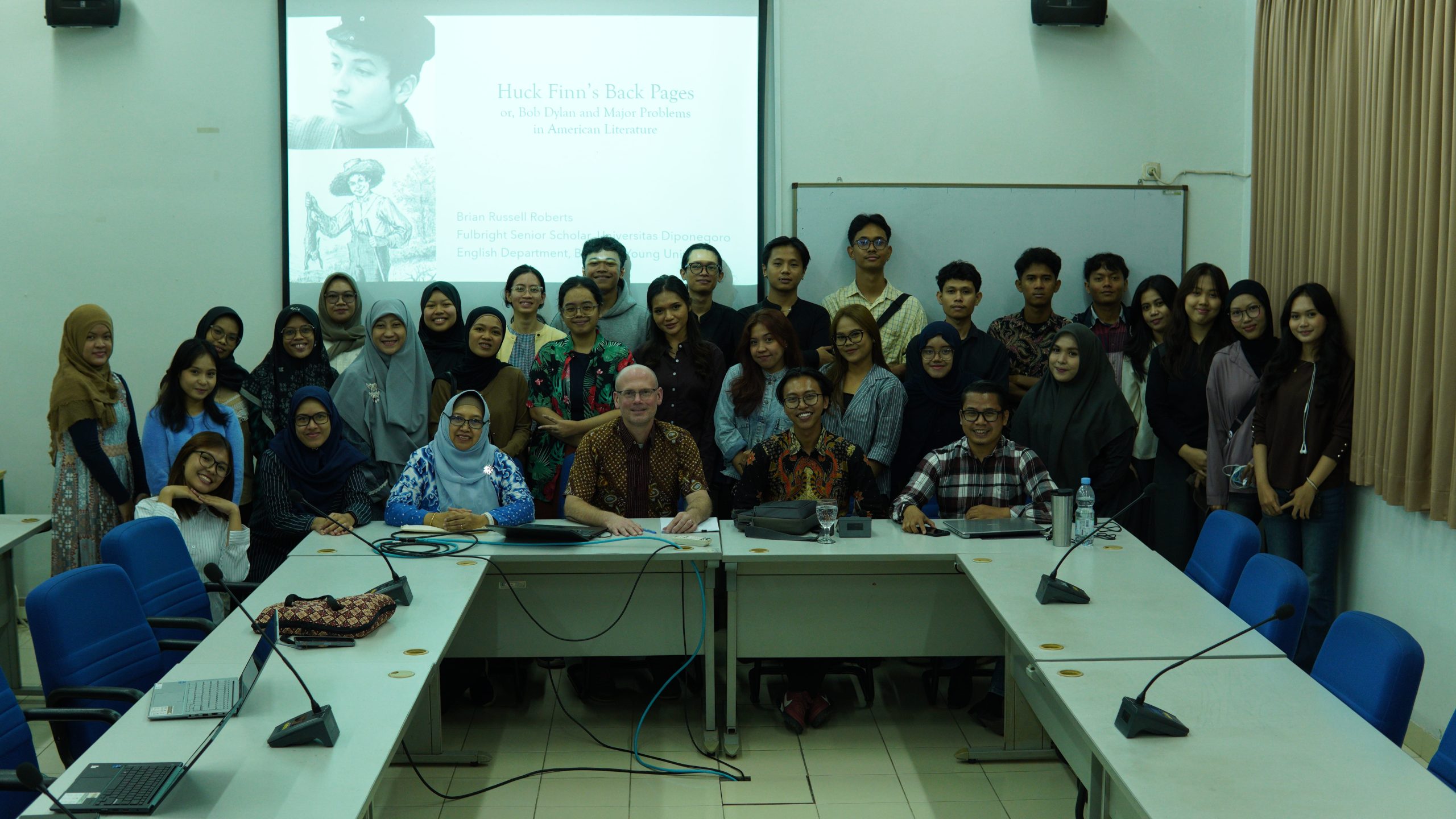
Participants also learned how Dylan’s songs often deal with issues such as justice, truth, and personal growth. These themes closely reflect the struggles faced by Huck and Jim in Twain’s novel. Professor Brian stated that Bob Dylan’s songs are most of them, if not, all of them are protest songs. Through his music, Dylan encourages listeners to think critically about society and the world around them. 

Another interesting discussion centered on Dylan’s place in American literary studies. Although he received the Nobel Prize in Literature in 2016, his work has not always been widely discussed in traditional literature classrooms and journals. This raises important questions about what we consider “literature” and whether songs can be studied alongside novels and poetry.

Overall, the session offered a fresh perspective on the relationship between music and literature. It encouraged us to see Bob Dylan not just as a musician, but as a storyteller whose work continues to shape conversations about American culture, identity, and history. It was an insightful discussion that reminded us that literature can be found in many forms, not only in books, but also in the songs that help define a generation. The session also served as a sneak peek into Professor Roberts’ upcoming book, a project that contributes new insights into the study of Dylan and American literature and is already highly anticipated by scholars and students. 

Author: American Studies Program

Public Lecture “Trauma and Cultural Awareness”: Understanding Trauma Through a Cultural Perspective

News Release Friday, 31 October 2025

Yogyakarta, October 31, 2025 — The American Studies Program, Faculty of Cultural Sciences, Universitas Gadjah Mada (FIB UGM), held a Public Lecture titled “Trauma and Cultural Awareness” at the Soegondo Building, FIB UGM.

The event featured Dr. Jack Leslie Redfern, Jr. from Goshen College, Indiana, United States, an affiliate professor renowned for his expertise in cross-cultural studies and trauma psychology.

In his presentation, Dr. Leslie explained that trauma is an intense emotional, psychological, or physical response to an event or series of events that exceed an individual’s capacity to cope. According to him, trauma can leave lasting effects on one’s functioning and overall well-being.

Furthermore, Dr. Leslie emphasized that trauma is not only defined by the objective event but also by the subjective experience of the person who undergoes it. He added that repeated minor stressors (chronic adversity) can have an impact as severe as a single catastrophic event.

In addition, cultural context plays a crucial role in shaping how trauma is recognized, expressed, and addressed within a society. Dr. Leslie illustrated this by referring to conditions in several rural Javanese villages, where values such as saving face and preserving family honor (rasa malu) often discourage individuals from disclosing experiences of domestic violence. Instead of seeking professional help, such cases are typically resolved internally through community elders or neighborhood meetings (RT/RW).

Through this public lecture, students were encouraged to understand that trauma management cannot be separated from the social and cultural contexts of a community. Cultural awareness, he explained, is essential for fostering empathy and developing more humane approaches toward trauma survivors.

This activity also aligns with the Sustainable Development Goals (SDGs), particularly SDG 3 (Good Health and Well-being) and SDG 4 (Quality Education). Through academic programs like this, FIB UGM reaffirms its commitment to deepening students’ understanding of mental health and cultural diversity while fostering awareness of the importance of inclusive, human-centered social support.

[Public Relations Office, FIB UGM – Alma Syahwalani]

Introduction to Bodies that Haunt: Rethinking the Political Economy of Racialized Death.

News ReleaseSDGs 16: Peace justice and strong institutionsSDGs 4: Quality Education Tuesday, 17 June 2025

Yogyakarta, 16/06/2025 – The Master’s Program in American Studies held a seminar titled “Introduction to Bodies that Haunt: Rethinking the Political Economy of Racialized Death.” Taking place in Room 709, 7th Floor of the Soegondo Building at the Faculty of Cultural Sciences, this event served as a platform for critical discussions on racial violence, politicized death, and cultural memory within a global context—particularly in the Americas and Southeast Asia.

Moderated by Achmad Munjid, Ph.D., the seminar featured two prominent speakers with strong backgrounds in cultural studies, feminism, and historical memory: Dr. Emily Itamura and Dr. Rachmi Diyah Larasati.

The discussion began with an introduction by the moderator, who drew parallels between horror films and everyday life, highlighting the mass production of ghosts in popular culture. From this point, the seminar explored the meaning of “bodies that haunt”—a term that goes beyond traditional ghostly figures, referring instead to collective trauma, unresolved death, and suppressed forms of knowledge.

Dr. Rachmi Diyah Larasati opened the first session by examining the concept of ghosts through a local Indonesian lens. She explained that in Indonesian culture, ghosts often emerge as warnings, memories, or connections to unresolved political violence. In her talk, titled “Train and Its Fugitive Rhythms: Reflecting on Political Violence through Sound Aesthetics,” Dr. Rachmi encouraged the audience to interpret sounds and rhythms—such as train noises—as invisible archives of political violence. These sounds, she argued, act like ghosts: ever-present and evocative, even if not always consciously perceived.

She emphasized the importance of seeing ghosts not simply as supernatural beings, but as a way of rereading history shaped by trauma. Ghosts become embodied through shadows, feelings, sounds, and memories that seep into our everyday lives.

Building on this, Dr. Emily Itamura led participants into the historical trauma of the Cambodian genocide through her presentation “Love Story, Ghost Story: The Cambodian Genocide, Labour Extraction, and Hout Bophana.” She highlighted how love stories can become ghost stories within the context of violence, and how female figures like Hout Bophana continue to haunt post-genocide development narratives.

Dr. Emily argued that the United States, as a modern imperial power, is a haunted space—saturated with the legacies of colonialism, racism, and capitalist extraction of nonwhite bodies. She pointed to Hmong, Laotian, and Vietnamese communities in Minnesota as groups who carry the “ghosts” of war and forced migration—now inextricably woven into the fabric of American cultural life.

The conversation between Dr. Rachmi and Dr. Emily unfolded into a rich cross-cultural dialogue, blending feminist theory, imperial critique, and ethnographic approaches to explore how haunted bodies continue to reappear in collective memory, art, and sound.

The event concluded with a powerful insight: ghosts are not simply objects of fear, but forms of alternative knowledge about trauma, violence, and histories left unresolved. Ghosts act as reminders that not all experiences can be archived or silenced by official historical narratives. They emerge through sound, shadows, and emotions—quietly shaping how we remember the past and envision the future.

This seminar served as a reflective space where theory met lived experience, popular culture intersected with violent histories, and Indonesian localities resonated with global traumas. A poignant reminder: haunted bodies are not meant to be dismissed—they are meant to be heard.

[Humas FIB, Alma Syahwalani]

Exploring Culture Inside and Out: National Seminar by UGM’s American Studies Graduate Program and UNAIR’s Literature and Cultural Studies Graduate Program

HEADLINESNews ReleaseSDGs 10: Reduced InequalitiesSDGs 16: Peace justice and strong institutionsSDGs 4: Quality Education Monday, 26 May 2025

Yogyakarta, 23/5/2025 – The national seminar held on May 16, 2025, marked the conclusion of the academic visit series by the Student Association of the Literature and Cultural Studies Graduate Program at Universitas Airlangga (UNAIR) to Universitas Gadjah Mada (UGM), hosted by the American Studies Student and Alumni Association (ASSAA). On this occasion, the seminar featured three speakers: Glory Emanuelle, a graduate student from UGM’s American Studies program, and Ahmad Faizin and Athaya Belia, graduate students from UNAIR’s Literature and Cultural Studies program.

In this session, each speaker presented various perspectives linked to culture and the identity of certain groups. For example, Ahmad Faizin’s presentation focused on the morning coffee-drinking culture in the Magelang area, which has become part of the identity of the community practicing it. Meanwhile, Athaya Belia’s presentation focused on the pop culture of metal music, specifically the Baddiecore genre, and concluded that fan communities can also evolve due to a shared sense of belonging. In the final presentation, Glory Emanuelle discussed the relationship between media and the representation of Native American tribes on the TikTok platform. Although each presentation brought a different perspective and focus, they shared a common theme: culture, media, and individual identity are interconnected and shape communities.

This collaboration between UNAIR’s Literature and Cultural Studies graduate students and UGM’s American Studies graduate students not only opens up opportunities to better understand how both local and global cultures influence and shape communities, but also builds a bridge for future collaboration between UNAIR and UGM.

[Public Relations of American Studies, Reni Renatawati]

Exploring American Hegemony in Indonesia: Culture, Negotiation, and Local Agency

HEADLINESNews ReleaseSDGs 11: Sustainable cities and communitiesSDGs 16: Peace justice and strong institutionsSDGs 4: Quality Education Friday, 2 May 2025

Yogyakarta, 30/4/2025 – Amid the shifting focus of American Studies, which is no longer confined to the geographical boundaries of the United States, the Master’s Program in American Studies at Universitas Gadjah Mada demonstrates how a transnational approach opens up a broader and more relevant scope of study. Students not only study America as a nation but also explore how American values, culture, and ideologies move across borders, infiltrate local spaces, and interact with the social realities in Indonesia. From street music to beauty pageant stages, this transnational approach places American Studies as a critical space to understand the intersection of global and local cultures, while also uncovering the power relations that accompany it.

One clear example of how American culture transforms into a local form can be found in the heart of Yogyakarta, specifically in the Wijilan area. A. Fahmi Dahlan, S.S., M.A., examines the hip-hop community in Wijilan, Yogyakarta. With a transnational approach in American Studies and Gramsci’s theory of cultural hegemony, Fahmi explores how the hip-hop culture, originating from America, is not merely imitated but reinterpreted and adapted to the local context. In the hands of the youth in Wijilan, hip-hop becomes more than just music or fashion—it becomes a medium for social criticism, identity expression, and community empowerment. Through activities like Kidz on the Beat, the Soringin festival, and distinctive fashion styles, it is evident how global culture is negotiated into a form that is both contextual and meaningful locally. This research shows that popular culture can create participatory spaces that are inclusive and promote social transformation from the grassroots.


Fahmi Dahlan, S.S., M.A. with Dr. Aris Munandar, M.Hum., Head of the American Studies Master’s Program, FIB UGM

Meanwhile, Aprilia Nilham, S.Pd., M.A., in her study of the Puteri Indonesia pageant, uncovers another side of American cultural hegemony, this time through international beauty contests, which often influence local cultural values in Indonesia. This study reveals how American culture, through the influence of Miss Universe, shapes the Puteri Indonesia pageant and reflects the evolving global cultural hegemony. Using Gramsci’s theory of hegemony, the research shows that while Puteri Indonesia is supposed to reflect Indonesian cultural identity, American culture has subtly integrated into various aspects, from lifestyle to language. Controversies surrounding issues such as bikinis, transgender participants, and cooperation with Israel highlight the tensions between local and global values. On the other hand, this hegemony also underscores the importance of critical understanding of the media and global culture, so that society can balance external influences while maintaining local values in the effort to create an inclusive, just, and competitive society.

Aprilia Nilham, S.Pd., M.A., with Dr. Aris Munandar, M.Hum., Head of the American Studies Master’s Program, FIB UGM

Through a transnational approach in American Studies, both studies encourage us not to passively accept the influence of global culture but to critically reexamine, question, and transform it into something more relevant and meaningful within the local context. American Studies, in this regard, serves not only as a study of America but also as a tool to understand and respond to global forces critically, opening spaces for more just and sovereign discourses. Thus, the contribution of American Studies in responding to global cultural dynamics is significant, both in understanding the influence of America in Indonesia and enriching global discourse with empowered local perspectives.

1234

Video UGM

[shtmlslider name='shslider_options']
Universitas Gadjah Mada

Faculty of Cultural Sciences
Universitas Gadjah Mada
Jl. Nusantara 1, Bulaksumur Yogyakarta 55281, Indonesia
   fib@ugm.ac.id
   +62 (274) 513096
   +62 (274) 550451

Work Units

  • Office of Journal & Publishing
  • INCULS
  • Information Technology and Database
  • Language Learning Center
  • Library Unit
  • Public Relations
  • Research

Facilities

  • Computer Laboratory
  • Gamelan
  • Guest House
  • Language Library
  • Library
  • Phonetics Library
  • Self Access Unit
  • Student Internet Centre

Importan Links

  • Journal of Humaniora
  • Subscriber Journal
  • Alumni Portal
  • Career
  • Departmens News
  • UGM Streaming

Contacts

  • Academic
  • Administration
  • Dean’s Office
  • Departments / Study Programs
  • Public Relations

© 2024 Faculty of Cultural Sciences Universitas Gadjah Mada

KEBIJAKAN PRIVASI/PRIVACY POLICY

[EN] We use cookies to help our viewer get the best experience on our website. -- [ID] Kami menggunakan cookie untuk membantu pengunjung kami mendapatkan pengalaman terbaik di situs web kami.I Agree / Saya Setuju