
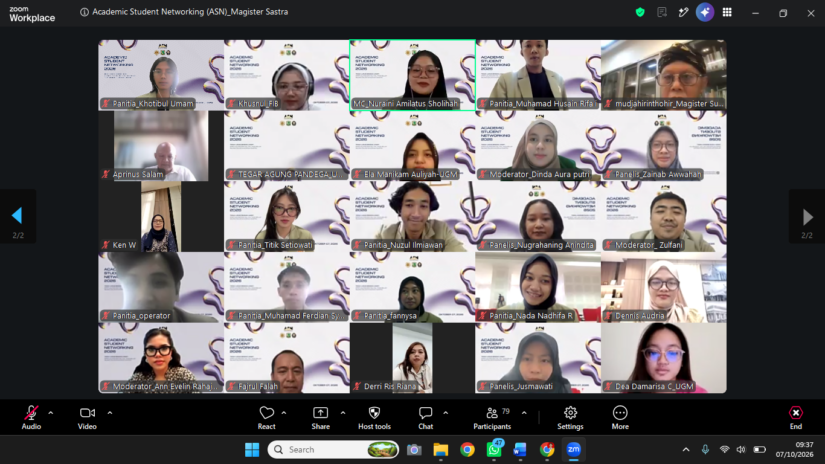
YOGYAKARTA — Ghosts, yellow wallpaper, mobile phones, and Malay manuscripts became entry points for exploring spirituality in literature. Through these diverse objects and experiences, presenters at Academic Student Networking (ASN) 2026, held on Wednesday (October 7), demonstrated that literature is not merely concerned with the beauty of language, but also offers critiques of environmental destruction, power relations, and modern human life.
These discussions emerged during the second and third sessions of ASN 2026, which brought together presenters from Universitas Gadjah Mada (UGM), Universitas Diponegoro (Undip), and Universitas Andalas (Unand). Through analyses of novels, short stories, poetry, and Malay manuscripts, the presenters explored how spiritual experiences and various forms of strangeness in literature relate to social and cultural issues.
During the second session, moderated by Dinda Aura Putri, Jusmawati from UGM’s Master’s Program in Literature presented a paper titled “Ghosts as the Personification of Climate Trauma in Ayu Welirang’s Jejak Balak.” She interpreted the ghost figure in the novel as a representation of climate trauma, particularly the anxiety arising from environmental destruction and the threat of ecological disasters.
Jusmawati applied E. Kaplan’s (2015) concept of climate trauma to examine the relationship between forest destruction, land ownership conflicts, and the traumatic experiences of local communities. In her reading, environmental damage not only transforms natural conditions but also disrupts communities’ relationships with customary land, traditions, and their living spaces.
One of the issues highlighted was the conversion of customary forest land into oil palm plantations by PT Zamrud Bumi through bureaucratic manipulation. This practice triggered land tenure conflicts and illustrated how economic pressures could push communities to relinquish their ancestral land.
The logging of teak trees also created an ecological space that had lost its function and meaning for the community. This was interpreted as a form of place alienation, in which an environment that had once been integral to community life became an unfamiliar space.
The threat of flash floods, known locally as galodo, intensified this collective anxiety. In the novel, forest destruction is understood as part of a chain of problems that could lead to wider disasters.
Amid this situation, the figure of Inyak emerges as a spiritual figure whose meaning undergoes a transformation. The appearance of a pair of white beads in the customary forest serves as a warning of impending danger before an ecological catastrophe occurs. Initially understood as a sacred ancestor who safeguards moral values, Inyak later appears as a spectral figure who punishes and spreads death in the disputed territory.
Jusmawati also examined the characters’ past trauma, including an experience in which a character’s father slaughtered animals. This trauma becomes intertwined with violence when the figure of Inyak seems to be appropriated through the killing of loggers using artificial claws. In this interpretation, unresolved trauma develops into destructive terror.
Through this analysis, Jusmawati presents the ghost not merely as a source of fear, but as a personification of climate trauma and the social conflicts accompanying environmental destruction.
Horror and the Weird as Critiques of Power
Horror was explored from a different perspective by a team of presenters from Undip, consisting of Nugrahaning Anindita C., Dennis Audria Permana, and Zainab Al Awwahah. In their paper, “Something Queer: Mark Fisher’s Weird Entities in Charlotte Perkins Gilman’s ‘The Yellow Wallpaper’,” they traced the shift from Gothic horror to weird fiction, particularly through Charlotte Perkins Gilman’s 1892 short story “The Yellow Wallpaper.”
The story follows an unnamed female narrator who undergoes the rest cure, a treatment that restricts a patient’s physical and mental activities. She is confined to a room by her husband, John, a physician, and can express her anxiety only through a hidden diary.
In the presenters’ interpretation, the house and its wallpaper are more than mere settings. The long-vacant house, with its history of inheritance disputes, becomes a space that harbors strangeness. Meanwhile, the room, which should provide shelter, instead becomes a space that restricts the narrator’s freedom.
The yellow wallpaper becomes the center of attention when the narrator begins to see a figure behind its patterns. This strangeness gradually expands, seemingly spreading beyond the room and disturbing other spaces in the house.
This reading demonstrates how something considered irrational can challenge rational explanations. John continues to prioritize medical logic, but the narrator’s experiences reveal that the rational framework he uses to understand her may not be sufficient to explain everything she experiences.
The situation is also connected to power relations within the household. As both the narrator’s husband and physician, John has the authority to determine what is considered true about his wife’s condition. By contrast, the narrator has limited opportunities to communicate her experiences and determine her own needs.
By the end of the story, the narrator increasingly abandons her social roles as a wife and mother. Her apparent madness can be interpreted as a form of resistance to a world that restricts her freedom, although the story offers no entirely conclusive resolution.
The discussion then expanded to the relevance of literature in social life. Wahyu Agung Ramdani questioned the extent to which literature can still be used to address political ecology, particularly when literary works remain inaccessible to many regions and book prices pose barriers to readers. He also raised the question of how readers can avoid becoming mere spectators amid the ecological crisis.
Meanwhile, Muhamad Ferdian Syah from UGM questioned the relationship between the narrator’s psychological condition in “The Yellow Wallpaper” and the weird experiences she undergoes. He suggested that the pressure caused by the rest cure and John’s treatment should not necessarily be separated from her experience of the weird; instead, the two may develop together and shape one another.
These questions extended the discussion beyond textual interpretation to broader issues of how humans understand trauma, the environment, and experiences that cannot always be explained through established frameworks of thought.
Prayer, Mobile Phones, and the Spirituality of Modern Humans
The discussion of spirituality continued during the third session, moderated by Ann Evelin Rahajeng. Awabeen Samsuding from UGM’s Master’s Program in Literature presented a paper titled “Reading Prayer in Joko Pinurbo’s Poetry: The Aesthetics of Irony as a Critique of Modern Human Spirituality.”
Awabeen examined how poet Joko Pinurbo presents prayer through everyday objects and activities. While religious poetry is often associated with solemn and sacred atmospheres, Pinurbo’s poems bring spirituality into spaces closer to modern life, including mobile phones, the human body, and cosmetics.
The research examined three poems: “Doa Orang Sibuk yang 24 Jam Sehari Berkantor di Ponselnya” (2018), “Doa Sebelum Mandi” (2000), and “Doa Seorang Pesolek” (2001).
For Awabeen, irony in these poems is not merely a linguistic device, but an aesthetic strategy for exposing contradictions in human life. Through irony, readers are encouraged to move beyond literal meanings and reconsider habits and beliefs that have long been taken for granted.
In “Doa Orang Sibuk yang 24 Jam Sehari Berkantor di Ponselnya,” for example, the protagonist loses all their contact numbers when their phone breaks but still has God’s number saved. The irony emerges when God reveals that His number is, in fact, the only one the protagonist never calls.
This situation critiques a modern life in which people have unlimited access to communication but may fail to maintain their spiritual connections. The mobile phone, a symbol of connectivity, also reveals the possibility of alienation from what is considered the most fundamental relationship.
Meanwhile, “Doa Sebelum Mandi” was examined through the issues of the body and violence. In Awabeen’s presentation, experiences of violence embedded in the body cannot necessarily be erased through physical cleansing alone.
“Doa Seorang Pesolek,” meanwhile, explores the relationship between the body, cosmetics, and mortality. Through irony, excessive attention to physical appearance is juxtaposed with the reality that human life remains finite.
To examine these issues, Awabeen drew on Y.B. Mangunwijaya’s concept of religiosity and Wayne C. Booth’s theory of stable irony. Using a qualitative approach and close reading, the study sought to demonstrate how poetry can critique modern spirituality without abandoning the everyday objects that are familiar to contemporary life.
Spirituality and Locality in the Malay Manuscript Syair Kupu-Kupu
Also during the third session, Afifah Chairunnisa and Aditya Fiandra from Unand presented a paper titled “Negotiating Spirituality and Locality in the Manuscript Syair Kupu-Kupu.” Their research applied Roland Barthes’s semiotic approach to examine the ideology embedded in the Malay manuscript, identified as Schoemann V 40.
Recognizing the importance of preserving the values contained in ancient manuscripts, the study examined their allegorical and symbolic dimensions, which allow them to be interpreted as more than written texts. The relationship between spirituality and locality was a central concern, particularly in understanding how cultural symbols and values intertwine within a literary work.
Using Roland Barthes’s semiotic approach, the researchers identified several local symbols. Mount Ledang and Mount Anta Sujana, for instance, are interpreted as sacred spaces, while songket textiles, keris daggers, betel leaves, and scarves represent honor, social status, and commitment. Meanwhile, references to Allah and the phrase “with Allah as the reason,” alongside various rituals, demonstrate how spirituality serves as a foundation for human actions and everyday life.
The study also examined how customs, etiquette, and honorific forms of address, such as Datuk, Tuanku, Kakanda, and Adinda, reinforce social structures. These findings indicate that spirituality and locality do not exist independently; rather, they shape one another in maintaining the values, ethics, and worldview of Malay society. Thus, Syair Kupu-Kupu preserves not only literary heritage but also records how Malay society understands the relationship between belief, tradition, and social life.
The discussions in the second and third sessions of ASN 2026 demonstrated various ways of interpreting spirituality in literature. Through ghosts in novels, weird phenomena in horror fiction, irony in poetry, and symbols in Malay manuscripts, the presenters showed that literary works can serve as spaces for questioning the relationships between humans and nature, power, the body, belief, and cultural traditions.
Through their diverse approaches, the discussions positioned literature not merely as an object of aesthetic study, but also as a means of understanding persistent issues in society.
Author: Khotibul Umam
