
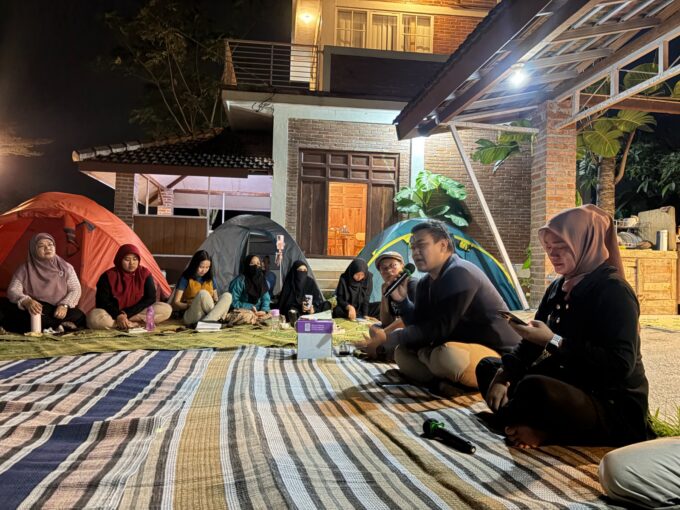
Yogyakarta— The Literary Camp with Nature and the Universe, organized by the Master’s Program in Literary Studies at the Faculty of Cultural Sciences, Universitas Gadjah Mada (UGM), at Pondok A. Salam, Kalimasada, featured a Literary Oration session on Friday evening, August 14. Beginning at 7:30 p.m., the session brought together two speakers from the academic community of FIB UGM: Muhammad Lutfi Dwi Kurniawan, a doctoral student in Humanities at FIB UGM, and Rini Febriani Hauri, a master’s student in Literary Studies at FIB UGM.
The Literary Oration was an important part of the camp, providing a space for reflection on literature, the relationship between humans and nature, technological developments, and the future of the humanities.
In his presentation, “Unveiling the Pulse of the Text: Biopoetics and the Crisis of the Human–Nature Boundary in Literature,” Muhammad Lutfi Dwi Kurniawan introduced biopoetics as a way of exploring the relationship between life, human beings, nature, and literary works.
Broadly speaking, biopoetics is an interdisciplinary approach that brings together biology—the study of life—with poetics, literature, the arts, and other forms of creative expression. It opens up a way of understanding literature not simply as a product of language and culture, but as part of a wider conversation about life and humanity’s relationship with the biological world around us.
In his presentation, Lutfi offered the Achilles tendon as an intriguing example. This important part of the human body connects the calf muscles to the heel bone. The name Achilles comes from Achilles, the legendary Greek hero immortalized in Homer’s epic Iliad. The example illustrates how traces of literature and mythology can become embedded in the language through which human beings describe and understand the world—even in scientific terminology.
From this perspective, biopoetics becomes particularly relevant as the boundary between humans and nature is increasingly being questioned. Literature can provide a space to explore how people understand life, how nature is represented, and how relationships between humans and other living beings are shaped through language, imagination, and experience.
The theme “Unveiling the Pulse of the Text” thus takes literature into a broader intellectual territory, bringing textual studies into conversation with questions of life and the environment. Biopoetics allows literature to engage with scientific knowledge while also inviting us to reconsider the human position—not as something entirely separate from nature, but as part of a larger web of life.
Meanwhile, Rini Febriani Hauri presented “Reading Literature in the Age of Algorithms: Experience, Interpretation, and the Future of the Humanities.” Her presentation invited participants to reconsider the experience of reading literature amid rapid digital transformation and the relentless flow of information.
During her presentation, Rini quoted Franz Kafka:
“A book must be the axe for the frozen sea within us.”
The quotation offered a starting point for thinking about reading as more than an act of gathering information. Reading can be an experience that moves us, unsettles us, and even transforms the way we understand ourselves and the world.
In a digital culture increasingly defined by speed, where information arrives continuously and algorithms help determine what we see and read, Rini encouraged participants to read slowly. The invitation to slow down becomes a form of pause, and perhaps even a quiet resistance to the pressure to move constantly from one piece of information to another and to form immediate judgments.
Reading slowly gives the reader space to allow a text to work its way inward. It creates an opportunity to attend to language, discover layers of meaning, question one’s own experience, and encounter interpretations that might otherwise be missed in hurried reading.
In the age of algorithms, the experience of reading therefore becomes increasingly significant. As technology becomes capable of producing, circulating, and processing an almost limitless amount of text, the human capacity to read, feel, interpret, and make meaning remains something worth preserving.
Together, the two presentations brought into focus two important questions facing contemporary literature: the relationship between humans and nature, and the relationship between humans and technology. On the one hand, biopoetics invites us to reconsider the boundary between humanity and the living world. On the other, the discussion of literature in the age of algorithms asks us to consider how technology is reshaping the experience of reading and interpreting literary works.
Bringing these two themes together broadened the intellectual scope of the Literary Camp. Literature was not treated merely as an activity of reading and writing, but also as a space for understanding a changing world, questioning the boundaries of human experience, and reconsidering the future relationship between humans, nature, and technology.
Held at night, the Literary Oration also formed an integral part of the distinctive atmosphere of the Literary Camp. After spending the afternoon outdoors and experiencing the natural surroundings of Kalimasada, participants gathered to listen, discuss, and exchange perspectives on literature and the wider questions of human life.
The Literary Camp thus offered more than an opportunity to camp and socialize. It created an intellectual space where literary works, ideas, nature, science, technology, and human experience could meet within a single shared experience.
Author: Khotibul Umam
