
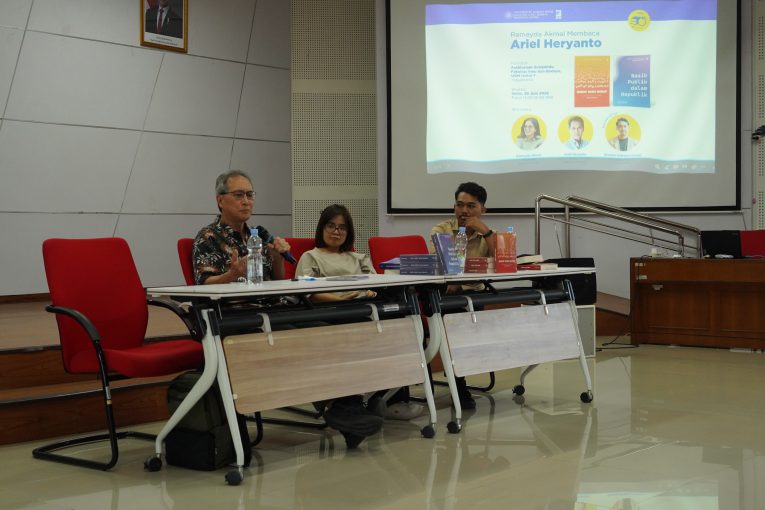
Yogyakarta — Ramayda Akmal, an author and lecturer at the Faculty of Cultural Sciences (FIB), Universitas Gadjah Mada (UGM), invited the public to revisit the ideas of Ariel Heryanto, Professor Emeritus at Monash University, during a discussion titled Ramayda Akmal Reads Ariel Heryanto, held at the Soegondo Auditorium, 7th Floor of the Faculty of Cultural Sciences, UGM, on Monday (June 29), from 1:00 to 3:00 p.m.
Moderated by Giandra Febrian, a graduate student in UGM’s Master’s Program in Literature, the event featured Ariel Heryanto as the keynote speaker. The discussion centered on two of his books, Huruf demi Huruf (Letter by Letter) and Nasib Publik dalam Republik (The Fate of the Public in the Republic), inviting participants to explore contemporary social, political, and cultural issues in Indonesia through these works.
In his opening remarks, Prof. Aprinus Salam, Head of UGM’s Master’s Program in Literature, reflected on his long intellectual journey with Ariel Heryanto. He also shared several archival photographs documenting their years of friendship, offering both a nostalgic recollection and a tribute to Ariel’s contributions to Indonesian scholarship.
Opening her presentation, Ramayda described Huruf demi Huruf as a collection of essays that encapsulates many of the most pressing issues confronting contemporary Indonesia. According to her, Ariel’s writings do more than address significant social and political questions—they encourage readers to reexamine assumptions that are often taken for granted. These include the notion of elections as a “democratic celebration,” the idea of the middle class, interpretations of the May 1998 mass rapes as a language of power rather than merely racial violence, and the extent to which Indonesia’s post-independence social structure continues to reflect the colonial legacy of the Dutch East Indies.
Ramayda also highlighted Ariel Heryanto’s distinctive intellectual approach, which does not rely exclusively on Western theoretical frameworks. Instead, many of his essays seek to understand Asian societies through the experiences, histories, knowledge, and intellectual traditions produced by fellow Asian societies—an approach often referred to as South–South knowledge exchange. In her reading, Ariel consistently situates Indonesian culture within its broader relationships with other Asian societies.
She further argued that one of Ariel’s greatest strengths lies in his ability to examine the increasingly complex relationship between popular culture, capitalism, and power. According to Ramayda, the rise of digital media has created various forms of alternative cultural production that appear open and inclusive while remaining embedded within capitalist structures.
“What makes Mas Ariel’s writings enduring is that they continue to invite new questions as the examples themselves become increasingly complex. Earlier, we discussed whether alternative literature belongs to pop culture or whether it should be understood as an alternative product. It is heavily facilitated by highly capitalist media. Although the space is remarkably diverse and inclusive—anyone can write and anyone can read—you still have to pay for the product. This makes the relationship between capitalism, popular culture, political power, and dominant forces even more complex,” Ramayda explained.
During the discussion, Ramayda also shared her personal appreciation for the essay “Huruf demi Huruf,” the title essay of the book. She described it as one of Ariel’s most memorable works because it begins with deeply personal childhood experiences before expanding into a broader reflection on Indonesia’s contemporary condition.
Meanwhile, Ariel Heryanto reflected on the question that has motivated his writing since around 1976. He explained that he has long been preoccupied with understanding why profound social inequality can persist within societies that nevertheless appear relatively stable, peaceful, and seemingly free of major upheaval.
The discussion became particularly lively when an audience member asked whether Indonesia might face national disintegration, referring to the title of Ariel’s book Nasib Publik dalam Republik. Responding to the question, Ariel argued that capitalism remains the most powerful force shaping the modern nation-state.
“In my view, the greatest force in the world today is capitalism—not radicalism, not separatism. Those forces certainly exist, but none surpasses capitalism. As long as a state operates within a capitalist system, it will endure—not only domestically but also internationally. In other words, nationalism is itself a product of, and serves the interests of, capitalism. The fate of a nation ultimately depends on whether it is constituted through a capitalist system,” Ariel said.
Through this discussion, the organizers hoped that both longtime readers and newcomers to Ariel Heryanto’s work would see the forum as an opportunity to critically engage with Indonesia’s contemporary challenges through the perspectives of literature, culture, and the social sciences.
The event concluded with a book-signing session by Ariel Heryanto. Many participants took the opportunity to have their books signed, take photographs, and engage in informal conversations with Ariel about the ideas discussed during the event. Their enthusiasm reflected the enduring interest in Ariel Heryanto’s works and intellectual contributions, which continue to offer relevant perspectives for understanding Indonesia’s contemporary social, political, and cultural issues.
Author: Khotibul Imam
