• About UGM
  • Academic Portal
  • IT Center
  • Library
  • Research
  • Webmail
  • Informasi Publik
  • English
    • Indonesia
Universitas Gadjah Mada Faculty of Cultural Sciences
Universitas Gadjah Mada
  • Home
  • Profile
    • History
    • Vision and Mission
    • Organizational structure
    • Administration
    • Staff
    • Faculty Members
  • Academic
    • Academic Calendar
    • Undergraduate Programs
      • Bachelor of Cultural Antrophology
      • Bachelor in Archaeolagy
      • Bachelor in History
      • Bachelor in Tourism
      • Bochetor in Korean Language and Culture
      • Bachelor in Indonesian Language and Culture
      • Bachelor in English
      • Bachelor in Arabic
      • Bachelor in Japanese Language and Culture
      • Bachelor in Javanese Language, Literature and Culture
      • Bachelor in French language and literature
    • Graduate Programs
      • Master in Antrophology
      • Master in ArchaeoIogy
      • Master in History
      • Master in Linguistics
      • Master in Literature
      • Master In American Studies
      • Master in Middle Eastern Cultural Studies
    • Post-Graduate Programs / S3
      • Doctor in Antropology
      • Doctor in American Studies
      • Doctor in Humanities
    • Student Service
  • KPPM
    • Research Information
    • Scientific / Academic Publications
    • Community Service
    • International Cooperation
    • Domestic Cooperation
  • Student Organizations
    • Student Executive Council
    • Semi-Autonomous Organizations
      • KAPALASASTRA
      • Christian Student Alliance
      • LINCAK
      • Saskine
      • Catholic Student Family
      • Dian Budaya
      • Sastra Kanuragan (sasgan)
      • Family of Muslim Cultural Sciences Students (KMIB)
      • Bejo Mulyo
    • Autonomous Organizations
      • Family of Anthropology Students (KEMANT)
      • English Department Student Association
      • Tourism Students Association (HIMAPA)
      • Family of Indonesian Literature Students (KMSI)
      • West Asian Literature Student Association (IMABA)
      • Association of Korean-Language Students (HIMAHARA)
      • Family of Regional Indonesian Literatures Students (KAMASUTRA)
      • The Family Body of History Students (BKMS)
      • The French Literature Students Association (HMSP)
      • Family of Anthropology Students
      • Japanese Student Association (HIMAJE)
  • Admission
    • Student Evaluation
  • Home
  • SDGs 10: Reduced inequality
  • SDGs 10: Reduced inequality
Arsip:

SDGs 10: Reduced inequality

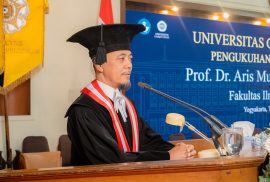
Inaugurated as UGM Professor, Aris Munandar Emphasizes Locally Rooted English Competence

News Release Thursday, 7 May 2026

Yogyakarta, May 7, 2026 – Professor Dr. Aris Munandar, M.Hum. was officially inaugurated as a Professor of English Pragmatics at the Faculty of Cultural Sciences, Universitas Gadjah Mada (UGM). The inauguration ceremony took place at the UGM Main Building on Thursday, May 7, 2026. In his inaugural speech, Prof. Aris emphasized the importance of developing English pragmatic competence oriented toward linguistic diversity in Indonesia.

Prof. Aris explained that English now serves as a crucial global communication tool for economic growth and education systems. Based on the concept of World Englishes, the diversity of the English language is divided into three circles. Indonesia falls into the expanding circle category. This position makes Indonesia a receiver of English norms from native-speaking countries, or the inner circle.

Indonesians learn English as a foreign language without a historical background of British colonialism. This condition creates unique challenges and characteristics. The characteristics of the English spoken by Indonesians are indirectly influenced by both the national language and regional languages. One of the most striking differences is seen in the application of politeness principles, which often differ from native speaker norms.

Today, intensive English communication occurs among speakers from developing nations. Prof. Aris gave an example of common interactions within the UGM campus environment between international students from Asia and Africa and the local academic community.

“As English has become an international lingua franca and the number of speakers in expanding circle countries continues to grow, there is a wide possibility of English communication occurring among fellow speakers from these expanding circle nations,” explained Prof. Aris during his speech.

Therefore, Prof. Aris believes that pragmatic competence with a multilingual orientation must be continuously developed. This approach aims to prevent society from adopting a monolingual view that could potentially generate negative perceptions of English variations in developing countries. He asserted that the diversity of English is an inevitable linguistic reality.

This condition has practical implications for language proficiency evaluations, such as the Test of English as a Foreign Language (TOEFL). Such standardized tests are still considered biased because they heavily prioritize native speaker norms. As a solution, Prof. Aris proposed adjustments to local evaluation instruments. The Academic English Proficiency Test (AcEPT) at UGM needs to be designed as a relevant benchmark for speakers in Indonesia. This test should incorporate materials that reflect the local realities of Indonesian speakers without violating generally agreed-upon linguistic standards.

An inclusive understanding of English language diversity aligns with efforts to create an equitable and adaptive education system. Through a multilingual approach, cross-border interactions involving diverse cultural backgrounds can run harmoniously. Ultimately, this step supports the creation of an equal and inclusive global order, where every individual receives equal respect without losing their local identity roots. This resonates with UGM’s vision to remain deeply rooted in local wisdom while achieving global respect.

[Public Relations of FIB UGM, Candra Solihin]

INCULS UGM Open Registration for the Regular Program – Even Semester 2025/2026

News Release Friday, 17 October 2025

Yogyakarta, October 17, 2025 – The Indonesian Culture and Language Learning Service (INCULS), Faculty of Cultural Sciences, Universitas Gadjah Mada (FIB UGM), has officially opened registration for the Regular Program – Even Semester of the 2025/2026 Academic Year. This program offers international students the opportunity to explore Indonesia through its language, arts, and traditions, right in Yogyakarta, a city renowned as the cultural and educational heart of the nation.

The program, which will take place from February 16 to June 19, 2026, is designed to provide a learning experience that focuses not only on language skills but also on cultural understanding. Through this initiative, INCULS contributes to the achievement of the Sustainable Development Goals (SDGs), particularly SDG 4 (Quality Education), by providing inclusive access to language and cultural education for learners from around the world.

Students are placed according to their language proficiency levels, ranging from Beginner (A1, A2) to Advanced (C2.1, C2.2). The curriculum covers reading, writing, listening, speaking, grammar, and vocabulary, delivered through interactive methods that connect classroom learning with real-life communication.

Beyond classroom activities, participants are invited to experience Indonesia more deeply through various cultural enrichment programs, such as Batik workshops, Gamelan (traditional music) classes, and visits to cultural and historical sites around Yogyakarta. Through these cross-cultural experiences, the program also supports SDG 10 (Reduced Inequalities) by fostering intercultural understanding and strengthening international friendships.

INCULS additionally offers elective courses such as Indonesian Culture, History and Politics, Tourism, and Translation, allowing students to broaden their academic perspectives based on their interests. At the end of the semester, participants will receive an official certificate and academic transcript, which can be transferred to their home universities.

Through collaboration with various international institutions and participation from students across the globe, INCULS also advances SDG 17 (Partnerships for the Goals) by fostering cross-cultural learning environments that enhance global understanding of Indonesia while strengthening international academic networks.

Registration for the Regular Program – Even Semester 2025/2026 can be completed online via admission.ugm.ac.id/registration. Further information is available at bit.ly/INCULSHowtoApply and bit.ly/INCULSBrochure

With the spirit of “At INCULS, language meets culture, and learning becomes a journey of discovery,” UGM invites international students to join and explore the richness of Indonesia’s language, culture, and humanity. ✨

[Public Relations, Faculty of Cultural Sciences UGM,  Alma Syahwalani]

Soft Launching Book “Reimagining Development in Southeast Asia: Alternative Practices from the Grassroots and Social Movements”

News Release Wednesday, 15 October 2025

Monday, October 6, 2025 – What if development did not have to repeat the same failed models?

This question is the main premise of the book Reimagining Development in Southeast Asia: Alternative Practices from the Grassroots and Social Movements. On Monday, October 6, 2025, the Department of Anthropology held a soft launch of the book Reimagining Development in Southeast Asia: Alternative Practices from the Grassroots and Social Movements. This book is the result of collaboration between a number of researchers who highlight various social, political, and geographical contexts in the Southeast Asian region. Through various field studies and theoretical reflections, this book places alternative development as its main focus, while inviting readers to reimagine the meaning of progress from the perspective of communities that have often been marginalized in mainstream development discourse.

Furthermore, the authors also invite us to question the perspective that limits people’s experiences within the framework of the nation-state. The division of regions such as “Southeast Asia” is in fact inseparable from the excesses of colonialism, which sought to compartmentalize social and cultural spaces into separate entities. Through this lens, Reimagining Development in Southeast Asia not only discusses alternative forms of development, but also how we can reimagine cross-border relationships—both historical and cultural—which are in fact a vital source for the emergence of grassroots development practices.

At the book’s soft launch on Monday, two of its authors, Ananeza P. Aban, PhD Researcher from Ghent University, and Jose Monfred C. Sy, PhD Researcher from the University of Hong Kong, were present to give a brief presentation on the outline of the book and the main topics discussed. Both highlighted how local initiatives and social movements in various Southeast Asian countries can become forms of alternative development that seek to break away from colonial formats and renegotiate power relations in the global context.

This event also provided a space for participants to revisit the concept of development, which has been dominated by global perspectives and mainstream economic policies. Through this launch, the authors hope to open a broader conversation about the future of development in the region, how grassroots experiences can be a source of inspiration for a more inclusive and sustainable direction of development, and encourage researchers to participate in documenting local development practices—especially in Southeast Asia.

[Antropologi Budaya, Daiva Keefe Kalimasadha]

Sixth Entrepreneurship Lecture: UGM Arabic Study Program Students Design Social Entrepreneurship Business Plans Based on Literacy

News Release Wednesday, 8 October 2025

Yogyakarta, October 6, 2025 – The Arabic Study Program, Faculty of Cultural Sciences, Universitas Gadjah Mada, continued its Entrepreneurship course in the sixth session by once again inviting Sofian Munawar, S.S., M.A., Founder of Ruang Baca Komunitas, as the guest lecturer. In this session, students were guided to design a business plan under the theme “Developing Social Entrepreneurship Based on Literature and Language”, as a practical application of the materials discussed in previous meetings.

During the lecture, Sofian Munawar emphasized the importance of understanding the literacy ecosystem within schools and communities as the foundation for developing literature- and language-based social enterprises. Students were encouraged to identify existing literacy issues—such as low reading interest, limited access to books, and weak writing culture among students. From these challenges, they learned how to conduct research, develop innovative concepts, and formulate sustainable business plans that take social and educational aspects into account.

Sofian Munawar also highlighted the significance of building cross-institutional networks involving schools, government bodies, and literacy communities. He introduced students to various literacy-based initiatives such as IKMASA Goes to School (a literacy outreach to Islamic boarding schools), collaborations with the Ministry of Religious Affairs and BAZNAS, and publishing opportunities through IKMASA Press. In this context, books are seen not merely as reading materials, but as tools of inspiration and instruments for community empowerment.

As a form of applied learning, Arabic Study Program students were assigned to create a group business plan titled “Social Entrepreneurship Design Based on Linguistic Literacy”, which included components such as background, problem identification, business opportunities, and implementation strategies. These business plans will later be presented in the following session as a tangible reflection of their ability to develop literacy-based social enterprise ideas.

Through this session, UGM Arabic Study Program students not only learned to be critical and creative academics but also changemakers capable of generating social impact through literacy innovation. This program also contributes to the achievement of the Sustainable Development Goals (SDGs), particularly SDG 4 (Quality Education) by strengthening literacy movements, SDG 8 (Decent Work and Economic Growth) by encouraging the creation of competitive social enterprises, and SDG 10 (Reduced Inequalities) through inclusive education and language-based community empowerment.

[Sastra Arab, Muhammad Ardiansyah]

Fifth Entrepreneurship Lecture: UGM Arabic Study Program Students Explore Opportunities in Social Entrepreneurship

News Release Friday, 3 October 2025

Yogyakarta, September 29, 2025 – The Arabic Study Program, Faculty of Cultural Sciences, Universitas Gadjah Mada, continued its Entrepreneurship lecture series with the fifth meeting featuring Sofian Munawar, S.S., M.A., Founder of Ruang Baca Komunitas. In this session, students were invited to explore the concept of social entrepreneurship, a business approach that prioritizes solving social, environmental, and community issues through innovative and sustainable methods.

The lecture highlighted that social entrepreneurship is not merely profit-driven but instead focuses on social missions, innovation, sustainability, and generating real impact for communities. In the context of literature and language studies, this can be applied through creative literacy initiatives such as reading and writing workshops, digital literacy development, promoting a reading culture, and expanding public access to educational resources.

Students of the Arabic Study Program were also introduced to various examples of social entrepreneurship practices, both globally and locally. Inspiring cases such as Grameen Bank in Bangladesh, Warby Parker in the United States, and Indonesia’s National Literacy Movement showcased how social enterprises can improve quality of life while fostering independence. Locally, best practices from Yogyakarta were presented, including CV Agradaya Indonesia, which promotes sustainable spice farming; Yayasan Penyandang Cacat Mandiri, which empowers people with disabilities through woodcraft; and Sayur Sleman Academy, which trains young agripreneurs. These examples served as both motivation and inspiration for students to see the potential in their own fields.

The lecture also addressed the challenges facing literacy movements, such as limited resources, lack of student motivation, and barriers to technology access. However, students were encouraged to view these challenges as opportunities for innovation through collaboration among schools, families, and communities. This perspective reinforced the idea that literacy is not confined to classrooms but is brought to life through community activities, local culture, and digital platforms.

Through this session, Arabic Study Program students not only gained a conceptual understanding of social entrepreneurship but were also challenged to develop real initiatives rooted in literature and language that could bring tangible benefits to society. This lecture also aligns with the Sustainable Development Goals (SDGs), particularly SDG 4 (Quality Education) by strengthening literacy movements, SDG 8 (Decent Work and Economic Growth) by fostering social enterprises that create meaningful jobs, and SDG 10 (Reduced Inequalities) through inclusive community empowerment programs.

[Arabic Literature, Muhammad Ardiansyah]

123…15

Video UGM

[shtmlslider name='shslider_options']
Universitas Gadjah Mada

Faculty of Cultural Sciences
Universitas Gadjah Mada
Jl. Nusantara 1, Bulaksumur Yogyakarta 55281, Indonesia
   fib@ugm.ac.id
   +62 (274) 513096
   +62 (274) 550451

Work Units

  • Office of Journal & Publishing
  • INCULS
  • Information Technology and Database
  • Language Learning Center
  • Library Unit
  • Public Relations
  • Research

Facilities

  • Computer Laboratory
  • Gamelan
  • Guest House
  • Language Library
  • Library
  • Phonetics Library
  • Self Access Unit
  • Student Internet Centre

Importan Links

  • Journal of Humaniora
  • Subscriber Journal
  • Alumni Portal
  • Career
  • Departmens News
  • UGM Streaming

Contacts

  • Academic
  • Administration
  • Dean’s Office
  • Departments / Study Programs
  • Public Relations

© 2024 Faculty of Cultural Sciences Universitas Gadjah Mada

KEBIJAKAN PRIVASI/PRIVACY POLICY

[EN] We use cookies to help our viewer get the best experience on our website. -- [ID] Kami menggunakan cookie untuk membantu pengunjung kami mendapatkan pengalaman terbaik di situs web kami.I Agree / Saya Setuju