• About UGM
  • Academic Portal
  • IT Center
  • Library
  • Research
  • Webmail
  • Informasi Publik
  • English
    • Indonesia
Universitas Gadjah Mada Faculty of Cultural Sciences
Universitas Gadjah Mada
  • Home
  • Profile
    • History
    • Vision and Mission
    • Organizational structure
    • Administration
    • Staff
    • Faculty Members
  • Academic
    • Academic Calendar
    • Undergraduate Programs
      • Bachelor of Cultural Antrophology
      • Bachelor in Archaeolagy
      • Bachelor in History
      • Bachelor in Tourism
      • Bochetor in Korean Language and Culture
      • Bachelor in Indonesian Language and Culture
      • Bachelor in English
      • Bachelor in Arabic
      • Bachelor in Japanese Language and Culture
      • Bachelor in Javanese Language, Literature and Culture
      • Bachelor in French language and literature
    • Graduate Programs
      • Master in Antrophology
      • Master in ArchaeoIogy
      • Master in History
      • Master in Linguistics
      • Master in Literature
      • Master In American Studies
      • Master in Middle Eastern Cultural Studies
    • Post-Graduate Programs / S3
      • Doctor in Antropology
      • Doctor in American Studies
      • Doctor in Humanities
    • Student Service
  • KPPM
    • Research Information
    • Scientific / Academic Publications
    • Community Service
    • International Cooperation
    • Domestic Cooperation
  • Student Organizations
    • Student Executive Council
    • Semi-Autonomous Organizations
      • KAPALASASTRA
      • Christian Student Alliance
      • LINCAK
      • Saskine
      • Catholic Student Family
      • Dian Budaya
      • Sastra Kanuragan (sasgan)
      • Family of Muslim Cultural Sciences Students (KMIB)
      • Bejo Mulyo
    • Autonomous Organizations
      • Family of Anthropology Students (KEMANT)
      • English Department Student Association
      • Tourism Students Association (HIMAPA)
      • Family of Indonesian Literature Students (KMSI)
      • West Asian Literature Student Association (IMABA)
      • Association of Korean-Language Students (HIMAHARA)
      • Family of Regional Indonesian Literatures Students (KAMASUTRA)
      • The Family Body of History Students (BKMS)
      • The French Literature Students Association (HMSP)
      • Family of Anthropology Students
      • Japanese Student Association (HIMAJE)
  • Admission
    • Student Evaluation
  • Home
  • News Release
  • UGM Arabic Study Program Students Conduct Field Study in Kudus–Demak to Explore Arab–Islamic and Javanese Cultural Acculturation

UGM Arabic Study Program Students Conduct Field Study in Kudus–Demak to Explore Arab–Islamic and Javanese Cultural Acculturation

  • News Release, Student's Activity
  • 12 December 2025, 14.19
  • Oleh: Humas FIB
  • 0

Central Java, 4 December 2025 — Students of the Arabic Study Program, class of 2023, Universitas Gadjah Mada carried out a field study in the cities of Kudus and Demak as part of the course Arabic Literature and Culture in Indonesia. The program was designed to provide empirical learning experiences on the dynamics of Indonesian culture and the historical connections between Arab–Islamic heritage and the development of local civilization.

Kudus and Demak were selected as the field study destinations due to their significant roles in the spread of Islam in Java. Through this field activity, students were expected to observe and analyze cultural heritage on-site and relate their findings to the theories studied in class.

The first destination visited was the Menara Kudus Mosque, also known as the Al-Aqsha Mosque, located in Kauman Village, Kudus, Central Java. Students examined firsthand how the mosque’s architecture, particularly its red-brick tower resembling a Majapahit-style temple, stands as strong evidence of acculturation between Islam and Hindu–Javanese culture. At the Menara Kudus Mosque, students observed Sunan Kudus’ cultural approach to da’wah, from preserving local traditions to utilizing Javanese arts and architectural forms that enabled Islam to be accepted peacefully by the local community. Traditions such as the prohibition of slaughtering cows, as well as Javanese songs and performing arts developed by Sunan Kudus, became part of the learning experience.

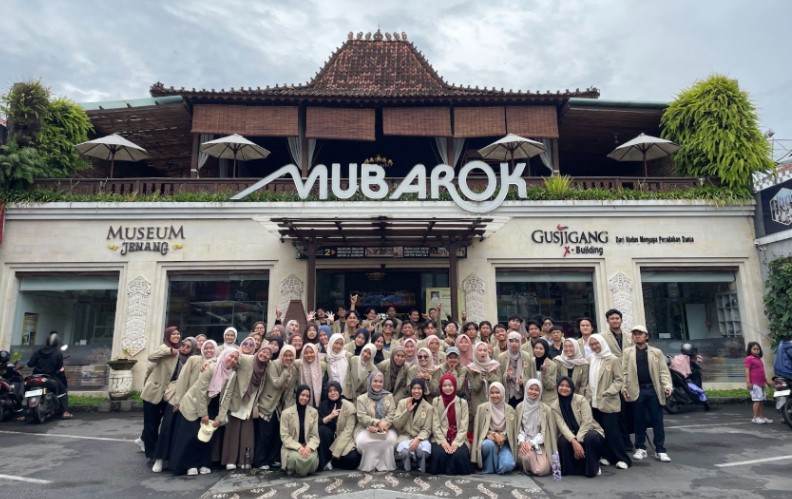
The field study continued at the Mubarok Jenang Museum, the first jenang museum in Indonesia, which highlights the history of Kudus’ jenang industry since 1930. Here, UGM Arabic Study Program students learned local wisdoms, particularly the values of Gusjigang (being morally good, mastering religious knowledge, and being skilled in trade) which shaped Kudus’ economic culture and intertwined with the Islamic teachings of Sunan Kudus. The museum offered a distinct experience, enabling students to observe how tradition, family-run industry, and regional identity are presented as public education and developed into creative economic potential.

The students then deepened their understanding of early Islamic da’wah in Java through a visit to the Great Mosque of Demak, a historical Wali Songo site and a central landmark of the Demak Sultanate. They examined the mosque’s traditional Javanese architectural form featuring a three-tiered pyramidal roof and the iconic saka guru pillars, including the legendary saka tatal. This visit provided richer insight into a model of da’wah rooted in local culture, dialogue, and gentle persuasion, reflected in the mosque’s architecture, traditions, and the social life of the surrounding community.

Through this series of field visits, students gained firsthand experience that history is not merely textual, but a living narrative present in buildings, traditions, and societal practices. The field study underscored the importance of understanding acculturation as a key element in the development of Islam in the archipelago which is visible in mosque architecture, local economies, and enduring cultural values.

This field study is expected to broaden the perspectives of Arabic Literature students and strengthen their analytical abilities in interpreting Indonesian cultural phenomena in a more comprehensive and applied manner.


Author: Jihan Pertiwi

Tags: Arabic Literature UGM FIB UGM SDGs 17: Partnerships for the Goals SDGs 4: Quality Education SDGs 8: Decent work and economic growth UGM Yogyakarta

Video UGM

[shtmlslider name='shslider_options']
Universitas Gadjah Mada

Faculty of Cultural Sciences
Universitas Gadjah Mada
Jl. Nusantara 1, Bulaksumur Yogyakarta 55281, Indonesia
   fib@ugm.ac.id
   +62 (274) 513096
   +62 (274) 550451

Work Units

  • Office of Journal & Publishing
  • INCULS
  • Information Technology and Database
  • Language Learning Center
  • Library Unit
  • Public Relations
  • Research

Facilities

  • Computer Laboratory
  • Gamelan
  • Guest House
  • Language Library
  • Library
  • Phonetics Library
  • Self Access Unit
  • Student Internet Centre

Importan Links

  • Journal of Humaniora
  • Subscriber Journal
  • Alumni Portal
  • Career
  • Departmens News
  • UGM Streaming

Contacts

  • Academic
  • Administration
  • Dean’s Office
  • Departments / Study Programs
  • Public Relations

© 2024 Faculty of Cultural Sciences Universitas Gadjah Mada

KEBIJAKAN PRIVASI/PRIVACY POLICY

[EN] We use cookies to help our viewer get the best experience on our website. -- [ID] Kami menggunakan cookie untuk membantu pengunjung kami mendapatkan pengalaman terbaik di situs web kami.I Agree / Saya Setuju