
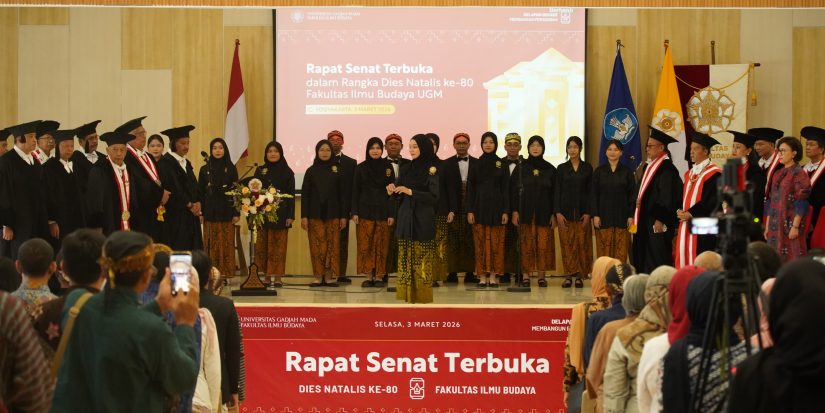
Yogyakarta, March 3, 2026 – The Faculty of Cultural Sciences at Universitas Gadjah Mada (FIB UGM) marks its 80th anniversary in 2026. This eight-decade journey serves as a moment of reflection as well as a source of hope to continue contributing to the advancement of the humanities. Carrying the theme “Eight Decades of Building Civilization,” this year’s Dies Natalis celebration reaffirms FIB UGM’s commitment to strengthening the role of the humanities in building a knowledgeable, inclusive, and culturally enriched society.
Reaching the age of 80 symbolizes a long journey marked not only by various academic achievements but also by challenges that have been successfully overcome together by the academic community. Over the past eight decades, FIB UGM has continued to develop as one of the main pillars for the advancement of humanities studies in Indonesia. Numerous important achievements have been attained, ranging from improved rankings in the QS World University Rankings and the EduRank ranking in literature, to outstanding study program accreditations and contributions through publications and news coverage that support the implementation of the United Nations Sustainable Development Goals (SDGs), particularly SDG 4: Quality Education and SDG 17: Partnerships for the Goals.
In terms of educational quality, FIB UGM has demonstrated remarkable achievements. In 2025, out of a total of 21 study programs within FIB UGM, 20 study programs received the “Excellent” (Unggul) accreditation from Badan Akreditasi Nasional Perguruan Tinggi (BAN-PT), while the Master’s Program in American Studies obtained an “Excellent” accreditation from Lembaga Akreditasi Mandiri Sosial Politik Administrasi dan Komunikasi (LAMSPAK). In addition, several study programs have gained international recognition through accreditation by global institutions. A total of 10 undergraduate programs and 2 master’s programs have been accredited by ACQUIN with an Unconditional rating, five undergraduate programs and one master’s program have received international certification from ASEAN University Network – Quality Assurance (AUN-QA), while the French Literature Program and the Master’s Program in Linguistics have obtained accreditation from Foundation for International Business Administration Accreditation (FIBAA) with an Unconditional rating.
FIB UGM’s achievements are also reflected in international rankings. Based on the QS World University Rankings by Subject, the Anthropology, Archaeology, and English Literature programs ranked first nationally, with global positions within the 101–170 and 151–200 ranges worldwide. In addition, the fields of Modern Languages, Arts and Humanities, and Linguistics have also been listed in the QS WUR. Meanwhile, in 2025, EduRank ranked the literature field of FIB UGM first among 68 literature education providers in Indonesia. This achievement is a particular source of pride for the Department of Language and Literature, which serves as a driving force for the development of literary studies within FIB UGM.
The commitment to the internationalization of education continues to be strengthened through various student mobility programs. FIB UGM actively promotes Student Exchange and Fast Track programs to broaden students’ academic experiences. In 2025, a total of 31 students participated in the Fast Track Program for the 2024–2025 period, 28 students joined exchange programs with other universities within Indonesia, 16 students took part in the Merdeka Student Exchange Program 2025–2026, and 64 students participated in International Student Exchange programs during the 2024–2026 period.
Through these achievements, FIB UGM reaffirms its commitment to continuously strengthening the quality of education, research, and community service. The eight-decade journey is expected to serve as a strong foundation for FIB UGM to continue contributing to the development of civilization through the humanities, while also supporting the global development agenda through the implementation of SDG 4 (Quality Education), SDG 9 (Industry, Innovation and Infrastructure) in strengthening research, and SDG 17 (Partnerships for the Goals) through international academic collaboration.
[Public Relations of FIB UGM, Alma Syahwalani]
