
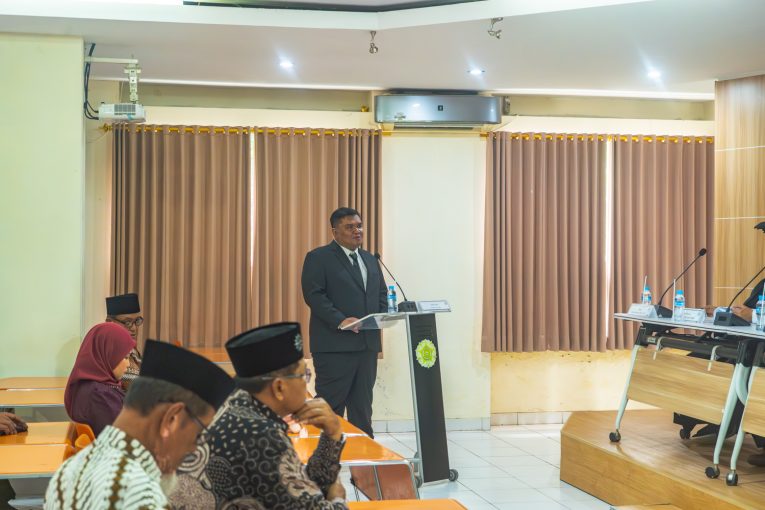
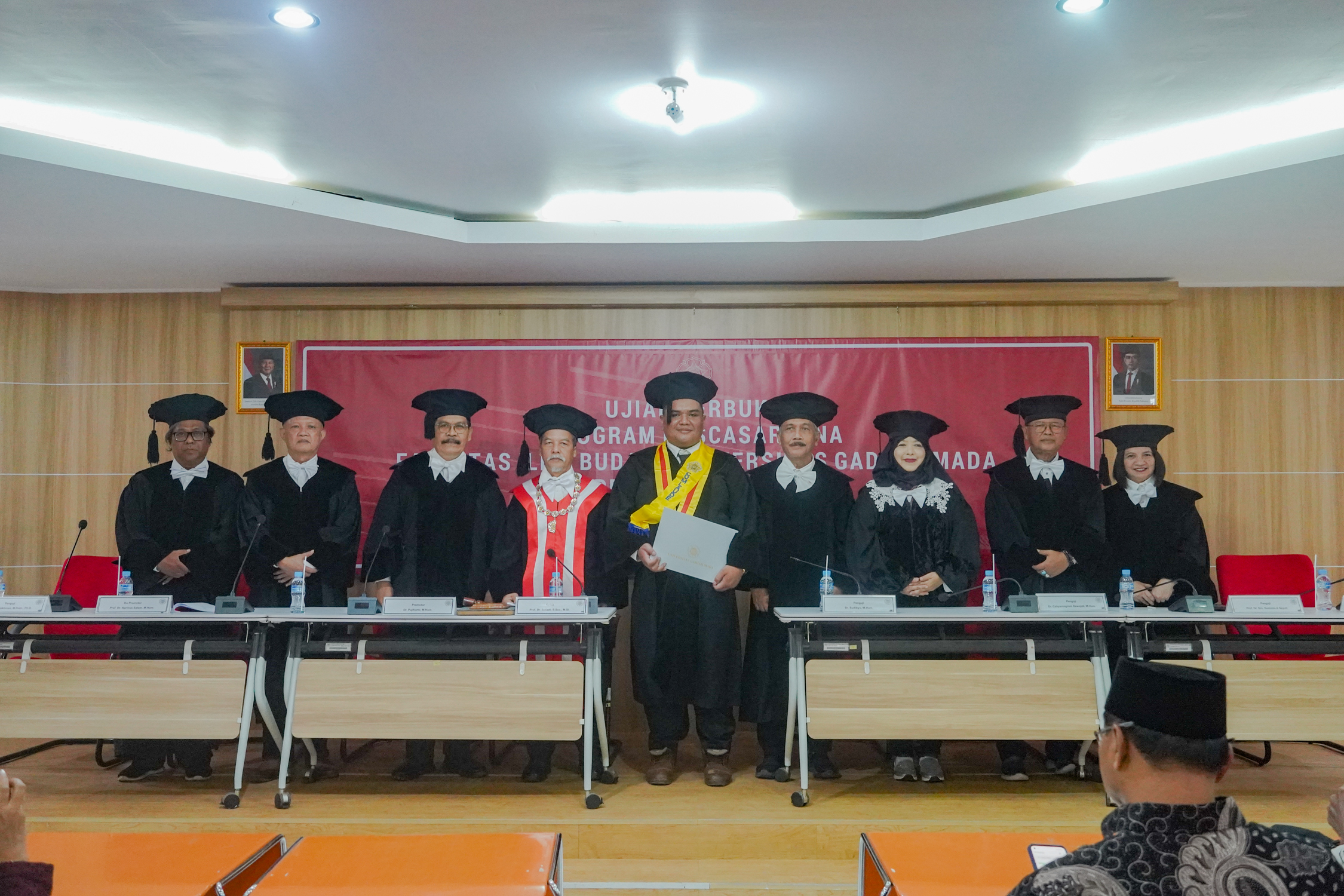
Yogyakarta, 13 January 2026 – Galuh Febri Putra underwent an Open Doctoral Promotion Examination at the Faculty of Cultural Sciences, Universitas Gadjah Mada (UGM) on Tuesday. In the examination held in the Multimedia Room of the Soegondo Building, Galuh defended his dissertation entitled Sexual Narratives in Motinggo Busye’s Novels from 1967 to 1969: A Study of Political Aestheticization, which analyzes literature as a medium of critique against power during the New Order era.
In his dissertation, Galuh examines the works of Motinggo Busye published in the early New Order period, specifically Tante Maryati (1967), Perempuan Paris (1968), and Cross Mama (1969). The study is rooted in the political context of Indonesia in the 1960s, when the government exercised strict control over freedom of expression in literature and media to support political and economic stability.
Galuh explained that the sexual narratives in Busye’s works go beyond mere entertainment. Instead, he argued, sexuality functions as an aesthetic strategy to disrupt mainstream literary patterns that tended to be repetitive and aligned with dominant ideology. “The sexual narratives in Motinggo Busye’s novels are used as a form of resistance against the New Order political system and as a means of raising readers’ social awareness,” Galuh stated during the examination.
The research outlines three primary focuses: the role of sexual narratives as an intervention in the New Order’s storytelling politics; the auratic effects these narratives produce in building class consciousness; and the role of such narratives in creating deautomatization of repetitive erotic literature of that period. Galuh employs the theory of political aestheticization to explain how literature can lose critical power when trapped in mass production devoid of social substance.
In his analysis, Galuh shows that Motinggo Busye incorporated criticism of patriarchy, capitalism, and authoritarianism through his portrayal of characters’ sexuality. Sexuality is thus positioned not only as a symbol of social tension and class conflict, but also as a medium to challenge state control over bodies and morality. This approach distinguishes Busye’s works from other erotic literature of his time, which generally prioritized sensation without social reflection.
The study’s findings also reaffirm the relevance of literary studies in interpreting Indonesia’s socio-political dynamics. By contributing theoretically to the development of sociological approaches to literature and political aestheticization, this dissertation is expected to serve as a reference for researchers and authors who view literature as a productive space for critique.
The open examination concluded with an emphasis that literary scholarship remains deeply connected to efforts to build critical societal awareness. Through re-reading past literary works, academic inquiry contributes to preserving collective memory, fostering freedom of thought, and nurturing cultural practices that support a more just and sustainable social life in the future.
[Public Relations of FIB UGM, Candra Solihin]
