• About UGM
  • Academic Portal
  • IT Center
  • Library
  • Research
  • Webmail
  • Informasi Publik
  • English
    • Indonesia
Universitas Gadjah Mada Faculty of Cultural Sciences
Universitas Gadjah Mada
  • Home
  • Profile
    • History
    • Vision and Mission
    • Organizational structure
    • Administration
    • Staff
    • Faculty Members
  • Academic
    • Academic Calendar
    • Undergraduate Programs
      • Bachelor of Cultural Antrophology
      • Bachelor in Archaeolagy
      • Bachelor in History
      • Bachelor in Tourism
      • Bochetor in Korean Language and Culture
      • Bachelor in Indonesian Language and Culture
      • Bachelor in English
      • Bachelor in Arabic
      • Bachelor in Japanese Language and Culture
      • Bachelor in Javanese Language, Literature and Culture
      • Bachelor in French language and literature
    • Graduate Programs
      • Master in Antrophology
      • Master in ArchaeoIogy
      • Master in History
      • Master in Linguistics
      • Master in Literature
      • Master In American Studies
      • Master in Middle Eastern Cultural Studies
    • Post-Graduate Programs / S3
      • Doctor in Antropology
      • Doctor in American Studies
      • Doctor in Humanities
    • Student Service
  • KPPM
    • Research Information
    • Scientific / Academic Publications
    • Community Service
    • International Cooperation
    • Domestic Cooperation
  • Student Organizations
    • Student Executive Council
    • Semi-Autonomous Organizations
      • KAPALASASTRA
      • Christian Student Alliance
      • LINCAK
      • Saskine
      • Catholic Student Family
      • Dian Budaya
      • Sastra Kanuragan (sasgan)
      • Family of Muslim Cultural Sciences Students (KMIB)
      • Bejo Mulyo
    • Autonomous Organizations
      • Family of Anthropology Students (KEMANT)
      • English Department Student Association
      • Tourism Students Association (HIMAPA)
      • Family of Indonesian Literature Students (KMSI)
      • West Asian Literature Student Association (IMABA)
      • Association of Korean-Language Students (HIMAHARA)
      • Family of Regional Indonesian Literatures Students (KAMASUTRA)
      • The Family Body of History Students (BKMS)
      • The French Literature Students Association (HMSP)
      • Family of Anthropology Students
      • Japanese Student Association (HIMAJE)
  • Admission
    • Student Evaluation
  • Home
  • Fakultas Ilmu Budaya UGM
Arsip:

Fakultas Ilmu Budaya UGM

Literary Orations Explore Biopoetics, Nature, Algorithms, and the Future of the Humanities

News Release Thursday, 20 August 2026

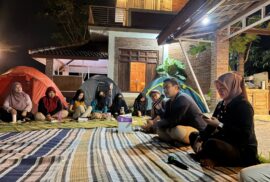
Yogyakarta— The Literary Camp with Nature and the Universe, organized by the Master’s Program in Literary Studies at the Faculty of Cultural Sciences, Universitas Gadjah Mada (UGM), at Pondok A. Salam, Kalimasada, featured a Literary Oration session on Friday evening, August 14. Beginning at 7:30 p.m., the session brought together two speakers from the academic community of FIB UGM: Muhammad Lutfi Dwi Kurniawan, a doctoral student in Humanities at FIB UGM, and Rini Febriani Hauri, a master’s student in Literary Studies at FIB UGM.

The Literary Oration was an important part of the camp, providing a space for reflection on literature, the relationship between humans and nature, technological developments, and the future of the humanities.

In his presentation, “Unveiling the Pulse of the Text: Biopoetics and the Crisis of the Human–Nature Boundary in Literature,” Muhammad Lutfi Dwi Kurniawan introduced biopoetics as a way of exploring the relationship between life, human beings, nature, and literary works.

Broadly speaking, biopoetics is an interdisciplinary approach that brings together biology—the study of life—with poetics, literature, the arts, and other forms of creative expression. It opens up a way of understanding literature not simply as a product of language and culture, but as part of a wider conversation about life and humanity’s relationship with the biological world around us.

In his presentation, Lutfi offered the Achilles tendon as an intriguing example. This important part of the human body connects the calf muscles to the heel bone. The name Achilles comes from Achilles, the legendary Greek hero immortalized in Homer’s epic Iliad. The example illustrates how traces of literature and mythology can become embedded in the language through which human beings describe and understand the world—even in scientific terminology.

From this perspective, biopoetics becomes particularly relevant as the boundary between humans and nature is increasingly being questioned. Literature can provide a space to explore how people understand life, how nature is represented, and how relationships between humans and other living beings are shaped through language, imagination, and experience.

The theme “Unveiling the Pulse of the Text” thus takes literature into a broader intellectual territory, bringing textual studies into conversation with questions of life and the environment. Biopoetics allows literature to engage with scientific knowledge while also inviting us to reconsider the human position—not as something entirely separate from nature, but as part of a larger web of life.

Meanwhile, Rini Febriani Hauri presented “Reading Literature in the Age of Algorithms: Experience, Interpretation, and the Future of the Humanities.” Her presentation invited participants to reconsider the experience of reading literature amid rapid digital transformation and the relentless flow of information.

During her presentation, Rini quoted Franz Kafka:

“A book must be the axe for the frozen sea within us.”

The quotation offered a starting point for thinking about reading as more than an act of gathering information. Reading can be an experience that moves us, unsettles us, and even transforms the way we understand ourselves and the world.

In a digital culture increasingly defined by speed, where information arrives continuously and algorithms help determine what we see and read, Rini encouraged participants to read slowly. The invitation to slow down becomes a form of pause, and perhaps even a quiet resistance to the pressure to move constantly from one piece of information to another and to form immediate judgments.

Reading slowly gives the reader space to allow a text to work its way inward. It creates an opportunity to attend to language, discover layers of meaning, question one’s own experience, and encounter interpretations that might otherwise be missed in hurried reading.

In the age of algorithms, the experience of reading therefore becomes increasingly significant. As technology becomes capable of producing, circulating, and processing an almost limitless amount of text, the human capacity to read, feel, interpret, and make meaning remains something worth preserving.

Together, the two presentations brought into focus two important questions facing contemporary literature: the relationship between humans and nature, and the relationship between humans and technology. On the one hand, biopoetics invites us to reconsider the boundary between humanity and the living world. On the other, the discussion of literature in the age of algorithms asks us to consider how technology is reshaping the experience of reading and interpreting literary works.

Bringing these two themes together broadened the intellectual scope of the Literary Camp. Literature was not treated merely as an activity of reading and writing, but also as a space for understanding a changing world, questioning the boundaries of human experience, and reconsidering the future relationship between humans, nature, and technology.

Held at night, the Literary Oration also formed an integral part of the distinctive atmosphere of the Literary Camp. After spending the afternoon outdoors and experiencing the natural surroundings of Kalimasada, participants gathered to listen, discuss, and exchange perspectives on literature and the wider questions of human life.

The Literary Camp thus offered more than an opportunity to camp and socialize. It created an intellectual space where literary works, ideas, nature, science, technology, and human experience could meet within a single shared experience.

Author: Khotibul Umam
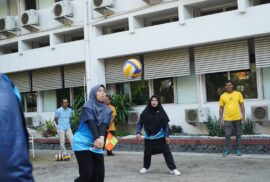
Celebrating FEB’s 71st Anniversary, Inter-Staff Volleyball Tournament Returns

News Release Wednesday, 19 August 2026

The inter-staff (tendik) volleyball tournament featuring the Faculty of Economics and Business (FEB), the Faculty of Philosophy, the Faculty of Psychology, and the Faculty of Cultural Sciences (FIB) was held once again. The event took place at the FEB South Volleyball Court on August 14, 2026, running from 07:30 to 09:30 WIB. Around 45 female staff members enthusiastically joined the competition, with each team consisting of 10 players.

This inter-faculty sports event was specially organized to celebrate the 71st Anniversary (Dies Natalis) of FEB.

From the opening round, the competition ran smoothly and full of excitement all the way to the final match, which brought together the staff teams of FIB and FEB. The final showdown delivered several intense rallies. Non-stop cheering from the FIB staff on the sidelines successfully brought a heated yet thrilling atmosphere to the court.

In the end, the FEB staff team emerged victorious with a convincing 3-0 sweep over FIB. Although falling short in the final, the FIB staff remained joyful and immensely proud of their team’s improved performance.

“It’s alright to take second place; we are a completely different team compared to before,” said Vivin, one of the FIB staff members, after the match. This achievement serves as a memorable moment for the FIB staff to further strengthen inter-faculty camaraderie while boosting the athletic spirit across the campus.


[Author: Humas FIB, Zaidan Abdurrahman]

First Stage of the Community Service Program “Polite and Responsible Social Media Use among Adolescents” Held at SMA Negeri 1 Depok, Sleman

News Release Wednesday, 19 August 2026

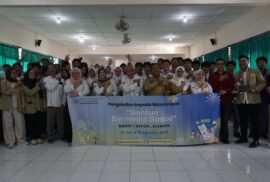
The first stage of the Community Service Program (PkM) entitled “Polite and Responsible Social Media Use among Adolescents,” organized by the Master’s Program in Linguistics, Faculty of Cultural Sciences, Universitas Gadjah Mada (FIB UGM), was successfully held at SMA Negeri 1 Depok, Sleman. The activity was enthusiastically attended by students and featured a series of educational activities focusing on polite, wise, and responsible social media use.

The activity began with a report on the implementation of the program delivered by the Head of the Master’s Program in Linguistics, Dr. Hayatul Cholsy, S.S., M.Hum. The report outlined the implementation of the program and its objectives, particularly in raising adolescents’ awareness of the importance of politeness in communication on social media.

Following the report, Drs. H. Tri Nardono, Public Relations Vice Principal of SMA Negeri 1 Depok, expressed his appreciation for the implementation of the program. He also welcomed the collaboration between SMA Negeri 1 Depok and the Master’s Program in Linguistics, FIB UGM, as a joint effort to provide students with guidance on using social media wisely and respectfully.

Before the main session, students completed a pretest designed to map their social media habits and experiences. The results provided an initial overview of social media use among the students and supported the delivery of materials that were relevant to their experiences and needs.

The main session on polite social media use was delivered by Prof. I Dewa Putu Wijana, S.U., M.A., with Dr. Wira Kurniawati, S.S., M.A. serving as the moderator. Through the session, students were encouraged to understand the importance of using polite, thoughtful, and responsible language when communicating in digital spaces.

The activity continued with group dynamics, during which students developed ideas and prepared creative follow-up projects. Working in groups, the students created flyers or videos under the theme “Jarimu Harimaumu!” (“Your Fingers, Your Responsibility!”). Through these works, students were encouraged to convey messages about the importance of thinking carefully before posting, commenting, or sharing information on social media.

All student works will be presented during the evaluation activity scheduled for 10 August 2026. The evaluation will form part of the PkM series and will provide an opportunity to assess the students’ understanding and creativity while allowing them to communicate messages about polite and responsible social media use through their own works.

Through this program, the Master’s Program in Linguistics, FIB UGM, continues to contribute to the development of language and digital literacy among adolescents. The collaboration with SMA Negeri 1 Depok is expected to serve as a meaningful step toward fostering a culture of polite, critical, and responsible communication in digital spaces.

The PkM program will continue with the next stage, featuring the evaluation and presentation of the students’ works. We look forward to seeing the students again in the next stage of the program!

Author: Magister Linguistik

Towards Global Career: Hesti Aryani, an alumna of the Faculty of Cultural Sciences at UGM, Senior Business Development Manager at JANZZ Technology in Switzerland

News Release Wednesday, 19 August 2026

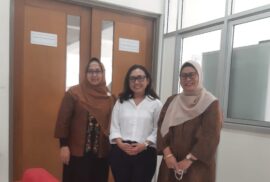
The Faculty of Cultural Sciences at UGM welcomed Hesti Aryani, S.S., M.A., an alumna of the English Literature Program at the Faculty of Cultural Sciences, UGM, who is now the Senior Business Development Manager at JANZZ Technology Switzerland and Director of PT JANZZ Technology Indonesia, a BIPA instructor at the Indonesian Embassy in Bern, Switzerland, and a member of the APPBIPA Germany executive board for the promotion of the Indonesian language in Europe. Before returning to Switzerland that afternoon, Hesti took the time to visit the Faculty of Cultural Sciences at UGM, where she received a warm welcome from the faculty leadership. Hopefully, Hesti’s visit to the Faculty of Cultural Sciences will help expand international networks and enhance the soft skills of UGM Faculty of Cultural Sciences alumni.

Hesti Aryani, S.S., M.A.’s Journey to Success:

After graduating from high school in 2007, Hesti Aryani went on to study at Gadjah Mada University (UGM) in Yogyakarta, majoring in English Literature. While a student at UGM, Hesti was active in student organizations and participated in youth exchange programs to Russia (2010) and Thailand (2011). Shortly after earning her Bachelor’s degree in English Literature, Hesti began her professional career as an instructor of English and BIPA (Indonesian for Foreign Speakers) at Chiang Mai University, Thailand, in 2012. At the same time, Hesti pursued her graduate studies and earned a Master of Arts degree from the English Language and Communication program at the Faculty of Humanities, Chiang Mai University, Thailand.

Hesti’s career journey has taken her to study, work, and live in various countries for over 15 years, spanning from Asia to Europe. Her teaching experience later expanded to the international level, including serving as a lecturer at the University of Zurich, Switzerland, where she taught the course “Sprachkurs Indonesisch.” Since moving to Switzerland in 2019, Hesti has continued the mission of the Indonesian Ministry of Education and Culture to globalize the Indonesian language and culture through various language and cultural training programs at the Embassies of the Republic of Indonesia in Bern and Warsaw.

Armed with an academic background in language and literature, education, international communication, business development, and technology, Hesti joined a Swiss IT company in 2022 as an Ontologist (an expert in Artificial Intelligence) to develop artificial intelligence (AI) technology in the field of human resources. Currently, Hesti has been entrusted with the role of Managing Director for the company’s representative office in Indonesia. In carrying out her current role, Hesti not only leads the company but is also involved in the development and training of AI systems to provide solutions that benefit the modern workplace—one example being her active advocacy for the importance of human intelligence in AI technology development and regulation at the United Nations (UN) in Geneva.

Hesti Aryani’s Journey in Teaching Indonesian to Foreign Speakers (BIPA):

For Hesti Aryani, teaching Indonesian to foreign speakers (BIPA) is not merely a profession, but a calling to introduce Indonesia to the world. A journey that began more than a decade ago has taken her to teach in various countries, build an international network, and earn awards for her dedication to Indonesian language education.

This journey began in 2011 when Hesti visited Thailand as part of the ASEAN Youth Friendship Network program. Recognizing market demand amid preparations for the ASEAN Economic Community, Hesti seized the opportunity to open the first BIPA class in Northern Thailand. In collaboration with the Language Institute at Chiang Mai University, she also initiated the establishment of the Indonesian Corner—a space serving as a hub for language learning, culture, and information about Indonesia, supported by the Embassy of the Republic of Indonesia in Bangkok. This initiative became a key milestone in the development of Indonesian language education in Northern Thailand.

This experience further strengthened her resolve to develop BIPA professionally by participating in a BIPA teacher certification training program with APBIPA Bali. After returning from Thailand, Hesti joined INCULS (Indonesian Culture and Language Learning Service) and the Center for Southeast Asian Social Studies (PSSAT) at Gadjah Mada University as a BIPA instructor. These experiences enriched her understanding of cross-cultural teaching strategies and the needs of adult learners from various parts of the world.

In 2019, Hesti continued her international career when she was given the opportunity to teach Indonesian as a Foreign Language (BIPA) at the University of Zurich (UZH) in Switzerland. Amid the COVID-19 pandemic, she successfully adapted her teaching methods to an online format that was interactive, creative, and still focused on real-world communication.

This dedication earned her national recognition when Hesti received the Best Online BIPA Teaching Award from APPBIPA Pusat, an acknowledgment of her innovation and the quality of her online Indonesian language instruction. This award serves as proof that digital transformation can be an effective means of expanding access to Indonesian language learning worldwide.

Outside the classroom, Hesti actively contributes to the international BIPA professional community. She is a member of APPBIPA Germany, collaborating with Indonesian language teachers across Europe to share best practices, develop academic networks, and strengthen the presence of BIPA on the international stage.

His commitment to language diplomacy is also reflected in his official appointment as a BIPA instructor by the Language Development and Guidance Agency of the Ministry of Education, Culture, Research, and Technology of the Republic of Indonesia. In this capacity, she was entrusted to teach at the Embassy of the Republic of Indonesia (KBRI) in Bern, Switzerland, and later at the KBRI in Warsaw, Poland, introducing the Indonesian language to diplomats, students, professionals, and the international community as part of Indonesia’s cultural diplomacy.

Now, after more than a decade of dedicating herself to the world of BIPA, Hesti’s journey has expanded beyond teaching. With a background as an educator, linguist, and artificial intelligence (AI) practitioner, she is actively developing innovations in language learning, the digitization of education, and the use of technology to expand access to the Indonesian language on a global scale.

For Hesti Aryani, every BIPA class is a space for diplomacy. Every word learned becomes a bridge between nations. And every student who successfully speaks Indonesian is a new ambassador who carries stories about Indonesia to all corners of the world.

Author: Unit PkM, Alumni, dan CDC Fakultas Ilmu Budaya UGM

Guest Lecture: Global China and Infrastructure Power by Professor Timothy Oakes

News Release Tuesday, 18 August 2026

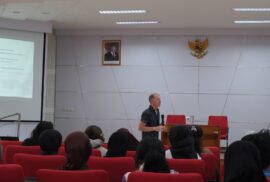
When you hear the term “Global China,” what comes to mind? Most people would probably answer immediately: the Belt and Road Initiative (BRI). However, for Prof. Timothy Oakes of the University of Colorado Boulder, viewing Global China solely through the lens of BRI policy is an oversimplification. In his guest lecture at the Department of Anthropology, Prof. Oakes invites us to set aside Beijing’s “grand strategy” narrative and shift toward a human geography perspective. He views China not as a monolithic actor operating according to a single blueprint, but rather as a complex “field of power.” This guest lecture explored why China’s obsession with concrete, asphalt, and fiber-optic cables is actually far more profound.

Drawing on the work of sociologist Ching Kwan Lee, Prof. Oakes explained that China’s state capital embodies “Sticky Power.” Unlike Western private capital, which is fluid and easily withdrawn, China’s capital is “anchored” to permanent physical infrastructure. Infrastructure is crucial to a country’s territoriality; it enables the state to control civil society through resources, ranging from dam water flow to the volume of traffic on toll roads. Interestingly, this “Sticky Power” is a double-edged sword. It is true that recipient countries become vulnerable to China’s influence. However, because this capital is “place-bound” (tied to a specific location), China itself becomes vulnerable to local political dynamics. China cannot simply remove toll roads or dams that have already been built if the political situation in the host country deteriorates.

As future scholars, we must view infrastructure projects not merely as bridges or ports, but as configurations of power that are determining who will control our space, data, and mobility in the future.

Author: Humas Departemen Antropologi 


123…40

Video UGM

[shtmlslider name='shslider_options']
Universitas Gadjah Mada

Faculty of Cultural Sciences
Universitas Gadjah Mada
Jl. Nusantara 1, Bulaksumur Yogyakarta 55281, Indonesia
   fib@ugm.ac.id
   +62 (274) 513096
   +62 (274) 550451

Work Units

  • Office of Journal & Publishing
  • INCULS
  • Information Technology and Database
  • Language Learning Center
  • Library Unit
  • Public Relations
  • Research

Facilities

  • Computer Laboratory
  • Gamelan
  • Guest House
  • Language Library
  • Library
  • Phonetics Library
  • Self Access Unit
  • Student Internet Centre

Importan Links

  • Journal of Humaniora
  • Subscriber Journal
  • Alumni Portal
  • Career
  • Departmens News
  • UGM Streaming

Contacts

  • Academic
  • Administration
  • Dean’s Office
  • Departments / Study Programs
  • Public Relations

© 2024 Faculty of Cultural Sciences Universitas Gadjah Mada

KEBIJAKAN PRIVASI/PRIVACY POLICY

[EN] We use cookies to help our viewer get the best experience on our website. -- [ID] Kami menggunakan cookie untuk membantu pengunjung kami mendapatkan pengalaman terbaik di situs web kami.I Agree / Saya Setuju