• About UGM
  • Academic Portal
  • IT Center
  • Library
  • Research
  • Webmail
  • Informasi Publik
  • English
    • Indonesia
Universitas Gadjah Mada Faculty of Cultural Sciences
Universitas Gadjah Mada
  • Home
  • Profile
    • History
    • Vision and Mission
    • Organizational structure
    • Administration
    • Staff
    • Faculty Members
  • Academic
    • Academic Calendar
    • Undergraduate Programs
      • Bachelor of Cultural Antrophology
      • Bachelor in Archaeolagy
      • Bachelor in History
      • Bachelor in Tourism
      • Bochetor in Korean Language and Culture
      • Bachelor in Indonesian Language and Culture
      • Bachelor in English
      • Bachelor in Arabic
      • Bachelor in Japanese Language and Culture
      • Bachelor in Javanese Language, Literature and Culture
      • Bachelor in French language and literature
    • Graduate Programs
      • Master in Antrophology
      • Master in ArchaeoIogy
      • Master in History
      • Master in Linguistics
      • Master in Literature
      • Master In American Studies
      • Master in Middle Eastern Cultural Studies
    • Post-Graduate Programs / S3
      • Doctor in Antropology
      • Doctor in American Studies
      • Doctor in Humanities
    • Student Service
  • KPPM
    • Research Information
    • Scientific / Academic Publications
    • Community Service
    • International Cooperation
    • Domestic Cooperation
  • Student Organizations
    • Student Executive Council
    • Semi-Autonomous Organizations
      • KAPALASASTRA
      • Christian Student Alliance
      • LINCAK
      • Saskine
      • Catholic Student Family
      • Dian Budaya
      • Sastra Kanuragan (sasgan)
      • Family of Muslim Cultural Sciences Students (KMIB)
      • Bejo Mulyo
    • Autonomous Organizations
      • Family of Anthropology Students (KEMANT)
      • English Department Student Association
      • Tourism Students Association (HIMAPA)
      • Family of Indonesian Literature Students (KMSI)
      • West Asian Literature Student Association (IMABA)
      • Association of Korean-Language Students (HIMAHARA)
      • Family of Regional Indonesian Literatures Students (KAMASUTRA)
      • The Family Body of History Students (BKMS)
      • The French Literature Students Association (HMSP)
      • Family of Anthropology Students
      • Japanese Student Association (HIMAJE)
  • Admission
    • Student Evaluation
  • Home
  • News Release
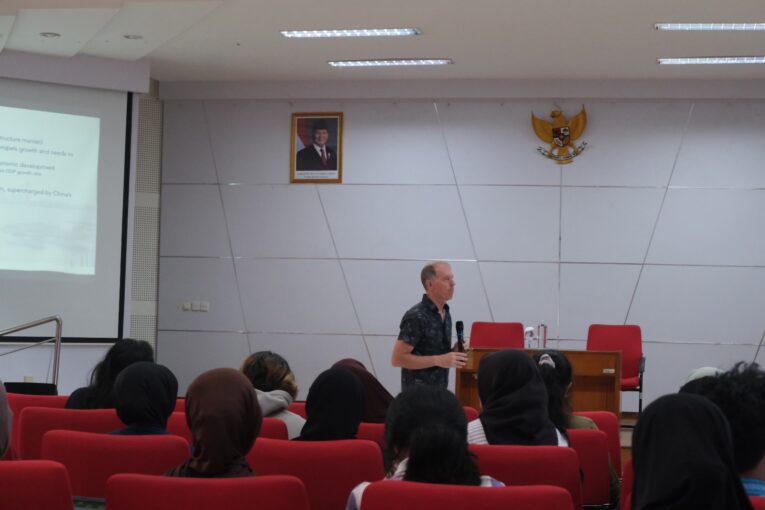
  • Guest Lecture: Global China and Infrastructure Power by Professor Timothy Oakes

Guest Lecture: Global China and Infrastructure Power by Professor Timothy Oakes

  • News Release
  • 18 August 2026, 11.33
  • Oleh: Humas FIB
  • 0

When you hear the term “Global China,” what comes to mind? Most people would probably answer immediately: the Belt and Road Initiative (BRI). However, for Prof. Timothy Oakes of the University of Colorado Boulder, viewing Global China solely through the lens of BRI policy is an oversimplification. In his guest lecture at the Department of Anthropology, Prof. Oakes invites us to set aside Beijing’s “grand strategy” narrative and shift toward a human geography perspective. He views China not as a monolithic actor operating according to a single blueprint, but rather as a complex “field of power.” This guest lecture explored why China’s obsession with concrete, asphalt, and fiber-optic cables is actually far more profound.

Drawing on the work of sociologist Ching Kwan Lee, Prof. Oakes explained that China’s state capital embodies “Sticky Power.” Unlike Western private capital, which is fluid and easily withdrawn, China’s capital is “anchored” to permanent physical infrastructure. Infrastructure is crucial to a country’s territoriality; it enables the state to control civil society through resources, ranging from dam water flow to the volume of traffic on toll roads. Interestingly, this “Sticky Power” is a double-edged sword. It is true that recipient countries become vulnerable to China’s influence. However, because this capital is “place-bound” (tied to a specific location), China itself becomes vulnerable to local political dynamics. China cannot simply remove toll roads or dams that have already been built if the political situation in the host country deteriorates.

As future scholars, we must view infrastructure projects not merely as bridges or ports, but as configurations of power that are determining who will control our space, data, and mobility in the future.

Author: Humas Departemen Antropologi 


Tags: Fakultas Ilmu Budaya UGM FIB UGM SDGs 17: Kemitraan Untuk Mencapai Tujuan SDGs 4 Pendidikan Berkualitas

Video UGM

[shtmlslider name='shslider_options']
Universitas Gadjah Mada

Faculty of Cultural Sciences
Universitas Gadjah Mada
Jl. Nusantara 1, Bulaksumur Yogyakarta 55281, Indonesia
   fib@ugm.ac.id
   +62 (274) 513096
   +62 (274) 550451

Work Units

  • Office of Journal & Publishing
  • INCULS
  • Information Technology and Database
  • Language Learning Center
  • Library Unit
  • Public Relations
  • Research

Facilities

  • Computer Laboratory
  • Gamelan
  • Guest House
  • Language Library
  • Library
  • Phonetics Library
  • Self Access Unit
  • Student Internet Centre

Importan Links

  • Journal of Humaniora
  • Subscriber Journal
  • Alumni Portal
  • Career
  • Departmens News
  • UGM Streaming

Contacts

  • Academic
  • Administration
  • Dean’s Office
  • Departments / Study Programs
  • Public Relations

© 2024 Faculty of Cultural Sciences Universitas Gadjah Mada

KEBIJAKAN PRIVASI/PRIVACY POLICY

[EN] We use cookies to help our viewer get the best experience on our website. -- [ID] Kami menggunakan cookie untuk membantu pengunjung kami mendapatkan pengalaman terbaik di situs web kami.I Agree / Saya Setuju