Questions such as “Nek kuliah neng Sastra Jawa ’ki arep dadi dukun ’pa?” (If you study Javanese Literature, do you want to become a traditional healer?) may still be encountered as a common perception of the field of Javanese language, literature, and culture. In reality, opportunities for students to develop themselves in these fields can take many forms, including performing arts, event hosting, and cultural activities.
This was among the things reflected in the implementation of Pionir Kampung Budaya 2026. A number of students from the Javanese Language, Literature, and Culture Study Program were involved in the series of activities in various roles. Their involvement extended beyond academic activities, encompassing participation in student activity units as well as experience in the arts and event hosting.
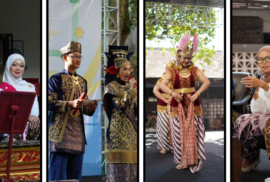
One of the groups involved was Gamelan Sastra Nusantara (Gamasutra), a student activity unit under the Student Association of the Javanese Language, Literature, and Culture Study Program (HMJ Kamastawa). Gamasutra performed gamelan music during the morning activities while welcoming the new students, or Mahadaya, of the 2026 cohort. The group also accompanied the opening series of events through the inauguration of Pionir Kampung Budaya 2026.
In addition to Gamasutra, Ratnaraya, a student organization dedicated to traditional dance, also took part in the event. Students from Ratnaraya performed Tari Golek Ayun-Ayun Jugag, a traditional dance from Yogyakarta that portrays a young woman entering adulthood and searching for her identity. The involvement of both student organizations highlights the activities of students in the Javanese Language, Literature, and Culture Study Program in the fields of art and culture.
Student involvement was also evident in event hosting. Two students from the Javanese Language, Literature, and Culture Study Program, Ghibran Arsha Daffa’ Musaffa’ and Ananda Choirul Nur Alalia, served as master of ceremonies (MCs) during Pionir Kampung Budaya 2026. Ghibran is a member of the 2024 cohort, while Ananda is from the 2025 cohort. Both have previous experience as event hosts on various occasions.
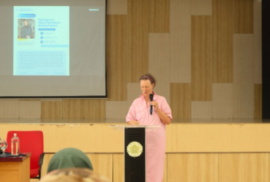
The event also involved alumni of the Javanese Language, Literature, and Culture Study Program. Nurma Aisyah, S.S., an alumna of the study program who currently works as an event host and journalist at Tribunnews, participated as one of the speakers. Her involvement represents another example of how graduates of the Javanese Language, Literature, and Culture Study Program have pursued professional careers related to communication and media.
These various roles demonstrate that students from the Javanese Language, Literature, and Culture Study Program can contribute to campus activities through a wide range of fields. Knowledge of language, literature, and culture can go hand in hand with the development of other skills, such as performing arts, public communication, leadership, and event hosting.
Participation in activities such as Pionir Kampung Budaya 2026 can also provide students with opportunities to gain experience beyond the classroom. Such experiences can become part of their learning process while helping them develop skills needed in both academic life and the professional world.
In this regard, Mahadaya are encouraged to continue learning and developing themselves through both academic studies and various activities on and off campus. These experiences can serve as valuable foundations for developing their knowledge, skills, and abilities in accordance with their areas of interest.
Author : Haryo Untoro
Editor : Haryo Untoro