
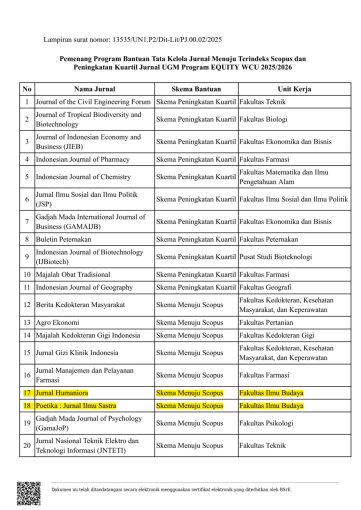
Yogyakarta, 25 November 2025 — The Faculty of Cultural Sciences (FIB) of Universitas Gadjah Mada has once again marked an important achievement in strengthening the governance of scholarly publications. Through the official announcement of the UGM Journal Management Assistance Program for Scopus Indexing and Quartile Improvement (EQUITY WCU 2025/2026), two journals under FIB UGM Jurnal Humaniora and Poetika: Jurnal Ilmu Sastra were selected as recipients in the Towards Scopus Scheme.
A total of 26 journals from various faculties across UGM were announced as awardees. Within this list, Jurnal Humaniora and Poetika ranked 17th and 18th, representing FIB UGM as two humanities journals deemed to have strong potential to progress toward Scopus indexing.
Through this program, each selected journal is required to prepare a final proposal that incorporates reviewer recommendations, develop a sustainability plan through 2030, and outline achievable targets projected until May 2026. In addition, journal managers must complete administrative documents, including the Statement of Absolute Responsibility (SPTJM), and upload all required files through UGM’s official administrative system.
This achievement demonstrates FIB UGM’s commitment to improving the quality of scholarly publication governance and expanding its academic contribution at the global level. With the selection of these two journals, FIB UGM reinforces its capacity to strengthen the role of the humanities internationally through enhanced editorial standards, broadened academic networks, and the dissemination of research relevant to contemporary scholarly development.
This accomplishment aligns closely with the principles of the Sustainable Development Goals (SDGs), particularly in supporting quality education through strengthened credibility and accessibility of academic publications. Efforts to enhance journal quality also reflect the faculty’s commitment to building a sustainable research ecosystem, fostering a strong academic culture, and encouraging both national and international collaboration as part of developing inclusive and globally competitive knowledge.

[Public Relations of FIB UGM, Alma Syahwalani]
