
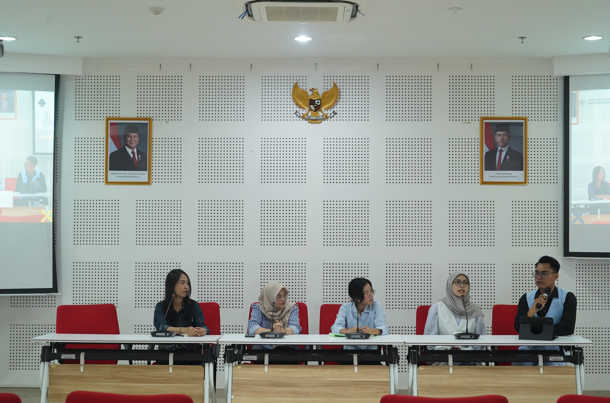
Yogyakarta, December, 16, 2025 – The Neuroscience-Based Language Teaching approach became the central focus of an academic activity held at the Faculty of Cultural Sciences (FIB), Universitas Gadjah Mada. The event aimed to introduce and discuss language learning strategies that emphasize the role of emotions, focus, and meaningful learning experiences grounded in how the human brain works.
The activity opened with the singing of the Indonesian national anthem Indonesia Raya and the Gadjah Mada Hymn, followed by opening remarks from the course lecturer. The program then continued with the screening of instructional videos and educational animations illustrating the application of neuroscience in the language learning process, before proceeding to an interactive talk show session.
In their presentations, the speakers emphasized that emotional elements play a vital role in language learning. Positive emotions, a sense of trust, and learner engagement have been shown to support the formation of emotional memory, making the learning process more meaningful and the material easier to retain. This was demonstrated through various examples of interactive learning media, including animated videos and educational games.
The first talk show session was moderated by Rizky Ramadhani under the theme “Languages Through Gamification: A Neuroscience-Based Approach.” Several language education practitioners served as speakers, namely Tabinda Putri, Eva Pras, Fajri, and Elvina. They shared their experiences in applying neuroscience-based approaches through gamification methods in language teaching.
Elvina, an English course instructor whose students range in age from 17 to 25, highlighted the characteristics of Generation Z learners, who tend to become easily bored. To address this challenge, she developed learning media in the form of a snakes-and-ladders–style board game as well as web-based games. According to her, language learning does not need to begin with a strong emphasis on grammar, but can be packaged in a more engaging way through games that train learners’ focus and participation.
Meanwhile, Tabinda Putri, an instructor of Indonesian for Speakers of Other Languages (BIPA), emphasized the importance of building emotional rapport with learners before introducing the core material. She explained that light conversations about students’ names, interests, and backgrounds serve as an effective initial approach to building trust. This trust fosters positive feelings that influence learners’ memory and comprehension of the learning material.
The speakers also underlined the importance of adjusting teaching methods to learners’ preferred learning styles—visual, auditory, and kinesthetic. The use of images, videos, writing on the board, role play, and games was considered effective in accommodating this diversity of learning styles. At the same time, Fajri highlighted challenges related to limited technological facilities in certain learning contexts, which need to be collectively addressed in the development of innovative teaching methods.
This activity reflects FIB UGM’s commitment to providing inclusive, innovative, and research-based language education. The Neuroscience-Based Language Teaching approach aligns with the Sustainable Development Goals (SDGs), particularly Goal 4 on Quality Education through the strengthening of effective, learner-centered teaching methods. In addition, the activity supports Goal 10 on Reduced Inequalities by promoting access to adaptive learning, as well as Goal 9 on Industry, Innovation, and Infrastructure through the use of innovative media and technology in language education.
[Public Relations of FIB UGM, Alma Syahwalani]
