• About UGM
  • Academic Portal
  • IT Center
  • Library
  • Research
  • Webmail
  • Informasi Publik
  • English
    • Indonesia
Universitas Gadjah Mada Faculty of Cultural Sciences
Universitas Gadjah Mada
  • Home
  • Profile
    • History
    • Vision and Mission
    • Organizational structure
    • Administration
    • Staff
    • Faculty Members
  • Academic
    • Academic Calendar
    • Undergraduate Programs
      • Bachelor of Cultural Antrophology
      • Bachelor in Archaeolagy
      • Bachelor in History
      • Bachelor in Tourism
      • Bochetor in Korean Language and Culture
      • Bachelor in Indonesian Language and Culture
      • Bachelor in English
      • Bachelor in Arabic
      • Bachelor in Japanese Language and Culture
      • Bachelor in Javanese Language, Literature and Culture
      • Bachelor in French language and literature
    • Graduate Programs
      • Master in Antrophology
      • Master in ArchaeoIogy
      • Master in History
      • Master in Linguistics
      • Master in Literature
      • Master In American Studies
      • Master in Middle Eastern Cultural Studies
    • Post-Graduate Programs / S3
      • Doctor in Antropology
      • Doctor in American Studies
      • Doctor in Humanities
    • Student Service
  • KPPM
    • Research Information
    • Scientific / Academic Publications
    • Community Service
    • International Cooperation
    • Domestic Cooperation
  • Student Organizations
    • Student Executive Council
    • Semi-Autonomous Organizations
      • KAPALASASTRA
      • Christian Student Alliance
      • LINCAK
      • Saskine
      • Catholic Student Family
      • Dian Budaya
      • Sastra Kanuragan (sasgan)
      • Family of Muslim Cultural Sciences Students (KMIB)
      • Bejo Mulyo
    • Autonomous Organizations
      • Family of Anthropology Students (KEMANT)
      • English Department Student Association
      • Tourism Students Association (HIMAPA)
      • Family of Indonesian Literature Students (KMSI)
      • West Asian Literature Student Association (IMABA)
      • Association of Korean-Language Students (HIMAHARA)
      • Family of Regional Indonesian Literatures Students (KAMASUTRA)
      • The Family Body of History Students (BKMS)
      • The French Literature Students Association (HMSP)
      • Family of Anthropology Students
      • Japanese Student Association (HIMAJE)
  • Admission
    • Student Evaluation
  • Home
  • FIB UGM
  • FIB UGM
  • page. 44
Arsip:

FIB UGM

Shedding Light on Timor Timur: How to Teach the History of Timor Timur in Indonesia

HEADLINESNews ReleaseSDGSSDGs 16: Peace justice and strong institutionsSDGs 4: Quality Education Thursday, 10 October 2024

On Tuesday, The UGM History Department held a public lecture titled “How to Teach the History of Timor Timur in Indonesia” (9/10). Prof. Dr. Asvi Marwan Adam, a historian and researcher at the National Research and Innovation Agency (BRIN), was the keynote speaker for this lecture. The primary goal of this public lecture was to raise awareness about the history of Timor Timur, which is often presented with a limited or biased perspective.

In his opening address, Dr. Abdul Wahid, Head of UGM’s History Department, noted that this topic is particularly intriguing since it deals with a former Indonesian province and is rarely discussed in depth by academics.

“Timor Timur is our neighbor. We are so close to each other, yet unfortunately, very few Indonesians have thoroughly studied its history,” said Abdul Wahid.

In his lecture, Prof. Dr. Asvi Marwan Adam explained that his deep interest in the history of Timor Timur stemmed from the fact that it has largely disappeared from the history curriculum in Indonesia.  

“With Prabowo’s election as president and the appointment of several ministers who previously served in Timor Timur, could this pose a challenge in teaching Timor Leste’s history? Will the history being written or taught be aligned with those currently in power, meaning that military violence in the past could be covered up?” he questioned.

He emphasized that writing the history of Timor Timur is incredibly complex, especially due to the numerous human rights violations that occurred there. This complexity is reflected in the many films, books, novels, and memoirs focusing on human rights abuses in Timor Timur. Prof. Asvi’s presentation sparked an engaging and lively discussion, with the audience enthusiastically asking questions over two separate discussion sessions.

The panel concluded that a deep understanding of Timor Timur’s history is crucial to be presented objectively and openly within Indonesian education. Understanding the historical events in Timor Timur will help Indonesians view the past with a broader perspective and comprehend its impact on regional relations and humanitarian issues. By studying this history, young generations can become more critical of political interference in historical narratives and better appreciate the importance of justice and reconciliation processes.

[PR of FIB UGM: Aldiza, Translated: Aldiza, Photo: Adnan, Putu]

Javanese Language, Literature, and Culture Study Program Students Mastermind the Puppet Performance of Gajah Mada Suci

News ReleaseSDGSSDGs 17: Partnerships for the GoalsSDGs 4: Quality Education Thursday, 12 September 2024

Yogyakarta, Monday night 19th of August 2024, the Faculty of Philosophy, Universitas Gadjah Mada (UGM), organized a shadow puppet show in the framework of the anniversary of the Faculty of Philosophy. The performance featured a special play, Gajah Mada Suci, which was performed collaboratively by UGM students who are members of the UGM Surakarta Style Javanese Arts Unit (UKJGS). One of the important roles in this performance was carried out by M. Rafi Nur Fauzy, a student of the Javanese Language, Literature, and Culture Study Program class of 2023, chosen to perform a play that was collaboratively worked on by the academics community of Universitas Gadjah Mada.

The script for the performance of Gajah Mada Suci was written by Dr. Rudy Wiratama S.I.P., M.A., lecturer of Javanese Language, Literature and Culture Study Program. Gajah Mada Suci tells the story of the scapegoating of Gajah Mada under the pretext of the failure of the Majapahit Kingdom expansion. The expansion also coincided with the kingdom’s internal political turmoil. To make matters worse, Gajah Mada was accused by the elites of trying to remove him from the kingdom. As a result, Gajah Mada felt desperate and afterward he visited the residence of his friend, Mpu Tantular. After a long dialog, Gajah Mada was finally enlightened, that the efforts he had made so far were not in vain. The spirit of Amukti Palapa to unite the archipelago will continue in the next era.

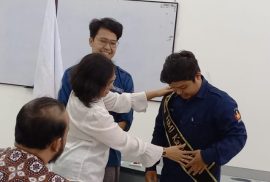
Handover of the Gajah Mada puppet from the Dean of the Faculty of Philosophy, Dr. Rr. Siti Murtiningsih, S.S., M. Hum, to M. Rafi Nur Fauzy. (Quoted from the Faculty of Philosophy Youtube Channel (01:22:51): https://www.youtube.com/watch?v=03x2lmMinTY).

“The performance of the Gajah Mada Suci is a form of depiction of the Indonesian nation that has experienced an identity crisis by winning over an interest and power through any means. Gajah Mada, who was a knight, finally moksa due to the deviant behavior of the Majapahit elite. After that, the Majapahit Kingdom lost its authority and then receded until it reached its collapse,” explained Rafi in an interview (05/09/2024).

As a special play, Rafi and his fellow UKJGS students practiced hard for a maximum performance. “The performance of Gajah Mada Suci has its own challenges for us. We practiced preparing for the performance in only half a month. Plus, this is my first time to play the Gajah Mada puppet, so it must be carefully prepared.”

“With these challenges, Alhamdulillah, the show can run smoothly. It was a great experience for me,” he continued.  Rafi hopes that the Gajah Mada puppet show will be held continuously because it is the work and identity of UGM as well as containing values that need to be socialized.

The existence of the Gajah Mada puppet is a real effort to promote the history and culture of the archipelago while still applying its relevance to the times. Through culture, we are not only ‘displaying’ aesthetics, but also reaffirming the nation’s identity through noble values for a better Indonesia.

International Collaboration: IMABTA UGM and PPIDK Timtengka Sign MoU in Jakarta

HEADLINESNews ReleaseSDGs 17: Partnerships for the GoalsSDGs 4: Quality Education Monday, 5 August 2024

The Middle Eastern Cultural Studies Student Association (IMABTA) of UGM and the Indonesian Students Association of the Middle East Region (PPIDK Timtengka) conducted a signing ceremony for a Memorandum of Understanding (MoU) on Wednesday evening, July 31, 2024, from 8:30 PM to 10:30 PM WIB at the Omega Education Group office, Senopati, South Jakarta. The signing of this memorandum was attended by representatives from both organizations. From IMABTA UGM, the signing was represented by Farhan Azis Wildani as Vice Chair of IMABTA UGM and Aisya Dianmar Adzani as Secretary. Meanwhile, from PPIDK Timtengka, the signing was represented by Siti Amaliah as Coordinator of the Indonesian Students Association of the Middle East and Africa. Representatives from several Indonesian Student Associations under the umbrella of PPIDK Timtengka were also present and actively involved in the event. Among the Indonesian Student Associations present at the event were PPI Oman, represented by Fu’ad Alfikr, and two prominent figures who are Ambassadors of Timtengka, Tubagus Muhammad (PPI Syria) and Hanifah Khairiyah (PPMI Egypt). Additionally, Imran Zarkasyi, Rifqy Ramdhani, and Imada Hanimul Haq from PPMI Egypt also attended and actively participated in the discussion forum for planning the realization of future collaborative activities between the two parties following the sacred ceremony.

The signing of the MoU between IMABTA UGM and PPIDK Timtengka is expected to be a strategic step in building cooperative relations between the two parties with the main goal of enhancing the implementation of the Tri Dharma of Higher Education. Additionally, the collaboration aims to strengthen academic relations and fortify the bonds of friendship among students. The forms of cooperation agreed upon include the exchange of information related to education, research, and community service intersecting between the two parties and plans for joint activities. In this regard, IMABTA UGM and PPIDK Timtengka are committed to continuing the collaboration agenda of the “Middle Eastern Culture Week,” which will be held annually. Moreover, both parties are committed to opening opportunities for student research collaboration and scientific publication in the Journal of Middle Eastern Culture & Religion Issues (MECRI).

Siti Amaliah, the Coordinator of PPIDK Timtengka, stated that the Middle East is a vast region that remains open for the study of its dynamics and culture. In the future, this international cooperation and collaborative commitment are expected to be a positive starting point for both parties.

Community Service Program (PKM) by Students of the Middle Eastern Cultural Studies Program (KBTT UGM) at Pabelan Islamic Boarding School: Inspiring Students with Middle Eastern Insights

HEADLINESNews ReleaseSDGs 17: Partnerships for the GoalsSDGs 4: Quality Education Friday, 2 August 2024

“Students of the Middle Eastern Cultural Studies Program (KBTT UGM) of Universitas Gadjah Mada (UGM) from the odd semester of 2023 successfully organized a Community Service Program (PKM) at Pabelan Islamic Boarding School, located in Pabelan Village, Mungkid Subdistrict, Magelang Regency, Central Java, on Sunday, July 28, 2024. The event, held in the Library Hall from 9:00 AM to 2:30 PM, featured a seminar titled ‘Middle East Talk: History and Culture’ and was attended by 54 final-year students of KMI.

The event began with an opening by the MC, followed by welcoming speeches from the head of the UGM PKM committee and Al-Ustadz Muhammad Muzakkir, M.Ag, Deputy Director of Dirasah Ulya at Pabelan Islamic Boarding School. He explained the origins of Pabelan Islamic Boarding School and its long-standing ties with UGM. “Pabelan Islamic Boarding School was founded by KH Hamam Dja’far al-Maghfurlah on August 28, 1965, and has had a personal connection with UGM for a long time. This is evidenced by several prominent professors from the Faculty of Cultural Sciences, Prof. Dr. Sangidu M.Hum and Prof. Dr. Fadlil Munawwar Manshur, M.S., who were former students at this boarding school.”

Following the speeches, the seminar proceeded with two sessions. The first session, titled ‘The Distinctiveness of the Middle East,’ was presented by Fahmi Mubarok Lc, and the second session was a sharing session on the academic world in the Middle East, presented by Naili Izzah Ramadhani, Lc. Muhammad Syahdan Hidayat, S.S., provided an overview of UGM’s academic programs and shared tips and tricks for applying to UGM.

At the end of the event, the Director of Kulliyatul Muallimin Al-Islamiyah at Pabelan Islamic Boarding School, Al-Ustadz Nur Musthofa S.H.I, gave a closing speech. He expressed gratitude to the UGM PKM students and motivated the students to master languages, especially Arabic and English. The event concluded with the presentation of a souvenir from UGM to Pabelan Islamic Boarding School, followed by a group photo session.”

Public Lecture by Prof. Bambang Hudayana: Becoming a Cultural Activist

HEADLINESNews ReleaseSDGs 4: Quality EducationSDGs 5: Gender equality Thursday, 1 August 2024

On Wednesday, July 31, 2024, Prof. Bambang Hudayana delivered a public lecture on culture as part of the Opening Ceremony of Pionir Kampung Budaya 2024. This lecture successfully captured the attention of many participants with its highly relevant and profound topic on the importance of becoming a cultural activist.

In his presentation, Prof. Bambang emphasized the importance of being a cultural activist. According to him, cultural activists must have awareness and sensitivity towards cultural issues present in society. He also stressed the roles of companion and cultural advocate that these activists must undertake. He added that promoting regional culture is crucial as it holds significant value for our lives.

Moreover, he highlighted that whatever is taught at the Faculty of Cultural Sciences at UGM always includes cultural elements that can serve as guidelines for empowering our culture.

Prof. Bambang also raised the issue of gender equality in all aspects of life. He reminded us that our culture contains values that elevate the dignity of women, making it essential to continue empowering them.

This public lecture provided valuable insights to the participants about the importance of preserving, maintaining, and empowering local culture. Prof. Bambang Hudayana successfully conveyed important messages that inspired the participants to become cultural activists committed to the preservation and development of culture in Indonesia.

1…4243444546…87

Video UGM

[shtmlslider name='shslider_options']
Universitas Gadjah Mada

Faculty of Cultural Sciences
Universitas Gadjah Mada
Jl. Nusantara 1, Bulaksumur Yogyakarta 55281, Indonesia
   fib@ugm.ac.id
   +62 (274) 513096
   +62 (274) 550451

Work Units

  • Office of Journal & Publishing
  • INCULS
  • Information Technology and Database
  • Language Learning Center
  • Library Unit
  • Public Relations
  • Research

Facilities

  • Computer Laboratory
  • Gamelan
  • Guest House
  • Language Library
  • Library
  • Phonetics Library
  • Self Access Unit
  • Student Internet Centre

Importan Links

  • Journal of Humaniora
  • Subscriber Journal
  • Alumni Portal
  • Career
  • Departmens News
  • UGM Streaming

Contacts

  • Academic
  • Administration
  • Dean’s Office
  • Departments / Study Programs
  • Public Relations

© 2024 Faculty of Cultural Sciences Universitas Gadjah Mada

KEBIJAKAN PRIVASI/PRIVACY POLICY

[EN] We use cookies to help our viewer get the best experience on our website. -- [ID] Kami menggunakan cookie untuk membantu pengunjung kami mendapatkan pengalaman terbaik di situs web kami.I Agree / Saya Setuju