• About UGM
  • Academic Portal
  • IT Center
  • Library
  • Research
  • Webmail
  • Informasi Publik
  • English
    • Indonesia
Universitas Gadjah Mada Faculty of Cultural Sciences
Universitas Gadjah Mada
  • Home
  • Profile
    • History
    • Vision and Mission
    • Organizational structure
    • Administration
    • Staff
    • Faculty Members
  • Academic
    • Academic Calendar
    • Undergraduate Programs
      • Bachelor of Cultural Antrophology
      • Bachelor in Archaeolagy
      • Bachelor in History
      • Bachelor in Tourism
      • Bochetor in Korean Language and Culture
      • Bachelor in Indonesian Language and Culture
      • Bachelor in English
      • Bachelor in Arabic
      • Bachelor in Japanese Language and Culture
      • Bachelor in Javanese Language, Literature and Culture
      • Bachelor in French language and literature
    • Graduate Programs
      • Master in Antrophology
      • Master in ArchaeoIogy
      • Master in History
      • Master in Linguistics
      • Master in Literature
      • Master In American Studies
      • Master in Middle Eastern Cultural Studies
    • Post-Graduate Programs / S3
      • Doctor in Antropology
      • Doctor in American Studies
      • Doctor in Humanities
  • KPPM
    • Research Information
    • Scientific / Academic Publications
    • Community Service
    • International Cooperation
    • Domestic Cooperation
  • Student Organizations
    • Student Executive Council
    • Semi-Autonomous Organizations
      • KAPALASASTRA
      • Christian Student Alliance
      • LINCAK
      • Saskine
      • Catholic Student Family
      • Dian Budaya
      • Sastra Kanuragan (sasgan)
      • Family of Muslim Cultural Sciences Students (KMIB)
      • Bejo Mulyo
    • Autonomous Organizations
      • Family of Anthropology Students (KEMANT)
      • English Department Student Association
      • Tourism Students Association (HIMAPA)
      • Family of Indonesian Literature Students (KMSI)
      • West Asian Literature Student Association (IMABA)
      • Association of Korean-Language Students (HIMAHARA)
      • Family of Regional Indonesian Literatures Students (KAMASUTRA)
      • The Family Body of History Students (BKMS)
      • The French Literature Students Association (HMSP)
      • Family of Anthropology Students
      • Japanese Student Association (HIMAJE)
  • Admission
    • Student Evaluation
  • Home
  • SDGs 17: Partnerships for the Goals
  • page. 68
Arsip:

SDGs 17: Partnerships for the Goals

UGM Archaeology Participates in UNESCO Activities to Commemorate World Heritage Day 2024

News ReleaseSDGs 11: Sustainable cities and communitiesSDGs 17: Partnerships for the GoalsSDGs 4: Quality EducationSDGs 9: Industry innovation and infrastructure Friday, 7 June 2024

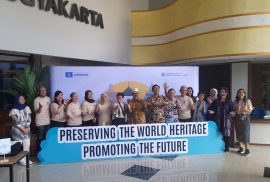
On Thursday, April 18, 2024, Faculty of Cultural Sciences UGM participated in a series of UNESCO Jakarta events together with Tidar University and Atma Jaya University Yogyakarta to commemorate World Heritage Day 2024. UGM Archaeology students joined the one-day event held at Campus II of Atma Jaya University Yogyakarta. This activity is an effort from UNESCO to raise public awareness, especially among young people or students, on the diversity of cultural heritage and draw people’s attention to the vulnerability of existing cultural heritage and steps to protect it. This activity also demonstrates collaboration for the management of cultural heritage sites that include aspects of conservation and interaction with heritage preservation communities for sustainable development.

The event began with an opening in the lobby of the Campus II building of Atma Jaya University Yogyakarta with an exhibition consisting of local crafts. The local works were inspired by Indonesia’s cultural heritage, such as leather wallets in the shape of Borobudur, typical Borobudur wedang powder, card games about cultural heritage conservation, miniature Prambanan temples, and others. The opening began with a group photo followed by representatives from UNESCO Jakarta, UGM, Tidar University, Atma Jaya University Yogyakarta, and Borobudur Conservation Center. The event then proceeded to the Campus II Auditorium for the opening by the representatives and a special opening by the Head of Culture Unit UNESCO Jakarta, Moe Chiba followed by a representative from Borobudur Conservation Center, Mr. Brahmantara. Followed by a panelist session by two main speakers.

The first and second main speakers, Mr. Brahmantara from Borobudur Conservation Center and Ms. Dian Nisa Anna Rahmayani, from Sangiran Conservation Center gave a panel presentation session entitled, “World Heritage Management, Community Engagement and Current Challenges”. This panel presentation presented how a cultural heritage site is managed and the interaction of the management institution to the community with current challenges. Cases used as examples were the management of Borobudur, Sangiran, and the presentation of various cultural heritage site mapping techniques.

The students of the three universities attended the event by sitting in groups and enlivened the event by voicing yells from each group and participating in two game sessions at the interval. Both games were in the form of cultural heritage site puzzles that emphasized the role of group cooperation to solve the puzzles together. Students were given 15 minutes to complete the puzzle. The winners of the puzzles were then awarded prizes after the event ended.

The commemoration of World Heritage Day held by UNESCO Jakarta supported by the National Federation of UNESCO Associations in Japan (NFUAJ) had an important impact on the community, especially on students. The introduction of local culture and crafts as well as the exposure of how to manage a cultural or world heritage site is the essence of building collective awareness. Awareness to maintain and preserve cultural heritage that becomes regional and national identity.
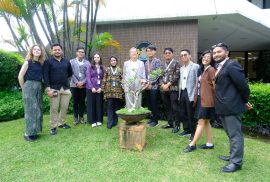
Undergraduate students of Cultural Anthropology attend a discussion with the Royal Netherlands Embassy and Public Virtue Research Institute

News ReleaseSDGs 17: Partnerships for the GoalsSDGs 4: Quality Education Friday, 7 June 2024

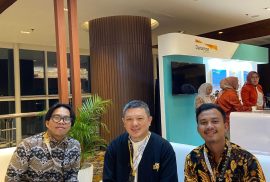
Jakarta, April 17, 2024, Public Virtue Research Institute (PVRI) together with the Embassy of the Kingdom of the Netherlands to Indonesia held the 8th edition of the A.E. Priyono Democracy Forum. Entitled “The Future of Indonesian Democracy,” the event took the form of a public forum at the Erasmus Huis Auditorium in Jakarta attended by speakers from STF Driyarkara, BRIN Political Research Center, Project Multatuli, and the ASEAN Youth Forum.

To start the day, PVRI and the Embassy of the Kingdom of the Netherlands to Indonesia also organized an informal meeting that provided a space for Indonesian students who have concerns about the development of democracy in Indonesia. Among the eight students represented at the meeting was Cornelius Prabhaswara Marpaung, an undergraduate student of Cultural Anthropology at the Faculty of Cultural Sciences, Universitas Gadjah Mada.

In a lively and relaxed discussion, attended by staff of the Political Affairs Department of the Royal Netherlands Embassy to Indonesia as well as PVRI, everyone was able to express their concerns, hopes and expectations for the development of democracy in Indonesia. In keeping with his interests, Cornelius raised the issues of health and social inclusion for marginalized groups as important factors to consider to support the development of not only procedural, but also substantive democracy in Indonesia.

The event lasted until late afternoon, and was closed with a visit to the exhibition booths of various civil society groups at Erasmus Huis Jakarta with the speakers and Embassy staff.

Visiting Professor: UGM Master’s Program in Middle Eastern Cultural Studies Presents a Professor from Canal Suez University Egypt

News ReleaseSDGs 17: Partnerships for the GoalsSDGs 4: Quality Education Friday, 7 June 2024

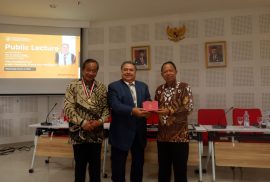
UGM Master of Middle Eastern Cultural Studies Program invited Prof. Dr. Hassan Youssef, Professor from Canal Suez University Egypt in a public lecture “The Development of Arabic Literature: Theory and Application” on Wednesday, March 6, 2024 in Room 709 Soegondo Building, Faculty of Cultural Sciences UGM. The public lecture was attended by the Vice Dean of the Faculty of Cultural Sciences UGM for Academic and Student Affairs, Dr. Nur Saktiningrum, M.Hum., lecturers of the Study Program, as well as students of the KBTT Master Program and the Arabic Literature Bachelor Program and a number of students from outside UGM.

In his remarks, the Vice Dean of FIB UGM explained two important points. First, the orientation of implementation is no longer to the ‘instrinsic’ of literary works, but must look at it more in relation to the culture of society. Second, the demand for international exposure for all academicians which can be done by involving lecturers from abroad and also providing financing opportunities abroad for students who want to disseminate their research.

The event continued with the presentation of material from Prof. Dr. Hassan Youssef. He explained that Arabic literature continues to develop from the pre-Islamic or Jahiliyah era to the contemporary period. Each era has its own advantages. For example, the excellence in the Jahiliy era was Muallaqat poetry. In the era of the arrival of Islam, his poems began to leave reproaches and insert the language of the Qur’an as a da’wah to spread Islam. The advantages of Arabic literature in contemporary times are the freedom of poetic patterns and the use of language that is easily understood by the public. The development of Arabic literature continues to move dynamically following the times. Therefore, students are encouraged to always actively follow its development and examine it so that they can understand the novelty in the world of Arabic literature.

Dr. Atik Triratnawati, M.A Encourages the Application of SDGs in Student Thesis

SDGs 17: Partnerships for the GoalsSDGs 1: No povertySDGs 2: Zero HungerSDGs 4: Quality EducationSDGs 5: Gender equality Friday, 7 June 2024

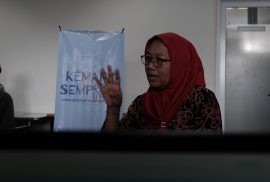
On Monday, March 4, 2024 a Thesis Proposal Seminar or Sempro was held offline for S-1 Cultural Anthropology students of FIB UGM. The Proposal Seminar was held openly, so that the academic community and the general public could see the seminar. This seminar was attended by 29 students who were divided into four clusters, namely the economic tourism cluster, lifestyle and health cluster, ecology and maritime cluster, and arts, gender, and labor cluster.

Dr. Atik Triratnawati, M.A as the Head of the S-1 Cultural Anthropology Study Program who was also present as a discussant lecturer in the proposal seminar this time delivered several comments, he conveyed a message related to the need for students to refer to SDG’s values in writing a thesis. He revealed that actually Gadjah Mada University has made a regulation where the final project, thesis, and thesis of students are required to refer to the values in the SDGs and all courses in the S-1 Cultural Anthropology Study Program have also referred to the values in the SDGs. However, from the seminars that have been held, almost none of them refer to or clearly link the thesis proposals that students present with the values in the SDGs. Responding to this phenomenon, he planned that in the future there will be a socialization related to embedding SDGs values in the thesis and thesis of Anthropology students.

In addition to mentioning about SDGs, Dr. Atik Triratnawati, M.A also responded to the seminar from a technical point of view, she advised related to the question sentence in the problem formulation. She revealed that there are still many students who underestimate the question sentence “why” and feel enough with the question sentence how, even though according to her if the why sentence is used in the right context, it will lead to broader and deeper research findings. He advised students who will take part in proposal seminars in the future to consider the aspect of the question sentence “why”.

From the proposal seminar that has been held, it can be seen that although the University has emphasized the importance of referring to SDGs values in the thesis, there are still gaps in its application by students. Support and socialization planning that will be initiated in the future are important steps to ensure that students can better understand and apply these principles in their thesis. In addition, messages related to the importance of asking “why” questions are also important points in improving the quality of research. All of this is an effort to encourage the achievement of the ideals contained in the SDGs, especially point 4 (Quality Education) through the contribution of Cultural Anthropology students at Faculty of Cultural Sciences UGM.

Hajj and Umrah Organizers Association (Himpuh) Engages Students of Master’s Program in Middle Eastern Cultural Studies as Liaison Officers

News ReleaseSDGs 17: Partnerships for the GoalsSDGs 4: Quality Education Friday, 7 June 2024

Two students of the Master of Middle Eastern Cultural Studies, Faculty of Cultural Sciences, Universitas Gadjah Mada, Fahmi Mubarok and Lutfi Nurfadli became Liaison Officers and Translators at the Hajj and Umrah Organizers Association (Himpuh) Deliberation on Wednesday-Friday, February 27-29, 2024 at the Marriot Hotel Yogyakarta. The event was attended by Prof. Hilman Latief, M.A., Ph.D. as the Director General of Hajj and Umrah of the Ministry of Religious Affairs of the Republic of Indonesia. The two students accompanied Mashariq’s VIP guests from Saudi Arabia, Wael Mohammad M. Rasheedi and Mohammedamin Hassan M. Andergiri.

Fahmi Mubarok and Lutfi Nurfadli are graduates from two leading universities in the Middle East, Al-Azhar Cairo University in Egypt and Yarmouk University in Jordan. Armed with experience and communicative Official (Fusha) and Local (Ammiyah) Arabic language skills, these two outstanding students successfully translated directly the remarks of Saudi Arabia’s VIP guest representatives at the event. They also received positive responses and good appreciation from the VIP guests who were accompanied. Thus, knowledge of Arabic and Arabic language skills, especially spoken language, play an important role in establishing and improving the quality of cooperation between countries.

1…6667686970

Video UGM

[shtmlslider name='shslider_options']
Universitas Gadjah Mada

Faculty of Cultural Sciences
Universitas Gadjah Mada
Jl. Nusantara 1, Bulaksumur Yogyakarta 55281, Indonesia
   fib@ugm.ac.id
   +62 (274) 513096
   +62 (274) 550451

Work Units

  • Office of Journal & Publishing
  • INCULS
  • Information Technology and Database
  • Language Learning Center
  • Library Unit
  • Public Relations
  • Research

Facilities

  • Computer Laboratory
  • Gamelan
  • Guest House
  • Language Library
  • Library
  • Phonetics Library
  • Self Access Unit
  • Student Internet Centre

Importan Links

  • Journal of Humaniora
  • Subscriber Journal
  • Alumni Portal
  • Career
  • Departmens News
  • UGM Streaming

Contacts

  • Academic
  • Administration
  • Dean’s Office
  • Departments / Study Programs
  • Public Relations

© 2024 Faculty of Cultural Sciences Universitas Gadjah Mada

KEBIJAKAN PRIVASI/PRIVACY POLICY

[EN] We use cookies to help our viewer get the best experience on our website. -- [ID] Kami menggunakan cookie untuk membantu pengunjung kami mendapatkan pengalaman terbaik di situs web kami.I Agree / Saya Setuju