
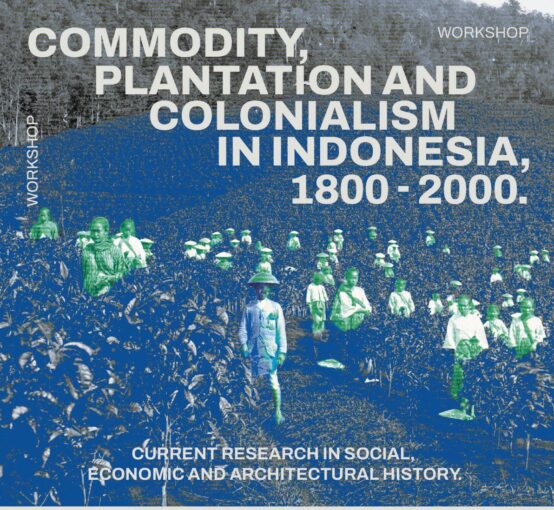
The international workshop “Commodity, Plantation, and Colonialism in Indonesia: Current Research in Social, Economic, and Architectural History” will be held on July 23–24, 2026, at Pavillon 333, the Architecture Museum of the Technical University of Munich (TUM), Germany. This workshop is part of the exhibition series “Nge-Téh / Tea Time: Architectures of the Colonial Commodity Chain from Indonesia to Germany, 19th Century,” which runs from July 23–26, 2026. The workshop brings together scholars from various disciplines engaged in the study of commodity history, plantations, and colonialism. This event aims to foster dialogue encompassing architectural, social, economic, and cultural history from a historical perspective, spanning the early modern to the contemporary periods that shaped the tea commodity chain from Indonesia to Europe. Through an interdisciplinary lens, the workshop explores how colonial plantation systems not only shaped the physical landscape but also created social, economic, and cultural relationships whose influence is still felt today.
This workshop was held in conjunction with a visit by Prof. Dr. Pujo Semedi, known as the “Historical Anthropologist.” He was invited to serve as the keynote speaker and spoke about plantations in Indonesia from 1870 to 2020. His contributions to the advancement of knowledge serve as a fine example for students. Through research rooted in the experiences of local communities, knowledge of Indonesia’s colonial history can be enriched and introduced to an international audience as part of efforts to foster a more inclusive understanding of global history.
In addition to the discussion sessions, a “Nge-Téh / Tea Time” exhibition was also held. The exhibition explored the history of tea as a colonial commodity, from the plantations in West Java, through the processing and distribution via Batavia and Hamburg, to its consumption by the public in Germany. A variety of historical archives, photographs, tea trade artifacts, ceramic artworks, and documentary films were displayed to illustrate Indonesia’s connection to global trade networks. The exhibition also underscored that although Indonesia was never a German colony, the tea trade linked the two regions within the global colonial economic system.
This workshop serves as an important forum for strengthening international collaboration in the fields of colonial history, anthropology, architecture, and Southeast Asian studies. The discussions that emerged not only shed light on the colonial past but also encouraged critical reflection on sustainability, historical justice, and the importance of incorporating local communities’ perspectives in understanding the history of global commodities.
Author: Dewi Widyastuti
Picture: Prof. Pujo Semedi
