
Yogyakarta (21/7) – The Department of Anthropology, Faculty of Cultural Sciences (FIB) at Universitas Gadjah Mada (UGM) welcomed Dr. Tan Yujing from Leiden University. Dr. Tan Yujing is a lecturer at the Institute for Area Studies and International Studies, whose research interests include mobility and migration, the political economy of innovation, Global China, and institutional sociology related to industrial and economic associations.
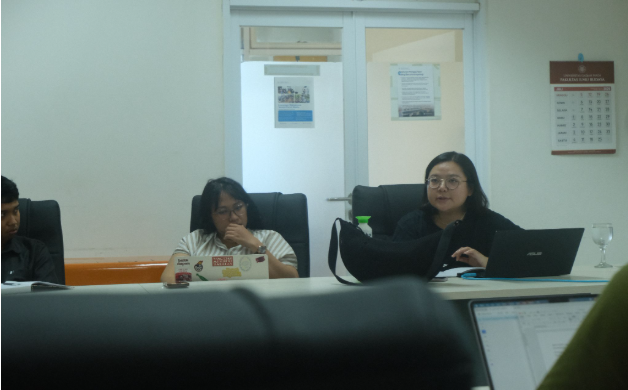
During her visit to the Anthropology Department’s Reading Room on the 5th floor, Dr. Tan Yujing presented her research findings from Batang, Central Java, titled “Understanding Mobility Regime in China-Indonesia Economic Cooperative Zone (Batang).” Her presentation discussed how the industrial area in Batang has transformed into an economic zone that absorbs a significant number of foreign workers, particularly from China, within its massive mobility regime. The event was moderated by Dr. Wahyu Kuncoro from the Department of Anthropology and spanned one and a half hours, from 1:00 PM to 2:30 PM.
Established in May 2025, the Batang Economic Zone was created to support foreign investment in Indonesia’s export industries as a response to the mobility regime, facilitating Chinese workers who frequently migrate to Indonesia. With her spectrum of expertise in mobility and the political economy of innovation within industrial contexts, she examined how arriving Chinese workers adapt to local industries and forge new relationships within the factory worker environment in Batang.
In this study, Dr. Tan Yujing employed various approaches to investigate the phenomenon of inter-country workers. One such method was participant observation, where she followed and worked alongside Chinese and Indonesian workers four days a week to study their daily routines. Semi-structured interviews and casual conversations were also utilized to gain a deeper understanding of the structural relationships between workers and their workplaces, encompassing employee management, domestic work, and the subsequent impacts on both local and global regional economies.
From her research, she discovered a differentiation in the lifestyle patterns of Chinese and Indonesian workers, which forms two distinct dimensions of life within the same space. Chinese workers bring their native culture to sustain themselves in Batang while simultaneously assimilating with the customs of the local population. The collaboration between workers from these two nations is not merely viewed as a migration culture driven by the pursuit of better economic standards. Moving beyond that, the workers in the Batang Economic Zone actively contribute to the macro-scale economic and bilateral success of both countries.
Dr. Tan Yujing’s research opens up a new perspective showing that bilateral economic cooperation between Indonesia and China should not only be measured by global success. There are grassroots actors who are rarely seen by the wider public yet serve as the main pillars supporting cross-border industrial success: the collaborative Chinese and Indonesian workers. It is hoped that this integrated economic zone in Batang can implementatively boost the economic surplus of both nations.
Author: Zaky Ahmad Hidayat
