
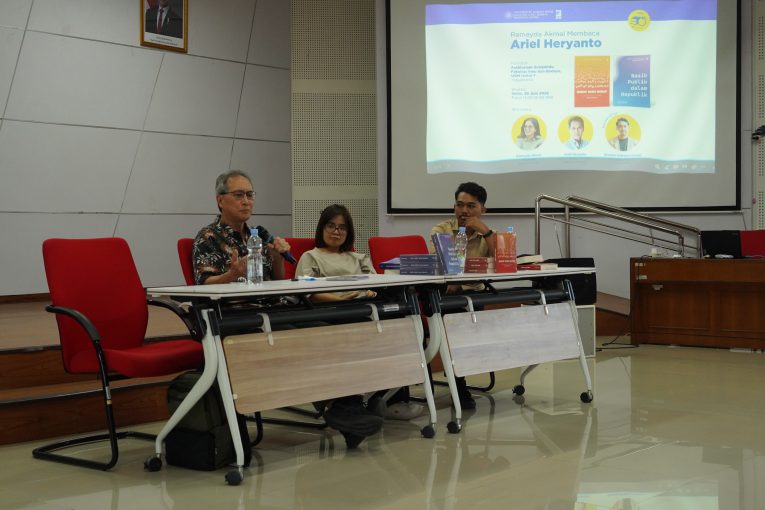
“Sometimes, to see ourselves, we need a mirror. And in some ways, Mas Ariel’s book serves that purpose,” said Ramayda Akmal during a discussion titled “Ramayda Akmal Membaca Ariel Heryanto” on Monday, June 29, at the Soegondo Building Auditorium, Faculty of Cultural Science, UGM. This discussion was a collaboration between KPG Publishing and the Master’s Program in Literature, featuring Ramayda Akmal—a lecturer in Indonesian Language and Literature and an author—as the speaker, Ariel Heryanto as the guest speaker, and Giandra as the moderator.
Through her analysis of the books Huruf Demi Huruf and Nasib Publik dalam Republik, Ramayda highlighted a common thread in Ariel Heryanto’s thought: the effort to position Indonesia as the starting point for understanding itself. According to her, Ariel’s writings not only offer a critique of established perspectives but also question why the production of knowledge about Indonesia remains so dependent on Western perspectives and theories.
One of the ideas highlighted by Ramayda is “Asia as Method,” an approach that encourages scholars to engage in dialogue with the experiences, ideas, and theories of Asian countries whose contexts are similar to Indonesia’s. She explained that Ariel demonstrates how Indonesia’s relations with countries such as China, Taiwan, Japan, and India can serve as a foundation for understanding various social and cultural issues, rather than always relying on the West as the sole point of reference.
“We rarely cite the writings of our own peers. Theoretical and academic interactions among scholars within the same academic community remain unbalanced,” Ramayda stated while explaining one of the critiques raised by Ariel Heryanto in his works. According to her, this imbalance means that perspectives on Indonesia are often shaped by standards that do not necessarily stem from the experiences of Indonesian or Asian societies.
This issue extends beyond the selection of theories and is also evident in the system of knowledge production. Ramayda explained that measures of literacy, publication standards, and even methods for evaluating the quality of academic work still largely rely on global benchmarks that do not always align with local conditions. Through his book Huruf Demi Huruf, Ariel reflects on his personal experiences to demonstrate that the process of learning and constructing knowledge is always influenced by diverse social, cultural, and historical contexts.
In response to the reading, Ariel Heryanto commended Ramayda’s approach to connecting her ideas with the current academic landscape. For him, a work of literature continues to live on through new interpretations by its readers. Therefore, discussions serve as a vital space for broadening interpretations while simultaneously reexamining various assumptions that have long been accepted in the academic world.
The discussion then continued with a Q&A session that addressed a variety of issues, ranging from exile literature and democracy to the dynamics of knowledge production in Indonesia. Through this event, the Master’s Program in Literature at the Faculty of Cultural Science, UGM, in collaboration with KPG Publishing, created a space for dialogue that encourages critical reflection on how Indonesia produces knowledge while opening up possibilities for building a scholarly tradition more deeply rooted in the experiences and context of the Asian region.
[Humas FIB, Maylafaizza Nafisha Zifa]
