
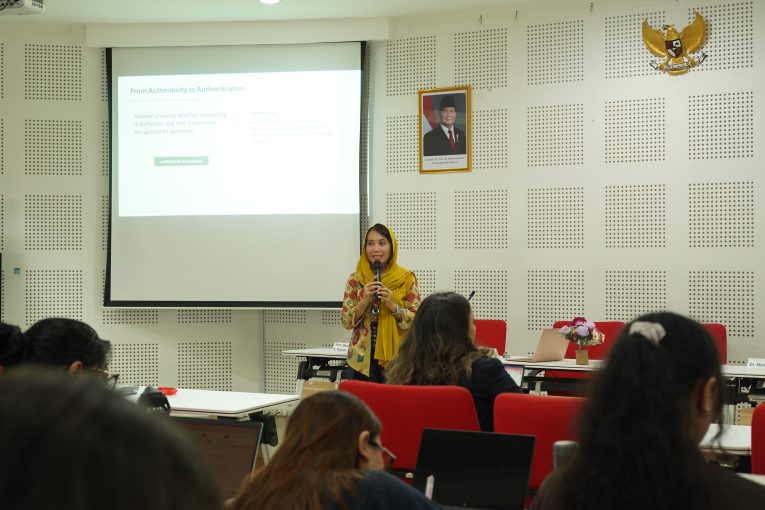
The Faculty of Cultural Sciences (FIB) at Gadjah Mada University (UGM), in collaboration with the Université de Montréal (Canada), is organizing the 2026 Off-Campus Summer School program. Under the theme “The New Orientalism: Understanding the Paradoxes of Mass Tourism in Southeast Asia,” this program invites students from various countries to critically examine the challenges and real-world impacts of the mass tourism industry. This event was the fourth installment of the “Political Issues in Southeast Asia” (POL6615) seminar series, attended by 32 selected students—16 from Canada and 16 from Southeast Asia.
Rooted in the framework of critical tourism studies, this Summer School invites students to understand the contradictory processes generated by the enthusiasm for mass tourism. The phenomenon of tourism in Southeast Asia is seen as presenting real ambiguities; on the one hand, it can foster cultural exchange and economic growth, but on the other hand, it contributes to the commodification of culture, the destruction of local ecosystems, and the construction of an imaginary “authenticity” for the sake of market interests. To explore these complexities, this program emphasizes a comprehensive pedagogical approach. Participants not only listen to theoretical presentations by experts at the R. Soegondo Building, Faculty of Humanities, UGM, but are also immersed in the field to conduct participant-observation research in small groups in Yogyakarta, a major destination rich in cultural and ecological heritage. As part of the academic requirements, every student is required to contribute to the course, prepare summaries of required readings, and produce research reports and reflective journals.
The theoretical complexity surrounding this tourism paradox was immediately brought to life on the first day through a keynote lecture delivered by Prof. Devi Roza K. Kausar, Professor and Dean of the Faculty of Tourism at Pancasila University. In her lecture titled “The Challenges and Paradoxes of Cultural Tourism in Yogyakarta,” Prof. Devi highlighted the ongoing tension between cultural preservation and the commercial expectations of tourism. He specifically analyzed the case study of the Borobudur Temple World Heritage Site to illustrate the real conflict of interest between the economic development of priority destinations and the conservation of cultural heritage.
The Borobudur case clearly demonstrates that tourism is not merely an ordinary economic activity, but rather a political decision shaped by power dynamics, institutional fragmentation, infrastructure priorities, and competing development visions. Through this analysis of a specific case, students are directly invited to critically reflect on how a cultural element is presented to the public, who actually benefits most from this industry, and how young researchers should position themselves ethically when conducting studies in socially and culturally complex environments.
Through this Off-Campus Summer School program, students are expected to move beyond a black-and-white view of tourism as something that is either “beneficial” or “harmful.” The goal is for them to graduate with a more nuanced understanding, while also developing research methodology, academic presentation, and cross-cultural collaboration skills that are crucial for future researchers.
[Author: Humas FIB, Zaidan Abdurrahman]
