• About UGM
  • Academic Portal
  • IT Center
  • Library
  • Research
  • Webmail
  • Informasi Publik
  • English
    • Indonesia
Universitas Gadjah Mada Faculty of Cultural Sciences
Universitas Gadjah Mada
  • Home
  • Profile
    • History
    • Vision and Mission
    • Organizational structure
    • Administration
    • Staff
    • Faculty Members
  • Academic
    • Academic Calendar
    • Undergraduate Programs
      • Bachelor of Cultural Antrophology
      • Bachelor in Archaeolagy
      • Bachelor in History
      • Bachelor in Tourism
      • Bochetor in Korean Language and Culture
      • Bachelor in Indonesian Language and Culture
      • Bachelor in English
      • Bachelor in Arabic
      • Bachelor in Japanese Language and Culture
      • Bachelor in Javanese Language, Literature and Culture
      • Bachelor in French language and literature
    • Graduate Programs
      • Master in Antrophology
      • Master in ArchaeoIogy
      • Master in History
      • Master in Linguistics
      • Master in Literature
      • Master In American Studies
      • Master in Middle Eastern Cultural Studies
    • Post-Graduate Programs / S3
      • Doctor in Antropology
      • Doctor in American Studies
      • Doctor in Humanities
    • Student Service
  • KPPM
    • Research Information
    • Scientific / Academic Publications
    • Community Service
    • International Cooperation
    • Domestic Cooperation
  • Student Organizations
    • Student Executive Council
    • Semi-Autonomous Organizations
      • KAPALASASTRA
      • Christian Student Alliance
      • LINCAK
      • Saskine
      • Catholic Student Family
      • Dian Budaya
      • Sastra Kanuragan (sasgan)
      • Family of Muslim Cultural Sciences Students (KMIB)
      • Bejo Mulyo
    • Autonomous Organizations
      • Family of Anthropology Students (KEMANT)
      • English Department Student Association
      • Tourism Students Association (HIMAPA)
      • Family of Indonesian Literature Students (KMSI)
      • West Asian Literature Student Association (IMABA)
      • Association of Korean-Language Students (HIMAHARA)
      • Family of Regional Indonesian Literatures Students (KAMASUTRA)
      • The Family Body of History Students (BKMS)
      • The French Literature Students Association (HMSP)
      • Family of Anthropology Students
      • Japanese Student Association (HIMAJE)
  • Admission
    • Student Evaluation
  • Home
  • News Release
  • Prof. Dr. Hendrokumoro, M.Hum.: Express Yourself, but Stay Njawani ‘Rooted in Javanese Values’

Prof. Dr. Hendrokumoro, M.Hum.: Express Yourself, but Stay Njawani ‘Rooted in Javanese Values’

  • News Release
  • 26 May 2026, 15.21
  • Oleh: Humas FIB
  • 0

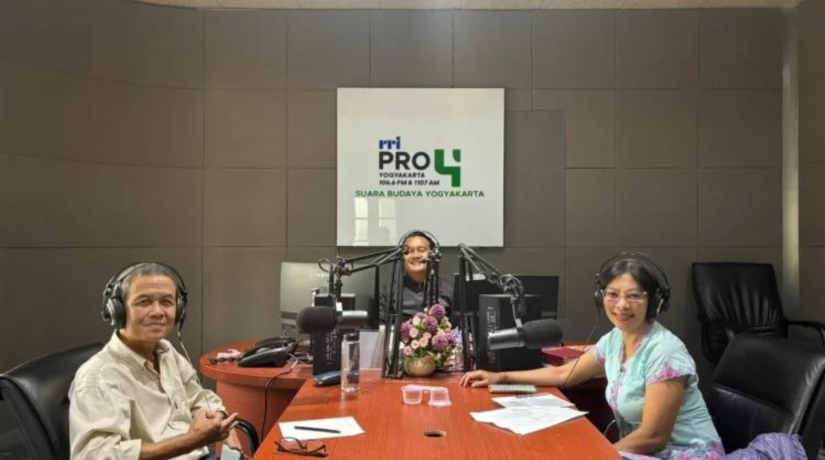
The rapid flow of global culture has made today’s younger generation vulnerable to being swept along and potentially losing their identity. To address this challenge, locally grounded character education is considered an important foundation for preserving identity while shaping strong personal character. This issue was discussed by Prof. Dr. Hendrokumoro, M.Hum., a lecturer in the Javanese Language, Literature, and Culture Study Program, Faculty of Cultural Sciences, Universitas Gadjah Mada, during the Kawruh broadcast on Pro 4 Radio Republik Indonesia Yogyakarta on Friday, May 22, 2026, from 09:00 to 10:00 WIB. The broadcast carried the theme “Slay tapi Njawani: Manifesto Pendidikan Karakter Berbasis Lokal di Hari Kebangkitan Nasional [Slay but Njawani: A Manifesto of Locally-Based Character Education on National Awakening Day]” in commemoration of National Awakening Day (Renggani, 2026).

In his presentation, Prof. Dr. Hendrokumoro, M.Hum., explained that modernity is not something to be rejected. Young people are encouraged to express themselves while still holding firmly to Javanese cultural values, or njawani. These values are reflected in attitudes such as andhap asor (humility), avoiding arrogance, and upholding ethical behavior.

He also emphasized that preserving culture does not mean abandoning progress. On the contrary, local wisdom can go hand in hand with modernity. In the context of language, for instance, although language continues to evolve dynamically, young people still need to understand the concept of empan papan, which means using language appropriately according to the situation and context.

Furthermore, he highlighted that instilling ethical and moral values cannot be achieved solely through a blame-oriented approach. The process must involve listening, guiding, and positioning things proportionally. In this regard, the role of parents is crucial as role models, as expressed in the Javanese principle ing ngarsa sung tuladha, ing madya mangun karsa, tut wuri handayani, “those in front set an example, those in the middle build initiative, and those behind provide encouragement.”

This discussion is expected to broaden public understanding of the importance of maintaining a balance between culture and modern progress. Culture does not need to be abandoned for the sake of modernity; rather, it should be harmonized to remain relevant in contemporary life.
In addition, this activity aligns with the Sustainable Development Goals (SDGs), particularly SDG 4 on quality education through the dissemination of knowledge to the public. It also supports SDG 17 on partnerships by emphasizing the importance of collaboration among educational institutions, cultural institutions, and society in preserving the cultural heritage of the Indonesian archipelago, especially Javanese culture.

Bibliography
Renggani, T. (2026, 23 Mei). Gen Z Berekspresi Modern namun Tetap Membumi dan Njawani [Foto]. rri.co.id. Diakses pada 24 Mei 2026, dari https://rri.co.id/yogyakarta/budaya/2433916/gen-z-berekspresi-modern-namun-tetap-membumi-dan-njawani.

List of Figures
Renggani, T. (2026, May 23). Gen Z Expresses Modernity While Remaining Grounded and Njawani [Photo]. rri.co.id. Fully cited from https://rri.co.id/yogyakarta/budaya/2433916/gen-z-berekspresi-modern-namun-tetap-membumi-dan-njawani.

Author : Haryo Untoro
Editor : Haryo Untoro

Tags: FIB UGM Javanese Language Literature and Culture SDGs 17: Partnerships for the Goals SDGs 4: Quality Education UGM Yogyakarta

Video UGM

[shtmlslider name='shslider_options']
Universitas Gadjah Mada

Faculty of Cultural Sciences
Universitas Gadjah Mada
Jl. Nusantara 1, Bulaksumur Yogyakarta 55281, Indonesia
   fib@ugm.ac.id
   +62 (274) 513096
   +62 (274) 550451

Work Units

  • Office of Journal & Publishing
  • INCULS
  • Information Technology and Database
  • Language Learning Center
  • Library Unit
  • Public Relations
  • Research

Facilities

  • Computer Laboratory
  • Gamelan
  • Guest House
  • Language Library
  • Library
  • Phonetics Library
  • Self Access Unit
  • Student Internet Centre

Importan Links

  • Journal of Humaniora
  • Subscriber Journal
  • Alumni Portal
  • Career
  • Departmens News
  • UGM Streaming

Contacts

  • Academic
  • Administration
  • Dean’s Office
  • Departments / Study Programs
  • Public Relations

© 2024 Faculty of Cultural Sciences Universitas Gadjah Mada

KEBIJAKAN PRIVASI/PRIVACY POLICY

[EN] We use cookies to help our viewer get the best experience on our website. -- [ID] Kami menggunakan cookie untuk membantu pengunjung kami mendapatkan pengalaman terbaik di situs web kami.I Agree / Saya Setuju