
Amid the overwhelming flow of information, writing is often reduced to a mere technical skill—the ability to arrange words so they read smoothly. Yet in an academic context, writing is fundamentally an intellectual act: a way of thinking, responding, and ultimately taking a position in relation to reality.
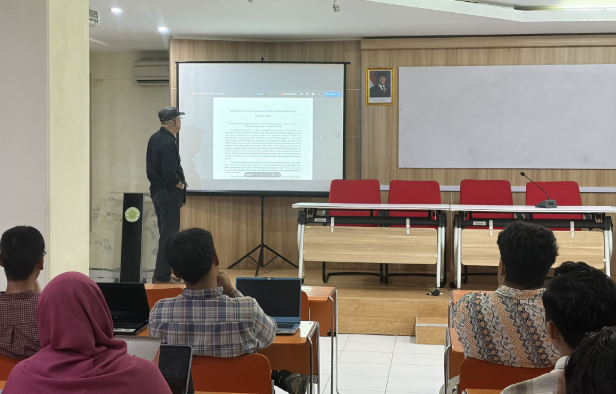
In a workshop organized by the Master’s Program in Literature at the Faculty of Cultural Sciences, Universitas Gadjah Mada, Prof. Dr. Aprinus Salam, M.Hum. emphasized that students should not remain confined to the classroom. Ideas, he argued, must be brought into the public domain—into mass media and shared spaces where discourse is exchanged and debated. “Students need to be present in the public sphere through their writing. It is also important to include institutional affiliation as a form of academic responsibility,” Aprinus noted.
There is often a noticeable gap between academia and the wider public. Overly technical language, ideas circulating within limited circles, and a tendency to write merely for assignments can strip knowledge of its broader relevance. This is where the essay finds its significance.
Unlike formal academic writing, essays do not demand rigid structures. They allow space for subjectivity, reflection, and even doubt. Paradoxically, this is precisely where their strength lies—in the courage to take a stance, not merely present data.
However, this freedom is not without direction. Essay writing still requires strategy. There is a long, often invisible process behind it: reading, experimenting, failing, and trying again. Prof. Aprinus illustrated that the journey of writing can be winding—from critiques that fail to “break through” to discovering more nuanced, even ironic ways of expressing ideas.
Writing, then, is not only about the end result, but about the process of finding one’s voice.
One approach offered is to use literary works as a lens for interpreting reality. Fiction is no longer seen as a separate world, but as another way of understanding the real one. From there, writers can build bridges between imagination and concrete social conditions.
Depth, too, becomes essential. In an age that favors speed and superficiality, there is a call to slow down and immerse oneself in a single idea, figure, or perspective until it is fully internalized—not to imitate, but ultimately to move beyond it.
In this session, there was no conventional Q&A. Instead, participants were invited to reflect directly through reviews of the essays they had previously submitted. The feedback may have seemed simple, yet it touched on fundamental aspects: appropriate length, fresh and relevant titles, and the courage to take a clear stance.
What may appear technical, in fact, conceals deeper questions: for whom do we write, and why?
When students begin to write for mass media, they are not merely practicing a skill—they are assuming a role. They step into the public sphere as thinking individuals who do not simply consume information, but actively produce it.
At this point, writing becomes more than just an academic exercise. It becomes a path home—a way for intellectuals to reconnect with the very reality that gave rise to them.
[Master of Arts in Literature, Khotibul Umam]
