
Amid the noise of everyday life, many things seem to unfold as if by default: traffic jams, crowded markets, and casual conversations in digital spaces. Yet for a social scientist, these are far from ordinary occurrences. They are living “texts,” rich with meaning and waiting to be interpreted more deeply.
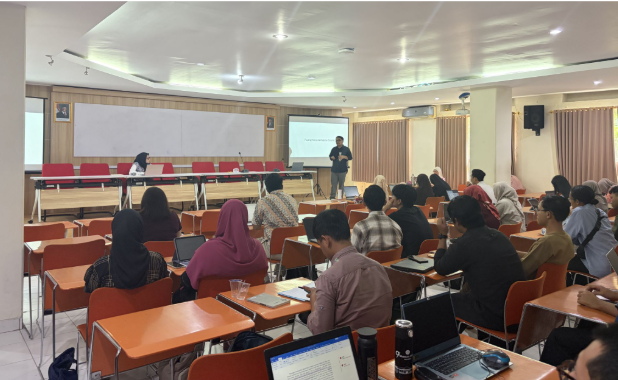
During a Social and Cultural Essay Writing Workshop held on Wednesday (April 8, 2026) by the Master’s Program in Literature at the Faculty of Cultural Sciences, Universitas Gadjah Mada, Prof. Dr. Agus Suwignyo, M.A. emphasized that the work of social scientists does not operate within fixed spatial boundaries. Their “laboratory” is life itself—a fluid, dynamic, and often unpredictable space.
According to Agus, social scientists inhabit a broad and ever-changing field of inquiry, as their object of study is human interaction across various dimensions of life. “All social phenomena—from traffic congestion to everyday habits—can serve as material for analysis that reflects social structures and public policy,” he explained.
He stressed that sensitivity is the key foundation of a social scientist’s work. With such sensitivity, seemingly mundane phenomena can be transformed into meaningful and critical analysis.
In the discussion session, participants highlighted the condition of social critics in Indonesia, who are perceived to face pressure from the state. Agus acknowledged that the situation is neither entirely hopeful nor entirely bleak. He argued that criticism will persist as long as social awareness remains alive within society.
“What matters is the courage to question reality while remaining grounded in one’s conscience,” he said.
He further asserted that subjectivity in social analysis is inevitable, but it must be anchored in rationality and a commitment to marginalized groups. This approach is essential for upholding social justice amid the complexities of power relations.
The discussion also addressed the shifting nature of social criticism—from what was once organic to forms that are increasingly complex due to interventions by various actors, including the state. In this context, social scientists are required to be more discerning in distinguishing between authentic, organic public voices and those that are manipulative.
Ultimately, being a social scientist is not only about analytical ability, but also about maintaining integrity. As reality becomes increasingly blurred, perhaps the only reliable compass is conscience—constantly reminding us that the primary task of social science is not only to understand humanity, but also to stand up for it.
[Master of Arts in Literature, Khotibul Umam]
