
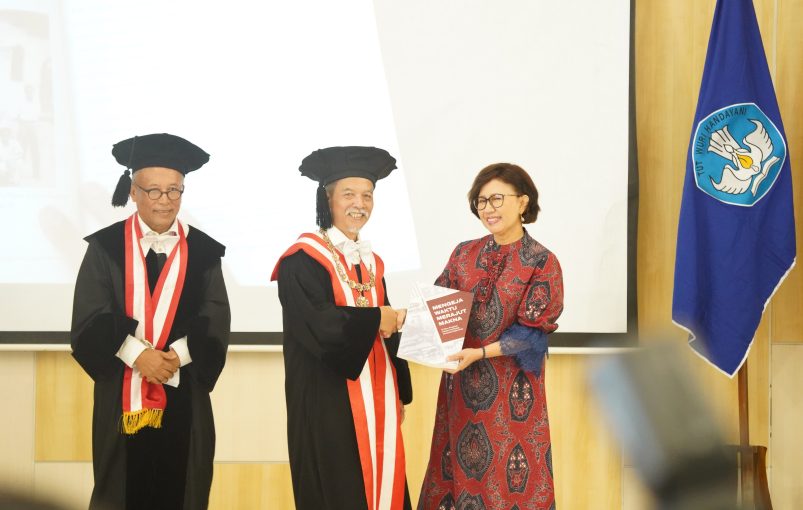
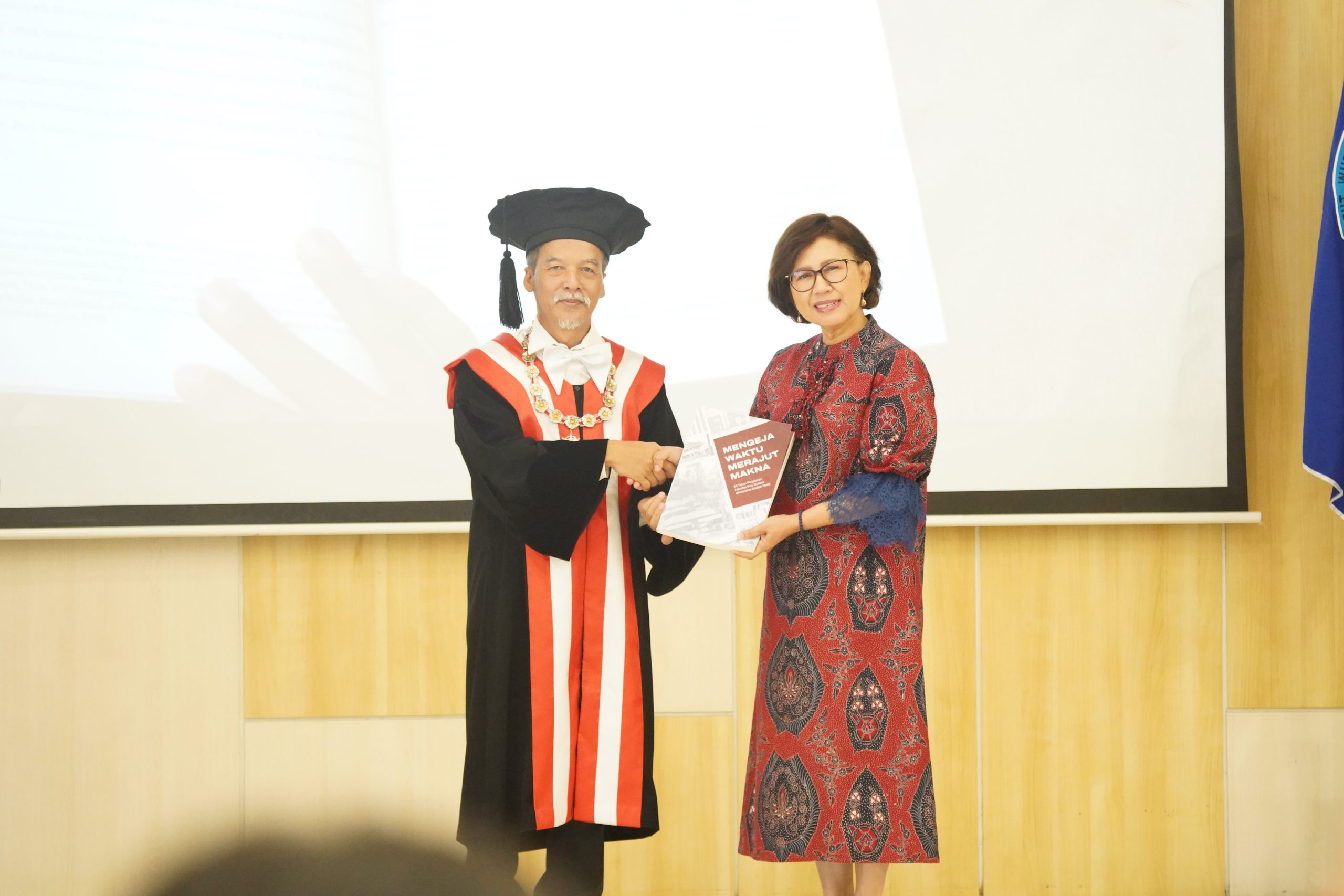
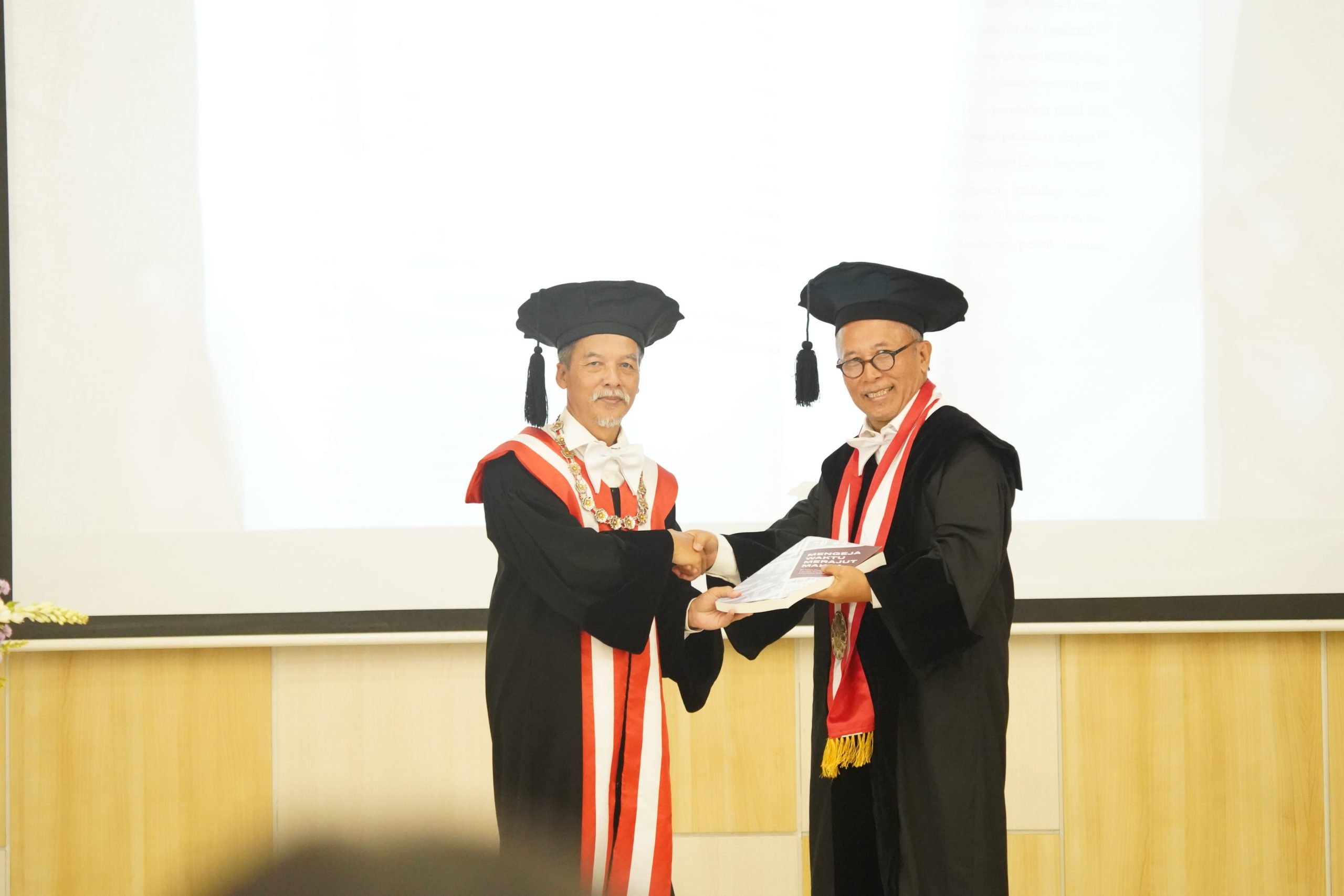
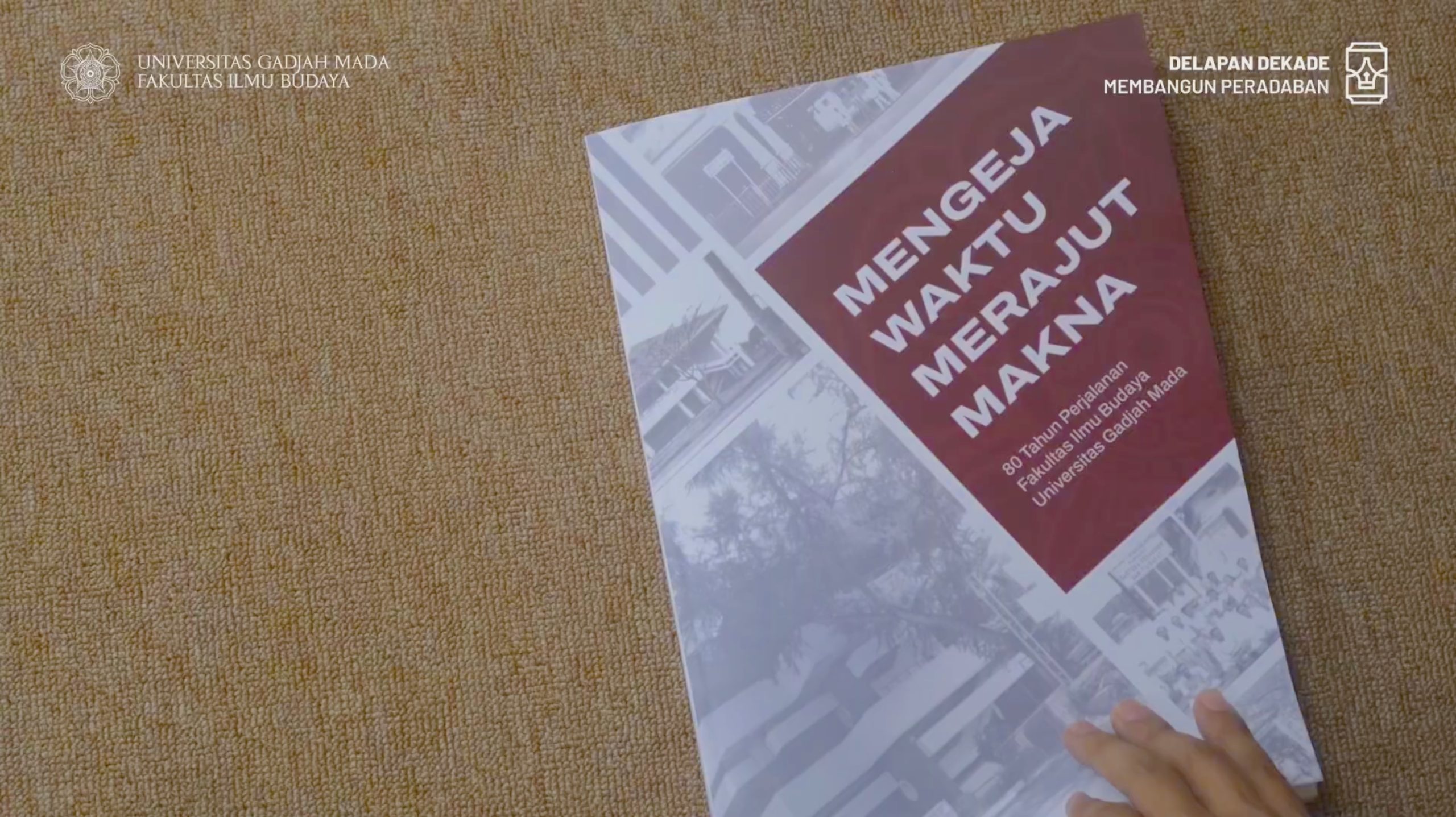
Yogyakarta, March 3, 2026 – Coinciding with its 80th anniversary, the Faculty of Cultural Sciences (FIB) at Universitas Gadjah Mada launched a historical book titled Mengeja Waktu Merajut Warna, 80 Tahun Perjalanan Fakultas Ilmu Budaya Universitas Gadjah Mada. The book was presented to the Chair of the FIB Senate, Professor Bambang Hudayana, M.A., and UGM Rector Professor Ova Emilia, Ph.D., as part of an effort to document the faculty’s long journey in developing literary and cultural studies in Indonesia.
The book was written by a team consisting of Abdul Wahid, Tatag Andriawan, Soraya Anugra Lia, and Lenna Aurelia Amalia. Although the writing process was completed within a relatively short period, it is expected to serve as an initial step in reconstructing the institutional history of FIB UGM over the past eight decades.
In the book’s introduction, the authors explain that this work represents an early effort to document more comprehensively the history of the Faculty of Cultural Sciences as one of Indonesia’s oldest higher education institutions in the fields of literature and culture. Through this historical exploration, the book also seeks to understand the meaning behind the transformations experienced by the faculty over time.
“This book is the first attempt to comprehensively reconstruct the 80-year journey of the Faculty of Cultural Sciences as the oldest higher education institution in Indonesia in the field of literature and culture, while also seeking meaning from this long historical process,” the authors wrote.
As a study of institutional history, the book explains the development of the Faculty of Cultural Sciences at UGM as an organization shaped by internal dynamics as well as external changes, including government policies, developments in higher education, and social dynamics. The institutional history approach does not merely record a chronology of events but also explains how an institution evolves and responds to changes over time.
Writing institutional history also plays an important role in preserving institutional memory. This memory includes physical aspects such as buildings, classrooms, organizational structures, and institutional artifacts, as well as non-physical aspects such as norms, rules, and workplace culture that develop within the institution.
For an academic institution, institutional memory has strategic value as it provides a basis for reflection in understanding the formation of collective identity while helping to shape future development.
In its preparation, the book was written chronologically to help readers understand the faculty’s development. The periodization used in the book is based on the changes in the faculty’s name throughout its history.
The discussion is divided into four main chapters. The first chapter covers the early development period from 1946 to 1955. The second chapter discusses the period of the Faculty of Letters and Culture from 1955 to 1982. The third chapter explores the Faculty of Letters period from 1982 to 2001. The fourth chapter discusses the Faculty of Cultural Sciences period from 2001 to 2025.
The authors acknowledge that the book still has limitations and does not yet fully capture the complexity of the faculty’s long history. Therefore, they hope the publication will serve as a starting point for more in-depth research on institutional and academic development within FIB UGM.
“We realize that this book is far from complete, let alone perfect. With humility, we hope it will receive constructive input so that it can be improved in the future,” the authors wrote.
The authors also expressed their gratitude to various parties who supported the writing process, particularly the FIB UGM Dean’s Office for the 2021–2026 period, which entrusted the team with the project.
The publication of this book is expected to serve as a reflection for the academic community to better understand the institution’s journey while strengthening its commitment to advancing knowledge, culture, and academic contributions to society.
[Public Relations of FIB UGM, Candra Solihin]
