
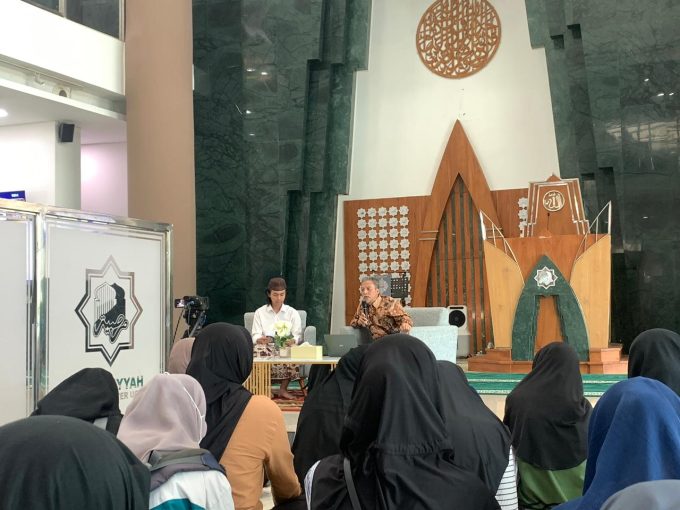
Yogyakarta, February 25, 2026 – The Dean of the Faculty of Cultural Sciences (FIB) at Universitas Gadjah Mada (UGM), Prof. Setiadi, S.Sos., M.Si., delivered a lecture at the Masjid Mardliyah UGM study session under the theme “Humanitarian and Justice Reflections on Refugee Issues.” . The discussion invited participants to examine forced migration not only from a policy perspective, but also through the lens of humanity and social justice.
In his presentation, Prof. Setiadi emphasized that the phenomenon of forced migration cannot be separated from social structures and power relations that often generate marginalization. He noted that when refugee issues arise, public discourse frequently shifts toward debates over who has the authority to address the matter, rather than focusing on substantive solutions and the protection of refugees themselves.
According to him, refugees are individuals striving to rebuild their life histories after being disconnected from their jobs, education, aspirations, and communities. Forced displacement can occur at both micro and macro levels due to conflict, discrimination, political pressure, or natural disasters. In this context, “fleeing” is fundamentally an act of survival in order to secure safety and continuity of life.
Conceptually, the term refugee in the international framework refers to the definition established by the United Nations High Commissioner for Refugees (UNHCR), which describes a refugee as a person who is outside their country of nationality due to a well-founded fear of persecution based on race, religion, nationality, membership in a particular social group, or political opinion, and who is unable or unwilling to return to that country. The definition also extends to individuals forced to leave their habitual residence due to external aggression, occupation, foreign domination, or events seriously disturbing public order. In addition, there are internally displaced persons who are compelled to relocate but remain within their country’s borders.
Prof. Setiadi further encouraged participants to view refugee issues as part of the broader historical dynamics of human life. Refugees are not merely statistical figures; they are individuals with dreams, hopes, and the right to rebuild a dignified future. The greatest challenges are not only administrative in nature, but also social barriers such as stigma, discrimination, and limited access to education and employment.
The study session also underscored the relevance of refugee issues to the Sustainable Development Goals (SDGs). Efforts to ensure protection and justice for refugees align with the global commitment to reducing inequalities (SDG 10) and promoting peace, justice, and strong institutions (SDG 16). Guaranteeing refugees’ access to quality education and decent livelihoods also supports the goals of ending poverty (SDG 1) and ensuring quality education (SDG 4), while international cooperation in addressing refugee crises reflects the importance of global partnerships (SDG 17).
Through this forum, the Dean of FIB UGM reaffirmed that reflecting on refugee issues is a moral imperative to build a more just and compassionate society, placing humanity at the core of policy and social action.
